X

    How can we help?

    Finance And Accounting Services

    Human Resource Services

    B2B SaaS Solution

    Customize Solutions

    Your Details

    Name*

    Email*

    Phone number*

    Organization*

    Location*

    Select Enquiry Type*

    How can we help?*

    What is 4 x 9 ?

    By clicking submit you agree with the Privacy policy of Osource

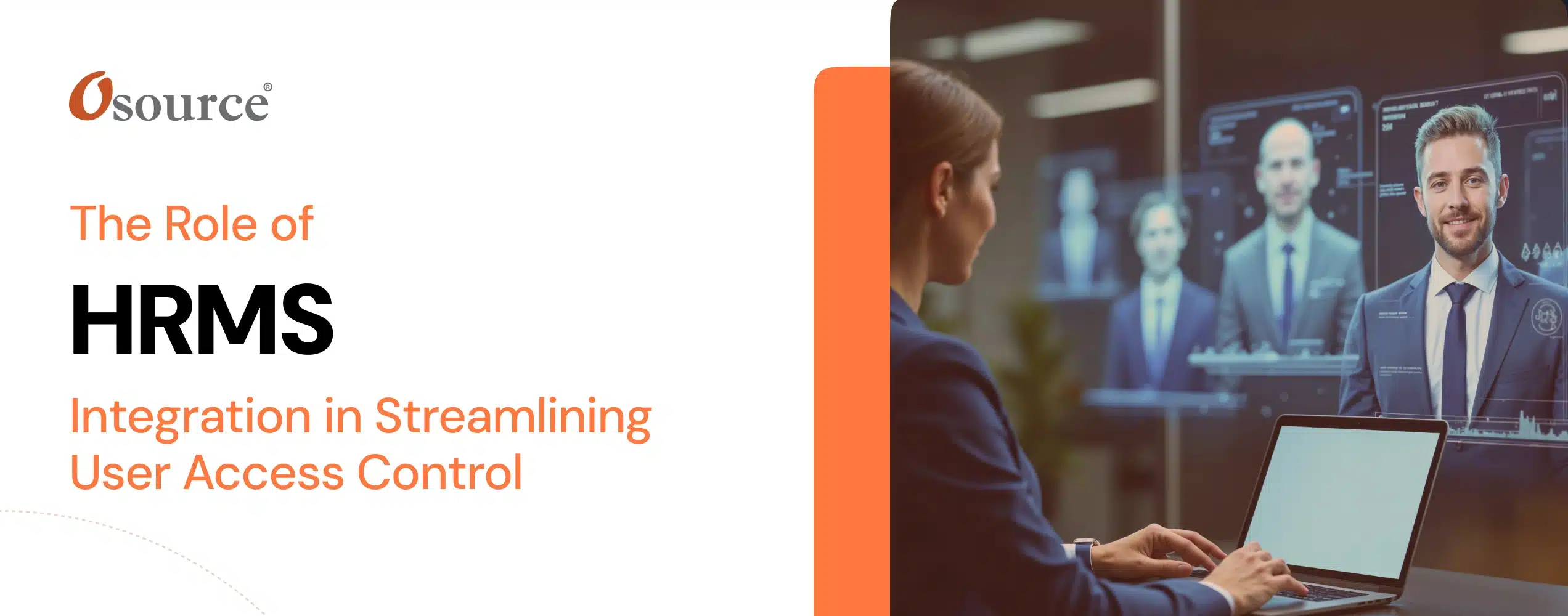
    The Role of HRMS Integration in Streamlining User Access Control

    Table of Contents

    1. Introduction
    2. What is HRMS Integration?
    3. How HRMS Integration Streamlines User Access Control
    4. Why HRMS Integration Matters for Modern Enterprises
    5. Challenges in Implementing HRMS-Driven Access Control
    6. Why Choose Osource for HRMS
    7. Wrapping it Up
    8. FAQs

    Introduction

    HRMS integration streamlines user access control by automating the process of granting, modifying, and revoking system permissions for employees. It ensures that access aligns with job roles, security policies, and compliance requirements from onboarding to offboarding.

    In today’s digital-first organisations, managing who can access what is no longer just an IT responsibility, but a core governance function. By integrating your HRMS with enterprise systems, organisations can achieve secure, efficient, and scalable User access control while eliminating manual errors and security risks.

    What is HRMS Integration?

    A Human resource management system is where organisations manage employee details, roles, and key lifecycle events like hiring, promotions, and exits. But when it works in isolation, access to systems and data often has to be handled manually, which can slow things down and increase risk.

    HRMS integration connects your HRMS with other business platforms, so employee data automatically drives workflows. This enables better User access control, where access is assigned based on accurate HR information instead of manual requests, creating a more secure, efficient, and compliant way to manage access across the organisation.

    In simple terms, it means fewer manual approvals, fewer errors, and greater visibility over who has access to what. By using HR data as the foundation, organisations can manage access consistently across teams, systems, and locations.

    How HRMS Integration Streamlines User Access Control

    1. Centralising Identity Data

    At the heart of effective Identity and access management is a reliable identity source. The HRMS already contains critical attributes such as job title, department, location, and employment status. Through HRMS integration, this information becomes the trigger for access decisions across connected systems.

    When a new employee is added to the Human Resource Management system, accounts can be created automatically. When a role changes, permissions are updated accordingly. When employment ends, access is revoked instantly, eliminating security gaps.

    2. Automating Access Provisioning

    Manual access assignment is slow, error-prone, and difficult to audit. Through Access provisioning, integrated systems automatically grant, modify, or revoke access based on predefined HR rules.

    For example:

    • A new hire in finance receives access to accounting tools on day one.
    • A promotion triggers additional permissions.
    • An employee’s exit immediately disables all system access.

    This automation ensures User access control is consistent, timely, and aligned with organisational policies without requiring constant IT intervention.

    3. Enforcing Role-Based Access Control

    Role-based access control (RBAC) assigns permissions based on an employee’s job function rather than individual requests. Through HRMS integration, roles defined in the Human Resource Management System become the foundation for permission structures across all connected applications.

    This ensures that:

    • Employees only access what they need to perform their duties.
    • Privileged access is restricted to authorised roles.
    • Changes in responsibilities automatically reflect in system access.

    By embedding Role-based access control into HR-driven workflows, organisations reduce risk while improving governance and operational clarity.

    4. Strengthening Identity and Access Management

    Modern Identity and access management strategies require real-time updates, audit trails, and centralised visibility. An integrated HRMS supports this by providing a single source of identity data that drives access policies across systems.

    With HRMS integration, organisations can:

    • Monitor access centrally
    • Enforce compliance with security standards
    • Generate audit-ready reports

    This not only improves security posture but also simplifies regulatory compliance in sectors such as finance, healthcare, and government.

    Why HRMS Integration Matters for Modern Enterprises

    1. Improved Security

    Inconsistent or outdated access rights are a leading cause of data breaches. Automated User access control ensures that only active employees with valid roles can access systems. Immediate de-provisioning through Access provisioning prevents ex-employees from retaining system access, closing a critical security loophole.

    2. Operational Efficiency

    Without HRMS integration, HR and IT teams spend significant time handling access requests, approvals, and corrections. Automating these processes through the Human resource management system eliminates bottlenecks and reduces administrative overhead.

    3. Compliance and Audit Readiness

    Many regulatory frameworks require strict controls over data access. Integrated Identity and access management enables consistent policy enforcement, detailed audit logs, and evidence of compliance. This makes internal and external audits faster, more accurate, and less disruptive.

    4. Scalability Across Regions

    For organisations operating across multiple geographies, maintaining consistent access policies can be challenging. A central HRMS ensures that regional teams follow the same security standards, regardless of location. This supports global governance while allowing local operational flexibility.

    Challenges in Implementing HRMS-Driven Access Control

    1. Complex System Environments

    Many organisations operate a mix of legacy and cloud-based systems. Achieving seamless HRMS integration across diverse platforms requires careful architecture and technical expertise.

    2. Role Design and Standardisation

    Developing accurate roles for Role-based access control is a strategic exercise. Poorly defined roles can lead to either excessive access or operational barriers.

    3. Data Accuracy in the HRMS

    Automated Access provisioning is only as reliable as the underlying HR data. Incomplete or outdated records can result in incorrect access assignments.

    4. Change Management

    Transitioning from manual access processes to automated Identity and access management requires training, stakeholder buy-in, and process alignment across HR and IT teams.

    Why Choose Osource for HRMS

    At Osource, we help organisations simplify workforce management while strengthening security and compliance. Our HRMS solutions are built to deliver efficiency, control, and scalability. Here’s what sets us apart:

    • Seamless Integration & Automation: Our HRMS connects effortlessly with enterprise systems to automate workflows, access provisioning, and employee lifecycle processes.
    • Secure & Compliant Access Control: With built-in role-based access and identity management, we ensure the right people have the right access at the right time.
    • Scalable, Customised Solutions: From growing businesses to large enterprises, our HRMS adapts to your operational needs without adding complexity.

    Wrapping it Up

    Managing who can access what doesn’t have to be complex or time-consuming. When your HRMS is seamlessly integrated, User access control becomes automatic, secure, and aligned with real roles. From onboarding to offboarding, the right HRMS integration reduces manual work, minimizes risk, and supports compliance.

    HRMS brings these capabilities together in a unified, enterprise-ready solution. Get in touch with Osource to see how our HRMS can help you implement secure, scalable, and compliant access management across your organisation.

    FAQ

    What is HRMS integration?
    HRMS integration connects a Human resource management system with enterprise applications so that employee data automatically drives business processes such as access control.

    How does HRMS improve user access control?
    By automating Access provisioning and enforcing Role-based access control, the HRMS    ensures that access is accurate, timely, and policy-driven.

    What is role-based access control?
    Role-based access control assigns permissions based on job roles rather than individual users, reducing risk and improving governance.

    Why is identity and access management important?
    Identity and access management ensures that only authorised users can access sensitive systems, supporting security, compliance, and audit readiness.

    Can HRMS-based access control support large, distributed organisations?
    Yes. With proper HRMS integration, organisations can apply consistent User access control policies across regions, systems, and business units.

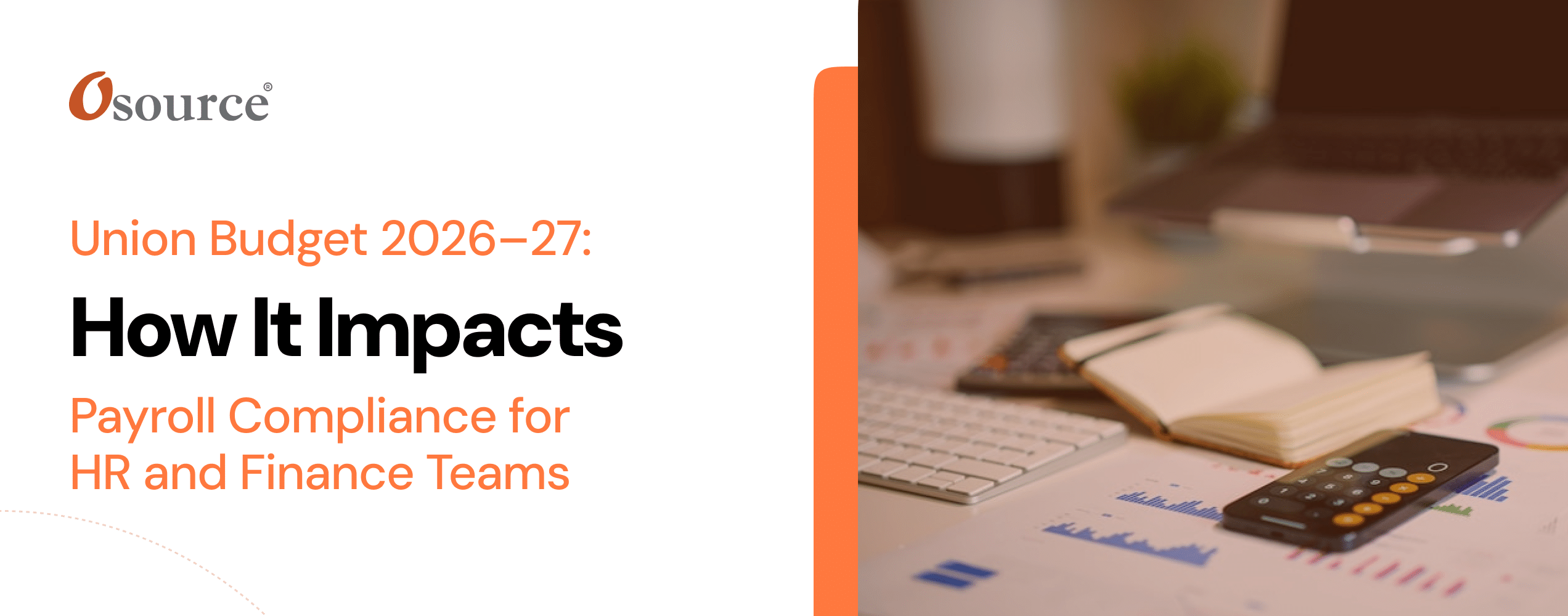
    Union Budget 2026-27: How It Impacts Payroll Compliance for HR & Finance Teams

    Table of Contents:

    1. Summary / TL;DR
    2. What Payroll Compliance Means After Budget 2026–27
    3. Before vs After Union Budget 2026–27: Payroll Compliance Impact
    4. Key Budget 2026–27 Updates That Impact Payroll
    5. What HR Teams Must Review after Union Budget 2026
    6. What Finance Teams Must Get Right post Budget 2026
    7. Why Manual Payroll Is Riskier Post-Budget Announcement
    8. How Osource Global Supports Payroll Compliance
    9. The Way Forward
    10. FAQs


    Union Budget 2026-27 affects payroll compliance by tightening how salaries, tax deductions, and statutory contributions are calculated, tracked, and reported, making payroll a joint operational responsibility for HR and Finance teams.

    While the Budget avoided sudden tax shocks, it introduced structural changes that directly impact payroll operations. These include clarified TDS rules on manpower services, relaxed PF and ESI deduction timelines, extended return-filing windows, and the implementation of a new Income Tax Act effective April 2026. Together, these changes increase the need for accurate payroll logic, stronger statutory compliance controls, and closer coordination between HR and Finance.


    Summary / TL;DR

    • Union Budget 2026–27 keeps income tax slabs unchanged for salaried employees, ensuring salary structure stability
    • TDS on manpower services is clarified at 1% or 2%, reducing ambiguity for contract and outsourced labour
    • The revised return filing deadline is extended to 31 March, allowing more time to fix payroll-related errors
    • Continued focus on job creation and formalisation of employment increases payroll volume and compliance scrutiny
    • Payroll compliance is now a shared responsibility between HR and Finance, making automation and payroll outsourcing critical for accuracy and audit readiness


    What Payroll Compliance Means After Union Budget 2026-27

    Payroll compliance means ensuring that employee salaries, tax deductions, and statutory contributions are processed strictly according to current laws and regulatory timelines.

    After Budget 2026-27, payroll compliance requires:

    • Accurate application of updated TDS rules
    • Correct timing and reconciliation of PF and ESI contributions
    • Alignment with the new income tax framework coming into effect
    • Audit-ready payroll records that reconcile HR data with Finance systems

    Any gap in payroll compliance can result in penalties, audit findings, or employee dissatisfaction.

    People often ask:
    “What does payroll compliance involve after the Union Budget 2026?”

    Short answer:
    It involves ensuring every employee payment, deduction, and statutory contribution follows the updated rules while HR and Finance remain fully aligned.

    Before vs After Union Budget 2026-27: Payroll Compliance Impact

    Payroll Area Before Budget 2026–27 After Budget 2026–27 What It Means for HR & Finance
    Income tax slabs (salaried employees) Stable No change announced Salary structures remain predictable; focus shifts to compliance accuracy
    TDS on manpower services Ambiguous application Clearly specified at 1% or 2% Correct worker classification becomes critical
    PF & ESI deduction timing Strict statutory timelines Deduction allowed if paid before ITR filing deadline Less risk of deduction loss, higher reconciliation responsibility
    Revised return filing deadline Up to 31 December Extended to 31 March More time to fix payroll errors, higher audit expectations
    Income tax framework Existing IT Act New Income Tax Act from April 2026 Payroll systems must update tax logic
    Payroll ownership Finance-led Shared between HR & Finance Cross-functional accountability required
    Manual payroll risk Manageable High compliance exposure Automation and payroll outsourcing become essential
    Audit readiness Periodic Continuous expectation Payroll data must always be audit-ready


    Key Budget 2026-27 Updates That Impact Payroll Compliance

    Some Budget announcements may seem technical, but they have real operational implications for payroll:

    1. Clarified TDS Rules on Manpower and Staffing Services

    Budget 2026–27 clarifies TDS on manpower and staffing services at 1% or 2%, removing long-standing ambiguity for businesses engaging contractors or outsourced labour.

    Payroll impact:
    HR must correctly classify workers and contracts, while Finance must ensure payroll systems apply the right TDS rates. Incorrect classification remains one of the most common payroll compliance issues flagged during audits.

    2. Relaxed PF & ESI Deduction Timing

    Employers can now claim tax deductions on PF and ESI contributions as long as employee contributions are paid before the income tax return filing deadline, even if statutory deposits occur later.

    Payroll impact:
    This reduces the risk of losing deductions but increases the need for accurate tracking, reconciliation, and statutory compliance reporting across payroll cycles.

    3. New Income Tax Act Effective April 2026

    The new Income Tax Act effective from 1 April 2026 aims to simplify tax laws and reporting structures.

    Payroll impact:
    Payroll systems must be updated with new tax logic, revised deduction rules, and refreshed reporting formats. Delayed updates can result in incorrect tax computation across entire payroll runs.

    What HR Teams Must Review After Union Budget 2026

    Payroll compliance after Union Budget 2026–27 is more than processing salaries; it’s about policy alignment, employee communication, and statutory accuracy. HR teams must ensure all changes are implemented correctly while keeping employees informed.

    HR teams should focus on:

    • Reviewing salary structures and allowances
    • Updating payroll policies, contracts, and documentation
    • Coordinating with Finance on deductions and statutory contributions
    • Addressing employee queries on take-home pay
    • Monitoring statutory compliance for PF, ESI, gratuity, and labour laws

    HR is often the first point of contact when payroll changes affect employees. Misalignment between policy and execution can erode trust and create operational friction. Many organizations choose to support HR through structured HR outsourcing services, which ensure compliance updates are applied consistently across the workforce and reduce manual effort.

    While HR focuses on policies and people, Finance teams handle governance, accuracy, and risk management. After Budget 2026, Finance must ensure payroll aligns with all statutory and financial regulations.

    Post-Budget 2026, Finance must ensure:

    • Accurate tax computation and TDS deductions
    • Correct classification of payroll expenses
    • Timely statutory payments and reconciliations
    • Audit-ready payroll documentation
    • Alignment between payroll data and financial statements

    Mistakes in payroll reporting or statutory payments can lead to penalties, audit issues, and operational disruptions. Leveraging Finance and Accounting Outsourcing (FAO) helps strengthen controls, improve reporting accuracy, and maintain compliance, allowing Finance teams to focus on strategy rather than manual payroll checks.

    Why Manual Payroll Processes Are Riskier After Budget 2026

    Manual payroll processes significantly increase compliance risk in a post-Budget 2026 environment.

    Common failure points include:

    • Incorrect TDS classification for contractors
    • Missed or misaligned PF and ESI timelines
    • Payroll systems not updated for new tax rules
    • Data mismatches between HR records and Finance ledgers

    Organizations relying on spreadsheets or fragmented tools face higher correction cycles and audit exposure compared to those using automated systems.

    How Osource Global Supports Payroll, HR & Finance Compliance

    Osource Global offers integrated solutions to manage payroll compliance end-to-end:

    • HR Outsourcing (HRO): It aligns salary structures, policies, and payroll updates with statutory and Budget changes
    • Finance & Accounting Outsourcing (FAO): It maintains audit-ready payroll records and accurate tax filings
    • Payroll Automation: It reduces manual errors, applies statutory updates consistently, and simplifies compliance reporting

    This enables HR and Finance teams to focus on strategy and employee experience while compliance execution is handled systematically.

    The Way Forward: Simplifying Payroll Compliance Post-Budget 2026-27

    Union Budget 2026-27 has made payroll compliance more important than ever. Manual systems and fragmented processes struggle to keep up with regulatory changes, leading to errors, penalties, and compliance gaps.

    A combination of payroll automation and expert-led payroll outsourcing helps businesses reduce risk, improve accuracy, and maintain audit readiness. Automation ensures statutory updates are applied accurately, while outsourcing brings compliance expertise and stronger controls.

    Get in touch with Osource Global to streamline payroll compliance and navigate Budget 2026 changes with greater confidence and efficiency.

    To review the complete official Budget document, please refer to the press release issued by the Government of India here.

    FAQs

    Q1. Did Union Budget 2026 change PF or ESI compliance rules?

    Core statutory frameworks such as PF and ESI contribution structures generally remain stable, but budget updates can influence tax treatment, reporting expectations, and employer compliance processes. Organisations should review payroll policies and statutory workflows to ensure alignment with the latest regulatory guidance. 

    Q2. What payroll compliance areas are most affected after Union Budget 2026–27?

    Budget updates typically influence payroll tax calculations, statutory reporting expectations, documentation standards, and the need for stronger compliance tracking across HR and Finance functions.

    Q3. Are there new payroll tax reporting requirements after Budget 2026?

    Budget announcements often increase expectations around accurate payroll reporting, tax reconciliation, and statutory documentation. HR and Finance teams should review reporting formats, compliance deadlines, and internal audit processes to remain compliant.

    Q4. How does Budget 2026 affect payroll TDS calculations?

    Payroll teams may need to reassess tax computation workflows, update payroll software configurations, and ensure TDS calculations align with any revised tax frameworks or reporting requirements introduced after the budget.

    Q5. What immediate payroll compliance actions should HR teams take after Budget 2026–27?

    HR teams should audit payroll processes, review statutory deductions, update policies, align with Finance on reporting requirements, and ensure payroll systems reflect current compliance expectations.

    Q6. What are the key payroll compliance responsibilities for Finance teams post-Budget?

    Finance teams should prioritise accurate tax computations, statutory payment tracking, payroll reconciliations, audit readiness, and maintaining compliant financial reporting structures.

    Q7. How can companies reduce payroll compliance risks after Union Budget changes?

    Organisations can reduce risk by conducting payroll audits, implementing automation, strengthening HR–Finance collaboration, monitoring statutory updates regularly, and maintaining clear payroll documentation.

    Q8. How do payroll outsourcing and automation support compliance after Budget 2026–27?

    Outsourcing and automation help maintain up-to-date statutory rules, reduce manual errors, standardise payroll processes, improve reporting accuracy, and support ongoing compliance monitoring.


    Top Identity and Access Management Features Every Growing Business Should Evaluate

    Table of Contents :

    In 2026 Organizations evaluating an Identity and Access Management solution must look beyond basic authentication. They need to understand how IAM tools support modern infrastructure, evolving threats, and data security compliance requirements. This blog outlines the most important IAM features to evaluate before choosing an Identity and Access Management solution in 2026.

    Why IAM Evaluation is Different in 2026 and a necessity? 

    In 2026, identity has become the new security perimeter. With distributed workforces, cloud-native applications, AI-driven attacks, and increasing regulatory pressure, Identity and Access Management (IAM) is no longer just about controlling logins. It plays a critical role in securing users, systems, and data across environments.

    Today employees log in from multiple locations, devices, and networks, while applications now span SaaS platforms, private clouds, and legacy systems. At the same time, attackers increasingly target identities rather than infrastructure.

    As a result, Identity and Access Management (IAM) solutions must support zero-trust security models, stronger access control, automated governance, and real-time visibility across environments. Evaluating IAM features carefully helps organizations avoid security gaps and scalability issues as access requirements evolve.

    The following are the top 8 Features organizations should consider evaluating before choosing the right IAM Solution for themselves:  

    1. How Intelligent Authentication Is no longer Optional?

    In 2026, passwords alone are no longer sufficient. Modern Identity and Access Management (IAM) solutions rely on intelligent, adaptive authentication, combining multi-factor authentication (MFA) with contextual signals such as user behavior, device trust, and login location.

    Industry reports indicate that over 60% of identity-based breaches involve weak or compromised credentials, highlighting why adaptive authentication is now a baseline requirement for organizations of all sizes.

    Business Impact:

    • Reduces the risk of unauthorized access and credential-based breaches
    • Minimizes login friction for employees and customers, enhancing productivity
    • Supports regulatory compliance by enforcing secure access policies
    • Strengthens overall organizational security posture

    2. How Single Sign-On (SSO) drives  Seamless Access

    As enterprise ecosystems expand, Single Sign-On (SSO) is no longer a convenience—it’s a necessity. SSO enables users to access multiple systems using a single secure identity, while giving administrators centralized visibility and control over access policies.

    By 2026, effective SSO must cover web applications, cloud platforms, mobile apps, APIs, and hybrid environments, ensuring consistent access management across all organizational systems.

    Business Impact:

    • Reduces password fatigue and IT support tickets, saving time and cost
    • Improves employee productivity with smoother access across systems
    • Provides IT and security teams with centralized access oversight
    • Enhances operational efficiency while maintaining strong access control

    3. Context-Aware Access Control for Modern Workforces

    Traditional role-based access models are insufficient for today’s dynamic and hybrid work environments. Modern identity and access management tools provide context-aware access control, evaluating real-time attributes such as device health, login time, location, and user behavior.

    This approach allows organizations to enforce least-privilege access more precisely, balancing security with flexibility.

    Business Impact:

    • Reduces insider threats by limiting access to only what users need
    • Protects sensitive data without slowing down day-to-day operations
    • Ensures compliance with regulatory requirements for access governance
    • Improves IT visibility and simplifies access policy management

    4. Cloud and Hybrid Compatibility Becoming the New Normal

    By 2026, most organizations operate across cloud and on-premise environments. Modern Identity and Access Management (IAM) solutions must integrate seamlessly with major cloud providers like AWS, Azure, and Google Cloud, while still supporting legacy systems critical to business operations.

    A future-ready IAM platform ensures consistent identity policies, unified access control, and centralized monitoring across all environments, allowing IT teams to manage access efficiently regardless of infrastructure type.

    Business Impact:

    • Prevents security gaps during cloud migration
    • Maintains consistent access policies across platforms
    • Enables IT teams to adopt new technologies at a controlled pace
    • Reduces risks associated with shadow IT and fragmented access

    5. Integration of compliance and audit readiness in one platform

    With evolving global regulations such as GDPR, ISO 27001, SOC 2, and local data protection laws, built-in audit logs, access reports, and compliance dashboards are essential features of modern IAM tools.

    These features help organizations track, monitor, and report access activities, ensuring that compliance obligations are met efficiently without manual overhead.

    Business Impact:

    • Cuts audit preparation time by automating compliance reporting
    • Reduces regulatory and financial risk
    • Demonstrates governance and accountability to clients and partners
    • Ensures organizations can respond quickly during regulatory audits

    6. Automated Identity Lifecycle Management reduces 70% manual stress

    Manual onboarding, role changes, and offboarding are no longer scalable for modern workforces. Advanced identity and access management tools automate these workflows, keeping access rights accurate throughout the employee lifecycle.

    An automated lifecycle management ensures that employees, contractors, and temporary staff always have the right level of access, while outdated permissions are promptly removed.Advanced solutions  like Osource Global’s Onex SAM automate identity lifecycle management, helping IT teams stay compliant and efficient .

    Business Impact:

    • Minimizes administrative workload for IT teams
    • Prevents orphaned accounts and over-provisioned access
    • Speeds up onboarding for employees, contractors, and temporary staff
    • Strengthens security by ensuring access aligns with job roles

    7. Zero Trust Isn’t Complete Without Privileged Access

    Privileged accounts, such as system administrators or finance users, remain high-value targets for attackers. Modern IAM solutions integrate Privileged Access Management (PAM), enforce least-privilege policies, and provide time-bound access.

    Zero-trust aligned IAM platforms continuously validate access requests, instead of assuming trust based on role or location, ensuring sensitive operations are tightly controlled.

    Business Impact:

    • Limits potential damage from credential compromise
    • Monitors and logs high-risk operations for accountability
    • Supports regulatory requirements for administrative access
    • Enhances the organization’s ability to detect and respond to threats quickly

    8. IAM Solution built for Scalability and Future Growth

    An IAM solution must scale seamlessly as organizations expand, supporting more users, applications, and global operations without slowing performance. High availability and fast authentication are critical for uninterrupted business operations.

    Scalable IAM platforms ensure consistent performance across multiple regions and growing user bases, avoiding bottlenecks as the organization modernizes or adopts new technology.

    Business Impact:

    • Prevents downtime and access issues during peak usage
    • Supports workforce growth and hybrid/remote teams
    • Enables adoption of new applications without reconfiguring access controls
    • Reduces long-term costs by avoiding migration or replacement of systems

    Choosing an IAM Solution That’s Ready for What’s Next

    Selecting the right IAM solution requires a strategic approach. Effective platforms combine intelligent security, seamless user experience, and strong governance. By evaluating features that support modern access patterns, automated lifecycle management, and data security compliance, growing businesses can build a resilient identity foundation that protects both users and business growth.

    If you’re ready to upgrade your IAM system, get in touch with Osource Global to explore enterprise-ready solutions tailored to your organization’s needs.

    FAQ’S :

    1.What is meaning of identity and access management? 

    2.What are the key features of an identity management solution?

    3.What are the 3 maine components of IAM

    4.What is th main purpose of IAM

    How to your streamline payroll outsourcing: 2026 Strategic Guide

    Table of Contents :

    Payroll outsourcing in 2026 is a strategic approach that enables businesses to manage payroll accurately, stay compliant, and scale operations without increasing their internal workload. As payroll regulations and workforce structures continue to evolve, outsourcing has become a reliable means of maintaining control and consistency

    It’s no longer just about running payroll on time. Between managing deductions, meeting compliance requirements, and keeping systems aligned, payroll leaves very little room for error. That’s why more businesses are choosing payroll outsourcing and managed services to reduce risk, avoid rework, and ensure payroll runs smoothly while they focus on running the business.

    What Is Payroll Outsourcing in 2026?

    Payroll outsourcing means engaging an external expert to manage your company’s payroll operations from salary calculations and statutory deductions to compliance filings and reporting. It enables you to unlock time, reduce errors, and manage risk across payroll elements that have become increasingly complex.

    In 2026, payroll outsourcing services in India go beyond basic processing. They integrate automation, real-time visibility, payroll compliance controls, and compatibility with top payroll software, helping organisations reduce errors and stay aligned with evolving regulations.

    At its core, payroll outsourcing acts as a single source of truth for employee compensation. A trusted payroll service provider enables organisations, including those using payroll services for small businesses, to manage risk, scale efficiently, and make informed workforce decisions.

    Why Businesses Are Turning to Payroll Outsourcing 

    Payroll outsourcing is frequently driven by operational stress rather than trend adoption. With few resources and antiquated procedures, internal payroll teams are expected to handle expanding headcounts, intricate pay structures, and continuous change.

    As businesses expand across states or adopt remote and hybrid models, payroll administration becomes harder to standardise. Manual interventions increase, dependencies on a few individuals grow, and small errors start cascading into employee queries and management escalations. Over time, payroll shifts from a routine function to a recurring disruption.

    Payroll outsourcing helps stabilise this function. By shifting execution to specialised teams with defined processes and accountability, organisations gain consistency and predictability. Leadership teams benefit from fewer payroll-related escalations and greater confidence that payroll operations will not slow down business momentum.

    Payroll Compliance Challenges and How Outsourcing Helps

    Payroll Compliance is a significant obstacle for companies in India, as errors can result in fines, audits, or damage to reputation.

    Key compliance challenges include:

    • Provident Fund (PF) regulations – ensuring accurate calculations, timely deposits, and proper reporting
    • Employee State Insurance (ESI) requirements – maintaining compliance for eligible employees across multiple locations
    • Professional Tax variations – managing differing rules and rates across states
    • Income tax deductions and filings – correctly applying TDS and completing year-end reporting
    • Frequent labour law updates – adapting to amendments that affect salary structures and employee categories

    How payroll outsourcing helps:

    Payroll outsourcing services in India provide dedicated compliance teams, automated calculations, and audit-ready documentation. This makes compliance a structured, continuously monitored process, reducing risk and giving leadership teams peace of mind.

    Choosing the Right Payroll Service Provider in 2026

    Not all payroll partners are created equal. Choosing the right payroll service provider in 2026 requires careful evaluation beyond pricing.

    Key factors to assess include:

    • Depth of payroll compliance expertise in India
    • Ability to manage multi-state and complex payroll structures
    • Data security and confidentiality standards
    • Integration with top payroll software and finance systems
    • Clear escalation and support mechanisms

    It is also important to distinguish between software vendors and full-service providers. While software plays a critical role, payroll is not just a technology problem  it is a regulatory and process challenge.

    Among payroll outsourcing companies in India, the strongest partners are those who take a proactive approach, identifying risks early, advising on compliance changes, and supporting business transitions smoothly.

    Payroll outsourcing in 2026 is evolving beyond processing, with businesses prioritising accuracy, transparency, security, and scalability from their payroll partners.

    • AI-assisted payroll validation – AI tools detect anomalies, inconsistencies, and potential compliance gaps early in the payroll process without replacing payroll professionals.
    • Employee transparency – Self-service portals enable employees to access payslips, tax details, and salary structures, which reduces HR queries, minimizes confusion, and builds trust.
    • Data security as a differentiator – Businesses are prioritizing payroll partners with strong cybersecurity frameworks and compliance controls due to increased focus on data privacy.
    • Structured and accessible payroll services for small businesses – Scalable outsourcing models allow growing companies to implement compliant payroll processes early and avoid costly corrections later.

    Together, these trends position payroll outsourcing as a future-ready function that supports compliance, trust, and business growth.

    How Payroll Outsourcing Supports Growing and Scaling Businesses

    Growth often exposes operational weaknesses, and payroll is one of the first areas to feel the strain.

    Start-ups may initially manage payroll manually, but as headcount grows, errors and delays become inevitable. SMEs expanding across states face new compliance requirements. Global organisations entering India must navigate local regulations without slowing down operations.

    Payroll outsourcing supports growth by providing flexibility without fragility. Businesses can scale teams, locations, and compensation structures without constantly reworking payroll processes.

    For leadership teams, this means confidence. Payroll becomes a stable foundation that supports expansion rather than a bottleneck that restricts it.

    Why Choose Osource Global’s Payroll Outsourcing Services

    Osource Global understands that payroll compliance is complex and unique to every organisation. That’s why its payroll outsourcing services in India are flexible, accurate, and aligned with real business operations, helping clients manage PF, ESI, professional tax, income tax filings, and labour law updates efficiently.

    With dedicated compliance teams, automated processes, and audit-ready documentation, Osource Global ensures payroll compliance is structured, reliable, and reduces risk, keeping businesses fully aligned with regulations and future-ready for 2026 and beyond.

    Conclusion: Making Payroll Outsourcing a Strategic Advantage

    In 2026, payroll outsourcing is no longer just about paying employees accurately. It is about protecting the business, supporting growth, and maintaining trust across all levels of the organisation. Strategic payroll outsourcing helps companies move from reactive problem-solving to proactive governance, reducing payroll compliance risk, improving operational efficiency, and ensuring payroll operations align with business goals.

    To make payroll a true business advantage, get in touch with Osource Global and explore solutions tailored to your organisation’s needs. Their expert teams help implement reliable, compliant, and scalable payroll processes that support growth and build long-term confidence.

    FAQ’s :

    1. What is the meaning of payroll outsourcing?
      Payroll outsourcing is the practice of assigning payroll processing, compliance, and reporting to an external payroll service provider.
    2. What are the main advantages of outsourcing payroll functions?

    Outsourcing payroll reduces compliance risk, improves accuracy, and saves time by using specialised payroll expertise.

    1. How to switch from manual payroll to outsourced payroll services?
      Businesses switch by securely transferring payroll data to a payroll service provider who manages setup, compliance, and execution.
    2. How to streamline a payroll process?
      Payroll processes can be streamlined by automating calculations, centralising data, and standardising compliance workflows.
    3. What are the future trends in payroll outsourcing?
      Future payroll outsourcing trends include AI-assisted validation, real-time visibility, stronger data security, and scalable compliance-focused models.

    Why Automated Expense Management Is Essential for Growing Enterprises

    Key Takeaways

    • Manual expense management hinders growth, leads to errors, and delays reimbursements.
    • Automated expense management reduces processing time, boosts compliance, and improves visibility.
    • Real-time insights empower better budgeting, forecasting, and team collaboration.
    • Adopting automation early prepares your enterprise for scalable, audit-ready operations.
    • Enterprise-wide ROI improves through operational savings and enhanced employee satisfaction.

    Table of Contents

    1. Introduction
    2. What Is Expense Management Automation?
    3. The Strategic Role of Expense Management in Enterprise Finance
    4. The Challenges of Manual Expense Management
    5. How Automated Expense Management Enables Scalable Growth
    6. Why Smart Enterprises Are Choosing Automated Expense Management
    7. Conclusion
    8. Frequently Asked Questions (FAQ)

    Introduction

    Expense management directly influences financial visibility, compliance, and operational efficiency, yet in many growing enterprises, it remains driven by manual processes. When spending data is fragmented across spreadsheets, emails, and delayed reports, every expense introduces uncertainty, limiting visibility, weakening oversight, and increasing exposure to errors, compliance gaps, and financial risk at a time when leadership expects precision and accountability.

    This is why many growing enterprises are turning to automated expense management solutions. These systems bring structure, visibility, and control to expense processes, allowing finance teams to focus on strategic decision-making while automation handles submissions, approvals, compliance, and reporting.

    Let’s take a closer look at how automated expense management can remove complexity and support scalable growth.

    What Is Expense Management Automation?

    Expense management automation uses digital systems to capture, process, approve, and report business expenses without depending on manual workflows. It replaces spreadsheets, emails, and paper receipts with centralized, automated processes. These systems centralize expense data, automate validations and approvals, and provide real-time visibility into organizational spending.

    By replacing spreadsheets and paper-based processes, automated expense management streamlines how enterprises handle reimbursements, travel expenses, vendor-related costs, and departmental spending.

    The Strategic Role of Expense Management in Enterprise Finance

    Expense management is more than reimbursement, it’s about maintaining control over organizational spend while enabling teams to operate efficiently. As enterprises expand, they face rising volumes of expense reports, travel reimbursements, vendor costs, and departmental spend.

    When these processes are managed manually, businesses encounter frequent delays, errors, and blind spots. Finance teams struggle to track expenses in real time, leaders make decisions based on outdated data, and employees experience frustration due to slow reimbursements.

    For enterprises focused on growth, manual expense management becomes a structural constraint, one that limits financial visibility, weakens control, and exposes the organization to compliance risks.

    The Challenges of Manual Expense Management

    1. Inefficiencies in Processing Expenses

    Manual expense management is a productivity killer, especially as organizations scale. With increasing volumes of expense reports, travel reimbursements, vendor payments, team budgets, and marketing spend, relying on spreadsheets and email chains leads to time-consuming submissions, frequent data entry errors, and increased processing time.

    Without the ability to automate expense reporting using modern expense management software, finance teams lose valuable time on administrative tasks, while delayed reimbursements negatively impact employee satisfaction and overall productivity.

    2. Lack of Real-Time Spending Visibility

    In a fast-paced, budget-driven enterprise, delayed spend visibility can cause serious setbacks. Manual expense tracking spreads data across silos such as emails, physical receipts, spreadsheets, and disconnected systems, making expense information outdated by the time it is reviewed. Budget overruns and untracked spending often go unnoticed without a centralized expense tracking software or spend management system. 

    This lack of real-time visibility prevents teams from making timely budget reallocations, adjusting campaign spend, or negotiating effectively with vendors, and it undermines accurate forecasting and financial strategy alignment.

    3. Compliance Risks and Challenges

    Manual systems also introduce significant challenges in enterprise expense management, particularly around compliance. Tracking policy adherence becomes difficult without centralized documentation, and inconsistent reviews increase the risk of fraud and errors. 

    As enterprises expand, ensuring expense policy compliance across teams, locations, and departments becomes increasingly complex. Without automated expense management, manual tracking cannot scale to meet growing legal, audit, and regulatory requirements, exposing organizations to unnecessary risk. Many enterprises reassess expense governance with support from experienced providers like Osource Global as financial oversight becomes more complex.

    How Automated Expense Management Enables Scalable Growth

    Overcoming Manual Inefficiencies

    Automated expense management systems revolutionize old, cumbersome processes. By digitizing and streamlining workflows, expense management software transforms how businesses manage expense management and day-to-day spending. Instead of relying on spreadsheets and email-based approvals, organizations can automate expense reporting across teams and departments.

    Solutions like Onex SMS, Osource Global’s enterprise-grade expense management software, centralize expense tracking, automate approvals, and give finance teams real-time visibility into organizational spend.

    Key capabilities include:

    • Mobile receipt capture
    • Policy integration
    • Hands-off processing

    This level of automation reduces manual intervention, minimizes errors, and enables employees to spend less time on administrative tasks and more time on revenue-generating activities, making it easier for enterprises to scale efficiently.

    Improved Spend Visibility and Insights

    Modern enterprise expense management tools centralize all spending data within a single spend management system, giving finance teams complete spend visibility across the organization. With connected expense tracking software, leaders can monitor expenses as they occur rather than after budgets are exceeded.

    These systems support:

    • Real-time analytics
    • Custom reporting
    • Forecasting support

    This data-driven approach helps teams collaborate better, align spend with business goals, and make faster, more informed financial decisions.

    Ensuring Compliance and Mitigating Risks

    With automated expense management, compliance becomes easier to enforce without increasing finance workload. Built-in controls ensure expenses align with policies and regulatory requirements throughout the expense lifecycle.

    Key compliance capabilities include:

    • Audit trails
    • Policy enforcement
    • Regulatory support

    This ensures finance teams remain audit-ready while employees follow expense guidelines consistently, reducing the risk of fraud and policy violations as expense volumes grow.

    Why Smart Enterprises Are Choosing Automated Expense Management

    Rapid growth demands systems that can scale without breaking. Automated expense management platforms are designed to expand alongside your organization, allowing businesses to:

    • Add users, departments, and locations with ease
    • Manage multiple currencies and tax structures
    • Maintain accuracy even as transaction volumes increase

    For example, a fast-growing SaaS company replaced manual expense processing with automation and reduced processing time by 70% within six months. Forecast accuracy improved by 30%, enabling more confident financial planning.

    In addition, automated workflows bring consistency and transparency to approvals. Custom approval hierarchies, digital sign-offs, instant notifications, and SLA tracking ensure faster reimbursements and better control, especially valuable for teams managing high-volume spend, such as marketing and operations.

    Conclusion

    As enterprises grow, manual expense management becomes increasingly inefficient and difficult to control. Limited visibility, slow approvals, and compliance risks make it harder for finance teams to manage spending effectively and support business growth.

    Automated expense management brings structure and transparency to expense processes. With real-time visibility, consistent approvals, and built-in compliance, organizations gain better control over spend while reducing manual effort and operational risk.

    If your expense processes are still manual, it may be time to move to automation. Osource Global helps enterprises streamline expense management, improve compliance, and scale with confidence. Contact us today to learn how our solutions can support your growth.

    FAQ

    Why is manual expense management a problem for growing enterprises?

    It leads to inefficiencies, errors, delayed processing, and compliance risks, making scalability difficult.

    How does automated expense management improve compliance?

    It enforces policies, maintains audit trails, and automatically supports regulatory standards.

    Is automated expense management suitable for mid-sized businesses?

    Yes, modern systems are modular and scalable, making them ideal for mid-sized and growing businesses.

    What kind of ROI can we expect from automation?

    Automation can cut processing time and cost by up to 70%, significantly improving ROI across the board.

    5 Key Features Of An Ideal Access Management System For Enterprises

    Estimated reading time: 8 minutes

    Key Takeaways

    • Understand how access management systems are a strategic asset for enterprises.
    • Explore the role of Onex SAM in enterprise-grade identity management.
    • Learn how features like MFA, SSO, ABAC, audit trails, and integrations can improve operational security and efficiency.
    • Discover how scalable systems future-proof your enterprise’s access control strategies.

    Table of Contents

    Introduction

    With digital tools and systems powering nearly every aspect of modern business, knowing who can access what has never been more important. As enterprises grow and roles evolve, uncontrolled or inconsistent access can quickly turn into security gaps, compliance issues, and operational bottlenecks.

    This is where an effective access management system plays a vital role. It decides who gets access to what, when, and under which conditions, helping organisations stay secure, compliant, and efficient at the same time. For business and marketing leaders alike, access management isn’t just a technical issue; it directly impacts brand trust, customer confidence, and the ability to scale safely.

    In this blog, we break down the five key features every enterprise should look for in an access management system and explore how modern solutions, like Onex SAM, help organisations meet these needs in a practical and scalable way.

    1. Comprehensive User Authentication

    The process of confirming that a person is who they say they are before allowing them access to an organization’s digital resources is known as user authentication. It acts as a gatekeeper for your company’s critical data and is the first line of defense against illegal access.

    Authentication isn’t just about security, it’s also about creating a seamless user experience. Inadequate authentication systems can frustrate employees, slow down business processes, and create friction, particularly for customer-facing departments such as marketing and sales.

    Key Features to Look For

    • Multi-Factor Authentication (MFA): Increases security by requiring two or more verification factors, such as a password and a mobile device verification.
    • Single Sign-On (SSO): Allows users to log in once to access a suite of applications, dramatically improving usability.
    • Passwordless Authentication: Utilizes biometrics or secure tokens to remove the risks tied to traditional password-based systems.

    Key Benefits 

    • Enhanced protection against credential theft, one of the leading causes of data breaches.
    • Improved user experience through streamlined login processes.
    • Reduction in helpdesk requests related to password resets, saving time and operational costs.

    How Onex SAM Supports this

    Onex SAM integrates advanced authentication technologies, including MFA and passwordless access. Its SSO capabilities allow marketing teams to access analytics tools, social media platforms, and customer engagement dashboards with a single credential, reducing friction while maintaining high security standards.

    2. Fine-Grained Access Control

    Fine-grained access control goes beyond basic “all-or-nothing” access models. It enables organizations to define access levels at a detailed level, granting permissions based on roles, attributes, and context. In high-stakes marketing operations where intellectual property, campaign strategies, and customer data are handled daily, ensuring that only the right people have the right access is critical.

    Core Features

    • Role-Based Access Control (RBAC): Assigns permissions based on a user’s role within the organization (e.g., marketer, content creator, campaign manager).
    • Attribute-Based Access Control (ABAC): Evaluates attributes like department, location, and device security before granting access.
    • Contextual Access Control: Considers circumstances like time of day, device used, or geolocation to decide whether access should be permitted.

    Key Benefits

    • Reduces the likelihood of internal threats, whether deliberate or unintentional.
    • Assures adherence to laws governing data privacy, such as GDPR and HIPAA.
    • Ensures operational efficiency by providing users with exactly the access they require, neither more nor less.

    How Onex SAM Puts This into Action

    Onex SAM enables enterprises to implement RBAC and ABAC with ease, offering a user-friendly admin interface for setting access policies. For example, a senior marketing executive working remotely can be granted full dashboard access using a company-authorized device, while a contractor can have limited access restricted only to specific campaign folders.

    3. Comprehensive Audit Trails and Reporting

    Audit trails are detailed records of who accessed what, when, how, and why. For enterprises operating in regulated industries or aiming for a proactive security posture, auditing and reporting features are non-negotiable.

    Moreover, with increasing scrutiny on data privacy practices from both regulators and customers, having a robust audit framework isn’t just a technical asset, it’s a brand differentiator.

    Core Features

    • Real-Time Monitoring: Continuously tracks user activities and flags anomalies.
    • Historical Logs: Maintains detailed, retrievable records of all access events.
    • Compliance Reporting: Produces preset and customizable reports aligned with regulatory frameworks like SOX, HIPAA, GDPR, and more. Learn how Onex SAM enables compliance automation.

    Key Benefits

    • Accelerates incident response by offering forensic insights in real time.
    • Simplifies audits and regulatory checks, reducing compliance-related stress.
    • Builds organizational transparency, an increasingly important market differentiator.

    How Onex SAM Excels Here

    With Onex SAM, marketing and IT teams gain access to intuitive dashboards displaying real-time access data. The system flags risky behaviors like repeated login attempts from unusual IP addresses and offers automated compliance reports, reducing the time spent preparing for audits from days to minutes

    4. Seamless Integration with Existing Systems

    A standalone access management solution that doesn’t “play well” with your existing tech stack can create more problems than it solves. Seamless integration ensures that the access management system enhances, rather than disrupts, business workflows.

    Marketing teams, for instance, rely on a tapestry of tools CRMs, email platforms, content management systems, and analytics suites. An access solution that supports these tools out of the box eliminates redundant processes and shadow IT.

    Core Features

    • Robust API Support: Enables custom integrations with proprietary or third-party applications.
    • Cloud and On-Prem Compatibility: Supports hybrid environments common among large enterprises.
    • Directory Services Integration: Syncs with existing identity stores like Active Directory and LDAP.

    Key Benefits

    • Reduces time-to-implementation, speeding up digital transformation.
    • Maintains operational continuity without requiring significant redesigns.
    • Strengthens enterprise security by ensuring consistent access policies across the entire ecosystem.

    Onex SAM’s Integration Advantage

    Onex SAM is built with enterprise interoperability in mind. It offers pre-packaged connectors for popular marketing platforms such as Salesforce, HubSpot, Adobe Experience Cloud, and more. Whether your resources reside in the cloud or on-premise, Onex SAM ensures a smooth, consistent access experience across the board.

    5. Scalability and Future-Proofing

    Scalability refers to the ability of an access management system to handle growth—whether that means a growing number of users, increasing complexity in permissions, or evolving security threats. A future-proof system doesn’t just solve today’s problems; it’s built to accommodate tomorrow’s needs.

    For marketing departments scaling globally or adapting to new regulations and channels, having a future-ready access system is an absolute necessity.

    Core Features

    • Cloud-Native Architecture: Leverages the flexibility and scalability of the cloud to support dynamic workloads.
    • Automated Role Lifecycle Management: Automatically updates roles and permissions as users join, leave, or shift roles within the organization.
    • Smart User Provisioning/De-Provisioning: Ensures users get timely access—and lose it promptly when they exit by syncing with HRIS or directory solutions.

    Key Benefits

    • Future-readiness eliminates the need for frequent upgrades or complete overhauls.
    • Reduces manual overhead, freeing up resources for strategic initiatives.
    • Supports business continuity across workforce changes and organizational restructuring.

    How Onex SAM Delivers Scalability

    Onex SAM is inherently built on cloud-first principles, offering autoscaling capabilities to handle fluctuating demand. Its smart provisioning features support zero-touch onboarding for new hires and contractors, making it especially effective for fast-growing enterprises. As your marketing team grows or evolves, Onex SAM scales in step with your needs.

    Conclusion

    An effective access management system plays a critical role in safeguarding enterprise data, ensuring compliance, and supporting smooth business operations. Features such as strong authentication, controlled access, and system-wide visibility are essential in today’s digital environments.

    As enterprises scale, access management must evolve to handle growing users, tools, and security demands without increasing complexity or risk. Scalable solutions help maintain consistent controls while supporting workforce agility.

    Platforms like Onex SAM combine these capabilities into a unified, enterprise-ready solution. Get in touch with Osource Global to learn how Onex SAM can support secure, scalable access management for your organisation.

    FAQ

    What is enterprise access management?
    Enterprise access management refers to systems and policies that control who can access what digital resources within a company based on roles, attributes, and context.

    Why is granular access control important?
    It ensures users only have access to data necessary for their roles, reducing the risk of internal breaches and ensuring compliance with regulations.

    How does Onex SAM integrate with marketing tools?
    Onex SAM provides prebuilt connectors and API support for platforms like Salesforce, HubSpot, and Adobe Experience Cloud, enabling secure, seamless access.

    Can Onex SAM support hybrid or cloud environments?
    Yes, Onex SAM is cloud-native and compatible with both on-prem and hybrid environments.

    How does scalable access management contribute to business continuity?
    Scalable solutions allow enterprises to quickly adapt to workforce changes, expansion, or new compliance requirements without overhauling existing systems.

    How Onex SAM Can Scale as Your Workforce Grows and Evolves

    Table of Contents

    1. Introduction
    2. What Is Access Management?
    3. What Is Onex SAM?
    4. Why Workforce Growth Makes Access Management Critical
    5. How Onex SAM Simplifies Scalable Access Management
    6. Why Organisations Need Onex SAM Today
    7. Key Components of Onex SAM
    8. Challenges in Scalable Access Management
    9. Conclusion
    10. FAQs

    Introduction

    As businesses expand, controlling access to systems, applications, and data becomes increasingly challenging. Growing teams, evolving roles, and an expanding digital ecosystem demand a structured approach to managing access without disrupting day-to-day operations.

    Effective Access Management enables organisations to maintain security, compliance, and control while supporting agility and productivity. Without a scalable framework for system access management, workforce growth can quickly introduce operational inefficiencies and unnecessary risk.

    This blog will explore how Onex SAM enables organisations to scale access management seamlessly as their workforce grows and evolves.

    What Is Access Management?

    Access Management is the structured approach to controlling how users are granted, modified, and revoked access to organisational systems and data. It ensures that employees, partners, and vendors only have access to what is necessary for their role, no more, no less.

    At an enterprise level, access management forms the foundation of system access management, enabling organisations to apply consistent access rules across applications, platforms, and departments.

    Why Access Management Matters

    As organisations grow, managing access manually becomes inefficient and risky. Effective access management helps businesses:

    • Maintain security by preventing unauthorised access
    • Ensure compliance through clear access controls and visibility
    • Support productivity by enabling timely access
    • Reduce dependency on IT through structured workflows

    Modern access management also aligns with identity and access management (IAM) frameworks, allowing organisations to scale user access securely while improving operational efficiency.

    What Is Onex SAM?

    Onex SAM is Osource Global’s enterprise-ready System Access Management solution, designed to centralize, automate, and govern user access across an organization’s digital environment. It provides a single platform to manage access requests, approvals, and controls in a secure and structured manner.

    Built to support workforce growth and organisational complexity, Onex SAM helps businesses move away from fragmented and manual access processes. Aligning access permissions with defined roles and policies ensures consistent access governance across systems while reducing administrative overhead.

    Onex SAM enables scalable access management without interfering with daily operations because it is made to connect easily with current identity and access management (IAM) systems. Enhancing overall operational efficiency and improving governance are two benefits of automating routine access changes and keeping audit-ready records.

    Why Workforce Growth Makes Access Management Critical

    As organisations scale, workforce growth is rarely linear. New hires, internal role changes, remote employees, contractors, and third-party vendors all require different levels of access across multiple systems. 

    Without a structured framework, this complexity results in inconsistent access decisions and increased security risks, such as :

    • Inconsistent access decisions due to manual approvals
    • Increased security risks from access creep
    • Operational delays in onboarding, offboarding, or role changes
    • Compliance challenges with audits and regulatory reporting

    A scalable solution ensures access evolves alongside the workforce, with standardised policies and automation maintaining control and efficiency.

    How Onex SAM Simplifies Scalable Access Management

    Onex SAM centralises and automates access management, giving administrators complete visibility across systems, applications, and departments through a single dashboard. New hires receive role-based access instantly, while permissions for departing employees are revoked automatically, ensuring timely and secure access changes.

    With role-based access control, Onex SAM reduces over-privileged accounts and maintains consistent governance. It integrates seamlessly with existing identity and access management (IAM) frameworks, while detailed audit logs simplify compliance and reporting. Automation also reduces manual IT tasks, accelerates onboarding and role transitions, and allows organisations to scale securely and efficiently without operational overhead or security risks.

    Why Organisations Need Onex SAM Today

    • Strengthened Oversight: Provides a centralised view of user access across systems and departments for better control.
    • Audit-Ready Records: Maintains detailed logs of access activity to simplify compliance and regulatory reporting.
    • Improved Operational Efficiency: Automates routine access tasks, reducing manual workload for IT teams.
    • Scalable Access Management: Supports workforce growth without increasing complexity or IT dependency.
    • Reduced Security Risks: Minimises over-privileged accounts and access creep by aligning permissions with roles.

    Key Components of Onex SAM

    Onex SAM consists of several robust features that together form a comprehensive access management platform. Each component plays a strategic role in simplifying and governing access at scale.

    1. Centralised Access Control

    At the heart of Onex SAM is a unified access dashboard that consolidates permissions across systems. This central control point ensures administrators can view, adjust, and govern access rights without toggling across multiple tools — improving visibility and reducing oversight. 

    2. Role-Based Access Control

    Permissions are aligned with predefined job roles, ensuring users receive only the levels of access necessary for their responsibilities. This structured approach reduces over-privileged accounts and supports secure, scalable access changes. 

    3. Automated Provisioning and De-Provisioning

    Onex SAM automates the entire lifecycle of access from onboarding and role changes to exits, minimising manual effort and accelerating operational readiness. Automated workflows reduce errors and ensure timely access changes. 

    4. Integration with IAM Solutions

    Designed to work seamlessly with existing identity and access management (IAM) frameworks and enterprise systems such as HRMS, ERP, and CRM, Onex SAM creates a unified access governance layer that supports organisational workflows without disruption. 

    5. Audit and Compliance Management

    Detailed logs and reports provide transparency into access changes. Onex SAM tracks who has access to which systems, why they have it, and when changes were made, enabling audit-ready governance and simplified compliance.

    Challenges in Scalable Access Management

    Even with modern tools, organisations often face persistent challenges as they grow:

    • Complex Access Structures: Multiple systems and departments make uniform access governance difficult.
    • Role Changes and Mobility: Frequent internal moves require rapid updates to access rights.
    • Compliance and Audits: Regulatory requirements demand detailed access visibility and traceability.
    • Manual Dependency: Human-driven approvals introduce delays and error risks.

    These challenges highlight the need for an automated, scalable solution that can adapt as organisations evolve a gap. Onex SAM fills by providing centralised, reliable, and efficient access governance.

    Conclusion

    As workforces grow and evolve, managing access efficiently becomes critical to maintaining security, compliance, and operational performance. Onex SAM provides a scalable, automated, and policy-driven solution that adapts to organisational growth.

    By centralising access, automating routine tasks, and ensuring audit-ready governance, Onex SAM enables organisations to expand their workforce confidently while reducing risk and improving operational efficiency.

    For businesses ready to streamline access management as they scale, get in touch with Osource Global to explore how Onex SAM can transform your access governance framework.

    FAQs

    1. How does Onex SAM support workforce growth?
      It automates and centralises access for new hires, role changes, and exits.
    2. Can Onex SAM integrate with existing IAM systems?
      Yes, it works seamlessly with existing identity and access management (IAM) frameworks.
    3. How does Onex SAM improve operational efficiency?
      Automates routine access tasks, reducing IT workload and speeding up processes.
    4. What security risks does Onex SAM prevent?
      Prevents over-privileged accounts, access creep, and ensures timely de-provisioning.
    5. Is Onex SAM suitable for large enterprises?
      Yes, it scales with complex systems and evolving workforce structures.

    The Top Challenges of Manual Spend Management And How to Overcome Them

    Estimated reading time: 9 minutes


    Key Takeaways

    • Manual spend management limits agility, visibility, and real-time decision-making.
    • Automated tools reduce errors, improve collaboration, and align spend with performance.
    • Scaling marketing budgets efficiently requires centralized, connected solutions.
    • Modern marketing teams are solving budget challenges without increasing headcount.


    Table of Contents


    Introduction

    Marketing budgets are becoming increasingly complex, yet many teams continue to rely on spreadsheets and email-based processes to manage their spending. These manual approaches were never built for today’s fast-paced, multi-channel marketing environment.

    Manual spend management leads to limited visibility, slow approvals, and frequent errors. As budgets grow and accountability increases, these inefficiencies make it harder for marketing teams to stay agile and aligned with Finance.

    In this blog, we explore the top challenges of manual spend management and how modern, automated solutions enable teams to gain control, enhance collaboration, and manage budgets more strategically.

    What Is Manual Spend Management?

    Manual spend management refers to handling all or most parts of budget tracking, procurement approvals, vendor payments, and spend reconciliation using non-automated tools. Think Excel spreadsheets, email requests, manually prepared reports, siloed systems, and time-consuming processes to pull insights.

    It often looks something like this:

    • Creating budget plans in spreadsheets and updating them manually
    • Reviewing spend approvals through chains of CC’d emails
    • Tracking invoices across departments and waiting for someone in Finance to reconcile things
    • Trying to cobble together performance data with little connection to financial impact

    These manual methods might seem like “business as usual,” but they create more problems than they solve in today’s data-driven, speed-first marketing environment.

    The Top Challenges of Manual Spend Management

    1. Lack of Real-Time Visibility Into Spend

    Problem: With budgets stored in spreadsheets and updated infrequently, you’re often working with outdated numbers. You don’t discover overspending or underutilization until it’s too late to course-correct.

    Impact:

    • Poor budget control
    • Surprises at month-end or quarter close
    • Inability to shift funds to high-performing channels

    For instance, imagine an agency returns unused display ad budget, but you don’t learn about it until the end of the month, too late to redirect it to a high-converting email campaign. Without real-time visibility, optimization is almost impossible.

    Solution: Implement tools that integrate with your financial and campaign platforms to deliver live updates. Automation platforms that connect media buying tools, marketing analytics, and ERP systems can surface up-to-the-minute insights so you can shift budget in real time instead of reacting after the results are in.

    2. Errors Due to Manual Data Entry

    Problem: People make mistakes. Manually entering invoices, updating spreadsheets, or copying over campaign spend from platforms like Google Ads or Facebook inevitably leads to errors.

    Impact:

    • Incorrect forecasting and spend projections
    • Missed vendor payments or duplicate payments
    • Mistrust between Marketing and Finance

    Let’s say your team accidentally logs the same media vendor spend twice in the budget sheet. That may artificially inflate your actuals and make it seem like you’re over budget when you’re not.

    Solution: Automate data entry wherever possible. Look for marketing-specific spend platforms that can absorb spend data directly from ad platforms and finance systems. Many modern workflow tools offer integrations that eliminate the need for manual entry altogether

    3. Fragmented Communication Between Teams

    Problem: When spending decisions are spread across departments, Demand Gen controlling digital ads, Brand managing agencies, Product running events, it’s hard to maintain alignment and visibility across the board.

    Impact:

    • Delayed approvals that slow down campaigns
    • Budget leaks through duplicated or overlapping spend
    • Confusion during financial reporting cycles

    Inter-team miscommunication is especially common in global or dispersed marketing organizations. For example, regional teams may set campaign budgets locally… only to discover they’re swimming in red when global Finance reviews the books.

    Solution: Improve collaboration with centralized spend management workflows that live in one shared system. Solutions that combine budget planning, vendor approvals, and reporting in a single platform prevent teams from working in silos. Everyone stays on the same page.

    4. Time-Consuming Monthly or Quarterly Close Processes

    Problem: End-of-month budget reconciliation is painful when you rely on scattered files, emails, and spreadsheets. It can take days (or even weeks) to validate actuals.

    Impact:

    • Delayed insights for decision-making
    • Hours of non-strategic work for senior marketers
    • Dysfunctional relationship between Marketing and Finance

    Your Finance counterparts want accountability. You want the freedom to move fast. But if Marketing and Finance can’t agree on the numbers or it takes too long to produce them, trust breaks down.

    Solution: Use automated reconciliation tools that connect expenses, purchase orders (POs), and actual vendor invoices in one place. When your spend data lives in a centralized, automated platform, reconciliation goes from days of manual work to a few clicks.

    5. Lack of Standardized Approval Workflows

    Problem: Approval processes become bottlenecks when they rely on chasing people over email or routing PDFs around for signatures.

    Impact:

    • Missed campaign windows, waiting on approvals
    • Rogue spending outside of policies or the budget
    • Inability to control cost escalation during program execution

    Without standardized, digital workflows for approving vendors, POs, or large campaign spends, marketing teams are left without the guardrails to stay on budget, especially when things move fast.

    Solution: Implement a configurable, rules-based approval system where thresholds trigger notifications for the right stakeholders (Legal, Procurement, Budget Owner, etc.) automatically.

    6. Inability to Align Budget With Performance

    Problem: With manually managed spend, it’s difficult to tie budget allocation directly to campaign performance in real time.

    Impact:

    • Marketing can’t prove ROI to stakeholders
    • Underperforming campaigns continue draining spend
    • Missed opportunities to double down on winners

    Let’s say your social campaigns are outperforming paid search, but your current process doesn’t allow spend reallocation without another drawn-out approval cycle. By the time it’s sorted, the window of opportunity is gone.

    Solution: Combine budget management with performance metrics in a single dashboard. Platforms that marry financial data with campaign performance enable smarter, faster marketing decisions.

    7. Scaling Becomes a Manual, Resource-Heavy Burden

    Problem: As marketing expands more channels, regions, teams, and vendors, the manual processes don’t scale. What worked for a $1M budget completely breaks under a $20M program.

    Impact:

    • Burnout among ops and finance staff
    • Errors multiply with increasing complexity
    • Spending approvals become the bottleneck of growth

    Solution: Invest in tools designed to scale along with your programs. Look for centralized platforms with automation, AI-assisted alerts, and cross-functional reporting that requires no extra human lift as your marketing grows in size and complexity.

    How Modern Marketing Teams Are Fixing Manual Spend Management

    Forward-thinking marketers are moving away from spreadsheets and email-based approvals toward intelligent, automated tools that bring Finance and Marketing closer together.

    Solutions such as Osource Global’s Onex SMS enable marketing teams to automate spend tracking, approvals, and reconciliation while maintaining real-time visibility across campaigns, vendors, and regions.

    Here’s what a modern, automated spend management system enables:

    • Real-time budget tracking and forecasting
    • Automated invoice and PO matching to avoid payment errors
    • Cross-team collaboration with role-based access control
    • Built-in approval workflows based on the budget owner hierarchy
    • Performance-integrated reporting to optimize in real time
    • Centralized dashboards that align spend and strategy.

    Choosing the Right Solution

    A Solution like Osource Global’s Onex SMS is designed specifically to eliminate spreadsheet dependency by centralizing budget tracking, approvals, and spend reporting into a single, connected workflow.

    When evaluating spend management solutions, look for key capabilities such as:

    • Finance-system integrations: Sync with ERP or AP tools (e.g., NetSuite, SAP)
    • Marketing tool integrations: Connect to ad platforms, CRM, and analytics
    • Invoice and PO management: Enable automated matching and error detection
    • Real-time budget visualization: See burn rate by campaign, region, or vendor
    • Collaboration features: Provide workflows for Marketing, Finance, Legal, etc.
    • Analytics and reporting dashboards: Surface insights without manual work

    Don’t just evaluate tools on features, evaluate them on how much time they’ll save your team every month, and how they enable faster decision-making across all levels of the organization.

    Case Study: How One Marketing Company Scaled Spend Management

    A global B2B tech company was managing a $15M+ marketing budget via spreadsheets and email-based approvals. Regionally dispersed teams struggled to provide Finance with consistent monthly reporting, and critical campaigns were delayed while waiting for budget signoff.

    After implementing a centralized spend and budget management platform, they saw:

    • 80% reduction in time spent on monthly reconciliation
    • 30% faster campaign go-to-market speed due to quicker approvals
    • Full visibility into spend across all regions, channels, and vendors
    • Finance and Marketing alignment on budget vs. forecast at quarter close

    The result? A more agile, efficient marketing team and a Finance partner that could actually trust the numbers.

    Final Thoughts: Making the Shift to Modern Spend Management

    Manual spend management may feel familiar, but it becomes a real barrier as marketing budgets grow in size and complexity. Relying on spreadsheets, emails, and disconnected tools limits visibility, slows decisions, and introduces unnecessary risk into an environment that demands speed and accountability.

    Modern spend management shifts budgeting from a reactive task to a strategic capability. With real-time visibility, automated workflows, and tighter alignment between Marketing and Finance, teams can control spend more effectively while scaling programs without adding operational overhead.

    If you’re ready to move beyond manual processes and build a smarter, more resilient approach to spend management, connect with Osource Global to explore how modern solutions can support your growth.

    FAQ

    What is manual spend management?
    It’s a process where budgets, approvals, and vendor payments are tracked manually typically using spreadsheets and email.

    What are the disadvantages of manual spend processes?
    They introduce errors, delays, misalignment between teams, and scale poorly with larger budgets.

    How do automated tools help with spend management?
    They provide real-time budget visibility, error-free reconciliations, and streamline approvals, ultimately saving time and increasing efficiency.

    Are there platforms tailored to marketing-specific spend management?
    Yes. Several platforms offer integrations with ad platforms and finance systems to support modern marketing workflows.

    Onex Contract Management System for Teams | Osource Global

    Estimated reading time: 8 minutes

    Key Takeaways

    • Manual contract management leads to hidden costs, inefficiencies, and compliance risks.
    • Marketing teams are significantly affected due to high-volume vendor and influencer contracts.
    • Indian businesses face unique challenges such as regulatory complexity and informal contract culture.
    • Modern contract management systems can automate and simplify workflows.
    • CLM solutions deliver tangible ROI in time, cost savings, and marketing execution speed.

    Table of Contents


     Introduction

    Most Indian businesses don’t realize how much money they lose to contract inefficiencies until something goes wrong. A missed renewal, an outdated clause, or a delayed approval can quietly drain budgets and stall execution, all without triggering immediate red flags.

    Manual contract management may seem manageable on the surface. But behind the scenes, it slows teams down, increases compliance risk, and creates blind spots, particularly for marketing teams juggling vendors, influencers, agencies, and event partners.

    This blog explores how manual contract practices are costing Indian businesses more than they realize, the unique challenges that amplify these risks in India, and how modern contract management systems are helping teams move faster with greater confidence.

     The Hidden Costs of Manual Contract Management

    Manual systems often seem inexpensive at first glance. After all, spreadsheets, shared drives, and email threads are already part of business workflows. But digging deeper reveals a slew of inefficiencies that rack up tangible and intangible costs over time.

    Here’s where manual contract management really bites:

    1. Time Drain Across Departments

    Fragmented processes mean stakeholders chase approvals across emails, calls, and in-person nudges.

    Retrieving specific versions or terms within contracts often consumes hours of unnecessary back-and-forth.

    Legal teams spend time on repetitive tasks like reviewing non-standard vendor agreements instead of handling strategic legal work.

    2.  Human Error

    Mismatched versions, incorrect dates, typing errors, and missed clauses are more common than you’d expect.

    Misfiled or unsearchable documents make audits and legal due diligence a nightmare.

    3.  Poor Visibility

    Managers often lack visibility into the status or obligations of current contracts.

    Missing key milestones (such as renewal dates or payment checkpoints) leads to revenue leakage or unnecessary vendor extensions.

    4.  Compliance Exposure

    In heavily regulated markets like India, failing to meet contractually mandated regulations or statutory compliance can lead to fines or legal trouble.

    Mismanaged contracts increase exposure to audits and regulatory scrutiny.

    To sum up: Manual contract management is not a cost-free approach. It’s loaded with hidden costs that affect operational efficiency, brand credibility, and bottom lines.

     Why Marketing Teams Suffer The Most

    Contracts are not just a legal or procurement issue, they’re a functional part of marketing life.

    Here’s how manual contracts complicate things for Indian marketing teams:

    Influencer and Talent Agreements

    With influencer marketing on the rise in India, every campaign involves multiple contracts, usage rights, timelines, NDAs, and payment terms. Without centralized monitoring, marketing teams risk:

    • Using outdated contracts.
    • Overpaying influencers.
    • Running into content rights issues post-campaign.

    Creative and Media Vendor Contracts

    Agencies, production houses, freelance writers, photographers, each vendor comes with their own terms. Scattered email approvals and Excel trackers are no match when:

    • Scope creep happens.
    • Quotation and invoicing disputes arise.
    • Retainers are renewed without performance reviews.

    Event and Sponsorship Deals

    Events are filled with moving parts from venue bookings to branding deliverables. Manual tracking makes it easy to:

    • Overlook cancellation clauses or deadlines.
    • Missed key deliverables.
    • Be unclear on performance-based payment clauses.

    In the vibrant, fast-moving Indian marketing ecosystem, one oversight in contract management can lead to budget overruns, brand reputation issues, or lost opportunities.

     Real-World Examples of Indian Businesses Losing Out

    Example 1: A Consumer Electronics Brand’s Missed Renewal

    The marketing team of an Indian consumer electronics brand commissioned yearly media buying from a reputed agency. Everything seemed on track until someone realized the contract hadn’t been renewed.

    Because the original contract was saved on a former employee’s hard drive, there was no alert or reminder. The result? Campaigns were run without renegotiated rates, ultimately leading to a Rs. 40 lakh overpayment.

    Example 2: Fashion Retailer’s Influencer Campaign Chaos

    During a festive campaign, a fashion e-commerce company contracted 25 micro-influencers. Months later, an influencer reused branded content in a promotional post invalidating the brand’s exclusivity clause.

    Turns out, the influencer’s contract lacked a clause about content usage rights. No one noticed during reviews because contracts were managed manually, and legal forgot to check that document before it was signed.

    The fallout? A legal dispute, PR headache, and an abrupt pause on influencer activity at a crucial sales moment.

    Both examples could have been prevented with a robust contract management system tracking obligations, timelines, and risks.

    Challenges That Make Manual Contract Management Worse

    Indian businesses face unique constraints when it comes to contract management:

    Fragmented Legal Ecosystem

    Many companies still operate without centralized legal counsel, especially mid-sized marketing firms. Contracts are often handled ad hoc and sometimes even by junior marketing personnel.

    Multiple Languages and Jurisdictions

    India’s multilingual and multi-jurisdictional setup complicates enforcement and clarity. Contracts with regional vendors or partners often have informal terms, increasing risk.

    Complex Regulatory Environment

    From GST nuances to advertising norms by ASCI and the Ministry of Information and Broadcasting, compliance requirements are vast. Without proper contract traceability and updates, violations are easy to commit unknowingly.

    Informal Contract Culture

    In India, verbal agreements and handshake deals remain common in certain sectors.When disputes arise, a lack of well-documented contracts hinders conflict resolution.

    Indian businesses need to deal not just with inefficiency, but also with the risks that come from these contextual issues that magnify the cost of manual processes.

    Signs That Your Contracts Are Costing You

    So how do you know if this issue affects your business? Here are key red flags:

    • Approvals take more than 3-4 days regularly.
    • You’ve missed or discovered expired contracts too late.
    • Team members save contracts in personal drives or disconnected folders.
    • Retrieval of certain contracts takes more than a few minutes.
    • Marketing budget spends can’t always be matched to documented deliverables.
    • Legal team time is spent tracking old versions or verifying execution history.

    Acknowledge any of the above, and you’re already paying the price for a broken system.

    What a Modern Contract Management Solves

    Fortunately, contract management doesn’t have to remain manual, complicated, or costly.

    Modern contract systems, such as Osource Global’s Onex CMS, take this further by unifying contract workflows with clause libraries, collaboration tools, reminders, and analytics. By integrating contract creation, approval, and tracking in one platform, marketing and legal teams gain clarity, speed, and control without the manual hassle. Here’s what to look for:

    1. Cloud-Based Repository

    All contracts are stored in a single, accessible, and secure location using document management software. Role-based access keeps sensitive data confidential while enabling cross-functional visibility.

    2. Automated Reminders & Milestones

    No more missed renewal or payment milestones. The notification system ensures accountability.

    3. Template & Clause Standardization

    Standardize legal-approved templates to reduce drafting time. Reduce reliance on legal for every document without compromising compliance.

    4. Collaboration Features

    Trackable change history avoids version confusion in business process management. In-line redlining tools cut down the approval loop in Onex Flow.

    5.  Integration with Existing Tools

    Integrate with CRM, project management, and accounting tools. Ensure contracts are part of existing workflows rather than another silo.

    6. Risk Mitigation

    Enable compliance checklists, GRC and audit compliance and approval routing. Improve audit readiness and future-proof your business.

    For marketing departments, adopting CLM means faster go-to-market timelines, better vendor relationship management, and reduced legal firefighting.

    Calculating the ROI of Contract Automation

    Wondering if the switch to an automated solution is worth it? Let’s break it down with some hard numbers.

    Here’s a sample view of potential savings per year for a mid-sized Indian marketing business handling 250+ contracts yearly:

    • Time saved from retrieval and approvals: 500+ employee hours
    • Reduced legal costs from fewer errors: ₹12–15 lakhs
    • Avoided overpayments & revenue leakage: ₹20–25 lakhs
    • Improved vendor relationship value: Intangible but impactful

    Beyond the numbers, there’s value in peace of mind, reputational protection, faster deals signed, and a better customer and partner experience.

    Getting Started with Contract Automation

    Modernizing the contract management system doesn’t have to be complicated. Here’s a simplified path to get started:

    Step 1: Conduct a Contract Audit

    • Map all current contracts, storage methods, and approval timelines.
    • Identify bottlenecks and frequently occurring issues.

    Step 2: Involve Both Legal and Marketing

    • Get stakeholder buy-in across departments that frequently handle contracts.
    • Understand requirements beyond legal, as marketing needs flexibility, and finance needs audit trails.

    Step 3: Select the Right CLM Tool

    • Don’t just look at pricing, factor in scalability, UI ease, support, and Indian compliance readiness.
    • Consider vendors with India-specific integrations and language support.

    Step 4: Migrate and Normalize Data

    • Digitize existing contracts where possible.
    • Standardize naming conventions and meta-tag important clauses.

    Step 5: Train Teams and Monitor ROI

    • Run internal training so people are aligned.
    • Track productivity gains and reduce issues over time.


    Conclusion 

    For Indian marketing leaders, the question is no longer if manual contract management is costing you time, but how much. Hidden costs, compliance risks, and operational drag add up in ways most businesses don’t quantify until it’s too late.

    Today, with affordable technology and heightened business expectations, there’s no reason to let outdated systems slow you down. A CLM platform doesn’t just benefit legal, but it tangibly boosts marketing agility, vendor management, and execution speed.

    Stop losing time, money, and peace of mind. Start automating your contract management and watch how quickly the wins stack up. Because in marketing, timing is everything, and your contracts shouldn’t be the bottleneck. Connect with Osource Global today to see how smarter contract workflows can support your growth.

    FAQ

    Why should marketing teams care about contract management?

    Because contracts impact vendor performance, payment cycles, and campaign execution—all of which affect marketing outcomes.

    Isn’t contract management purely a legal responsibility?

    No. While legal is a key stakeholder, many departments, especially marketing, interact with contracts daily. Collaboration is essential.

    How long does it take to implement a CLM system?

    Depending on vendor and complexity, implementation can take 2–8 weeks. Starting small and scaling helps ensure adoption.

    Can small businesses benefit from CLM systems?

    Yes. Scalable CLM solutions exist that are cost-effective for small and medium-sized businesses and offer significant ROI.

    Why Spend Management Systems Are Essential for Growing Businesses in 2026

    Estimated Reading Time: 10 minutes

    Key Takeaways

    • Marketing spend is high-volume, fast-moving, and increasingly complex
    • Without modern systems, companies face inefficiencies, overspending, and misalignment
    • Spend management platforms offer real-time visibility, automation, and vendor control
    • Choosing the right system unlocks faster campaign cycles, reduced waste, and better collaboration
    • In 2026, CMOs managing spend effectively will lead faster-growing, more profitable teams

    Table of Contents

    What Is Spend Management System, Really?

    Spend Management System refers to the end-to-end control of how a business tracks, approves, distributes, and analyzes its expenditures. It encompasses everything from procurement processes and employee reimbursements to software subscriptions, vendor management, and spending limits.

    In the past, finance teams were mainly responsible for this area. But today, especially in growing companies where marketing accounts for a significant portion of the annual budget, marketers are becoming key stakeholders in spend governance.

    A modern spend management system connects finance, procurement, marketing, operations, and leadership to ensure transparency, real-time insight, and proactive discipline around where money goes and why.

    The 2026 Marketing Landscape and Why Spend Is Getting Harder to Manage

    Marketing today isn’t what it was five years ago. The number of channels has exploded, tools are more specialized, and agencies work in increasingly fragmented capacities. Add remote teams, global vendor diversity, and constant experimentation, and it’s easy to see how fast things can get out of control.

    Here’s why spend management has never been harder or more critical:

    • Decentralized teams making ad-hoc purchases without finance oversight
    • Subscription overload: Dozens of SaaS tools, many with auto-renewals and little visibility, choose the best expense management systems
    • Shadow spending from departments using budgets without formal approval processes
    • Compliance concerns as privacy laws and financial regulations become more complex
    • Pressure for ROI: CMOs are now accountable not just for reach, but for financial efficiency

    As 2026 unfolds, marketers are being asked to stretch budgets further while proving profitability. Visibility into spend isn’t just a finance need, it’s a strategic imperative.

    The Key Benefits of Using a Spend Management System

    1. Centralizes All Spending in One Place

    No more digging through email threads, Slack approvals, and dusty spreadsheets. A spend management system provides teams with a unified workspace to manage all aspects of financial commitments. Marketing can track agency contracts, campaign budgets, SaaS subscriptions, and ad spend in real time.

    2. Enables Real-Time Budget Visibility

    Blue-sky forecasting doesn’t work when you’re in the middle of a volatile quarter. Spend systems offer dashboards and alerts that keep everyone from CMOs to CFOs informed about current burn rates, upcoming obligations, and variances from projected spend, unleashing the Power of Spend Management. Solutions like Onex SMS centralize spend, automate approvals, and deliver real-time visibility across budgets and vendors.

    3. Automates Approval Workflows

    Manual approvals delay launches and frustrate teams. A spend management platform lets you set automated approval paths based on department, budget size, or vendor type. This speeds up work while maintaining control. AP process upgrade signs

    4. Prevents Budget Leakage

    Ever discovered a forgotten annual subscription that auto-renewed? Or a duplicate software purchase by two different teams? With proactive alerts, vendor management tools, and policy enforcement, spend systems help prevent these costly oversights. spend management software for financial visibility

    5. Streamlines Vendor Relationships

    As your business grows, so does your list of external partners. A centralized system tracks contract dates, renewal terms, contacts, and payment history, reducing risk and improving negotiation leverage. accounts payable automation for banking and insurance

    6. Simplifies Compliance and Audit Trails

    Companies are increasingly subject to internal audits, legal scrutiny, and data regulations. Spend systems log activities, approvals, and document uploads to help you stay compliant without extra work. financial risk with reconciliation tools

    7. Enhances Marketing and Finance Collaboration

    This isn’t about surveillance; it’s about alignment. Marketing leaders can use actual data to plan campaigns and justify spending. Finance gets the clarity it needs to forecast accurately. Everyone moves faster when budget conversations are grounded in real-time visibility.

    What Happens When Companies Don’t Implement Spend Management?

    To understand the value, consider the risk of doing nothing.

    Here’s what it looks like when companies attempt to scale without a spend management system:

    • Operational inefficiency: Teams waste time requesting approvals, reconciling invoices, and guessing at budget balances
    • Overspending: Lack of visibility leads to duplicate tool purchases, over-budget campaigns, and surprise renewals
    • Delayed decision-making: Unclear financial data leads to missed opportunities or off-the-mark campaign adjustments
    • Internal misalignment: Finance and marketing teams end up pointing fingers instead of solving problems
    • Loss of credibility: Leadership loses trust when forecasts are unreliable, and budgets aren’t adhered to

    Growing businesses without spending discipline are like rockets without guidance systems, fast, impressive at liftoff, but at serious risk of veering off course.

    Features to Look for in a Modern Spend Management System

    • Cloud-Based and User-Friendly: Look for intuitive, web-based platforms that require minimal training. Adoption across departments is key.
    • Budgeting and Forecasting Tools: Capability to set budgets, track against actuals, and dynamically forecast over time.
    • Automated Approval Workflows: Customizable rules to route requests to the right stakeholders while maintaining policy control.
    • Vendor and Contract Management: Tools for overseeing contract terms, renewals, vendor contact info, and linked invoices. accounts payable automation
    • Integration Capabilities: Your system should sync with accounting software (e.g., NetSuite, QuickBooks), CRM tools, and payment systems. reconciliation software for your business
    • Mobile Accessibility: Decision-makers should be able to approve requests or check spend data on the go.
    • Reporting and Analytics Dashboards: High-level spend visualizations as well as drill-downs by department, campaign, or vendor.
    • Subscription Tracking: Real-time list of all active subscriptions with renewal dates, costs, and linked usage data. expense management systems

    Spend Management Isn’t Just for Finance Anymore

    Historically, spending oversight fell to finance teams. But in 2026, the roles have shifted:

    • CMOs want faster approvals and clearer campaign ROI
    • Marketing operations need better tooling hygiene and contract visibility
    • VPs of Growth need to evaluate vendor performance quickly
    • Revenue leaders need to align spend with pipeline targets
    • CFOs require accurate forecasting and spend discipline companywide

    Spend management systems create the central nervous system that each of these roles plugs into, making collaboration seamless and data-backed.

    Platforms like Osource Global help organizations unify finance, marketing, and operations under a single spend governance framework, making collaboration faster, clearer, and data-driven.

    Real World ROI for Growing Companies

    Scenario 1: Marketing Team Saves Over $50,000 in Annual SaaS Costs
    A 200-person SaaS startup deployed a spend management system and discovered 12 duplicate tool subscriptions across product marketing and demand gen teams. By consolidating tools and eliminating unused licenses, they cut $53,000 in annual costs.

    Scenario 2: Faster Campaign Turnarounds by 30%
    By replacing manual Slack approvals with automated workflows, a fast-growing e-commerce brand reduced its average campaign-go-live time by 6 days, improving agility and outcomes during product launches.

    Scenario 3: CFO Gains Accurate Forecasting Within Days, Not Weeks
    The finance team at a Series C startup decreased its forecasting time from 3 weeks to 4 days and improved accuracy by 98%, thanks to real-time data visibility across all departments.

    The Evolving Role of the CMO in Spend Strategy

    Modern CMOs can’t just be creative thinkers, they must be business operators. Today’s growth demands that marketing prove results, justify investments, and adapt spending strategies to changing conditions.

    Spend management systems empower marketing to own its financial destiny:

    • Justify budgets with historical ROI and forecasted impact
    • Stop overspending before it starts, not after
    • Support more agile campaigns with faster request-and-approval loops
    • Report spend performance to leadership with confidence

    As AI tools become more embedded in MarTech stacks, your marketing operations need to be just as intelligent. Smart spend management is the foundation.

    Conclusion

    For growing businesses in 2026, managing spend is no longer just about saving costs, it’s about maintaining speed, clarity, and control as operations scale. With increasing complexity across marketing channels, tools, and vendors, visibility into spend directly impacts growth performance.

    A modern spend management system replaces fragmented processes with real-time insights, automated approvals, and stronger alignment between marketing and finance. This allows teams to move faster, reduce waste, and make confident, data-backed decisions without slowing innovation.

    Growth today demands control without friction. If you’re ready to bring structure and visibility to your business spend, contact Osource Global to discover a spend management solution designed to scale with your ambition.

    FAQ

    What is a spend management system?
    It’s a software platform that centralizes and automates how businesses approve, track, and analyze all types of spending across departments.

    Is this only for finance teams?
    No, marketing, operations, procurement, and executive leadership all benefit from increased visibility and efficiency.

    Can spend management software help reduce SaaS costs?
    Yes. It helps identify duplicate tools, unused licenses, and auto-renewals for better vendor management.

    What’s the ROI of implementing a spend system?
    From direct savings to improved forecasting and faster decision-making, ROI emerges via cost control and business agility.

    How long does implementation take?
    Modern cloud-based solutions can be deployed in days or weeks, depending on your complexity and integration needs.

    Unit No. 4, 5th Floor, B Wing, Phoenix House, High Street Phoenix, 462 S.B. Marg, Lower Parel (w) Mumbai - 400 013. India.

      How can we help?

      Finance And Accounting Services

      Human Resource Services

      B2B SaaS Solution

      Customize Solutions

      Your Details

      Name*

      Email*

      Phone number*

      Organization*

      Location*

      Select Enquiry Type*

      How can we help?*

      What is 8 x 6 ?

      By clicking submit you agree with the Privacy policy of Osource