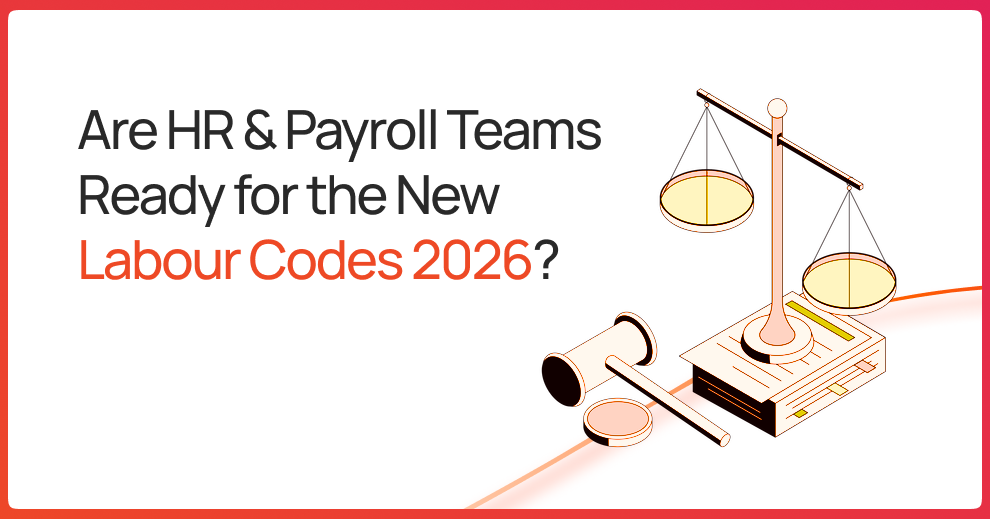
The new labour laws India and the expected rollout of the new labour codes 2026 will impact the salary structures, PF and gratuity calculations, working hours, and HR policies. For businesses and HR teams, early preparation can help reduce compliance risks and ensure a smoother transition. But first, let’s understand what the new labour codes in India actually include
What Are the New Labour Codes in India?
The new labour codes are consolidated laws that replace 29 older central acts with 4 labour codes to form the foundation of India’s modern employment framework.
Breaking Down the 4 Labour Codes
- Code on Wages, 2019: Standardizes the definition of “wages,” sets a national floor wage, and introduces the 50% basic pay rule.
- Industrial Relations Code, 2020: Governs unions, layoffs, retrenchment, strikes, and dispute resolution.
- Code on Social Security, 2020: Expands coverage to gig and platform workers and covers PF, ESI, gratuity, and maternity benefits.
- Occupational Safety, Health & Working Conditions Code, 2020: Consolidates 13 older laws, including the Factories Act, and sets working-hour limits and safety norms.
Why Labour Code Implementation Matters for Businesses?
Labour code implementation is not a one-time exercise. It affects offer letters, payroll, attendance, and the new 48-hour exit settlement window. Businesses that align early can avoid last-minute compliance challenges. The new labour codes 2026 also push employers toward technology backed systems because manual spreadsheets are difficult to manage at scale.
How New Labour Laws India Could Affect Growing Businesses in 2026?
The new labour laws India will reshape three core areas: salary structures, statutory contributions, and working-hour policies.
1. Revised 50% Basic Pay Rule
Under the Code on Wages, “wages” include Basic + DA + Retaining Allowance, and this must account for at least 50% of total CTC. If allowances exceed 50%, the excess amount is added back to wages for statutory calculations. Many companies historically kept basic pay at 20–30% of CTC to reduce PF outflow, but the new rule closes this gap.
2. Impact on Payroll, PF & Gratuity
Labour code implementation creates a direct impact on statutory costs:
- Higher PF contributions: Take-home pay may reduce by 2–7%, but retirement savings increase.
- Larger gratuity payouts: A broader wage base increases employer liability.
- Pro-rata gratuity after 1 year: Fixed-term employees qualify after one year, while permanent employees still require five years.
- 48-hour full and final settlement: All exit dues must be cleared within two working days
3. 48 Hour Work Week
The OSH&WC Code caps weekly hours at 48 with a standard 8-hour workday. The new flexibility allows employers to distribute these 48 hours across 4, 5, or 6 days. A 4-day workweek is allowed if daily hours do not exceed 12. Overtime beyond 8 hours per day or 48 hours per week must be paid at double the regular rate based on the revised wage structure. This makes accurate attendance tracking essential.
What are the New Challenges of Labour Law Compliance?
Labour law compliance India is becoming more complex because HR processes now move faster and operate across multiple jurisdictions.
1. Manual Payroll Documentation
Payroll teams must restructure CTCs, recalculate contributions, generate updated wage slips, and maintain inspection-ready digital records. Even a small payroll error can lead to retrospective PF dues or gratuity shortfalls.
2. Multi-State Workforce Compliance Challenges
Labour falls under the Concurrent List, so each state must notify its own rules. For pan-India employers, this creates varying compliance requirements across locations. An employee in Bengaluru may fall under different operational rules compared to employees in Mumbai or Hyderabad.
3. Financial Risks of Delayed Labour Code Compliance
- Retrospective dues: Backdated PF and ESI can demands along with interest.
- Inspection penalties: Fines and legal risks.
- Exit disputes: Missing the 48-hour settlement window can result in employee claims.
- Reputational damage: Compliance gaps can negatively impact employer branding.
Businesses focusing on labour code implementation and labour law compliance India should also stay updated on payroll and statutory changes introduced in the Union Budget 2026–27 payroll compliance guide for HR & finance teams.
How HRMS Solutions Can Help Businesses Stay Compliant?
The new labour codes assume employers use technology-backed HR systems. A modern HRMS can turn labour code implementation into a structured and manageable process.
1. Automating Payroll & Compliance Processes
A capable HRMS can automatically apply the 50% wage rule, calculate PF, ESI, gratuity, and TDS accurately, file PF/ESI/PT returns, and process full-and-final settlements within 48 hours. This reduces the most common labour code compliance risks.
2. Centralized HR and Attendance Management
A centralized system tracks attendance across locations, shifts, and work modes through a single dashboard. Leave policies and working-hour structures can be configured once and applied consistently, improving labour law compliance India across multi-state teams.
3. 24/7 Compliance Tracking for HR Teams
Real-time dashboards help HR teams identify risks early, including employees with sub-50% basic pay, expiring fixed-term contracts, overtime overruns, and pending filings. This visibility helps organizations avoid last-minute compliance issues.
Conclusion
The new labour codes 2026 will eventually become standard business practice. Early preparation can reduce audit risks, improve payroll predictability, and strengthen employer branding, helping businesses prepare for compliance-led growth in 2026 and beyond.
For businesses looking to stay compliance ready, modern HRMS solutions like Osource Global can help streamline HR operations and support smoother labour code compliance management.
Frequently Asked Questions
1. What are the new labour codes in India?
The new labour codes in India are four consolidated laws replacing 29 older acts: the Code on Wages (2019), Industrial Relations Code (2020), Code on Social Security (2020), and OSH&WC Code (2020). These codes were notified on 21 November 2025, with implementation targeted from 1 April 2026.
2. What is the 48 hour work week rule?
The 48 hour work week rule limits weekly working hours to 48 with a standard 8-hour workday. Employers can distribute these hours across 4, 5, or 6 days, with daily hours capped at 12. Work beyond these limits qualifies for overtime at double the regular wage rate.
3. What are the business risks for not following labour code compliance?
Avoiding Labour law compliance can lead to retrospective dues, penalties, and employee disputes for businesses. Strong compliance practices also support smoother audits, predictable costs, stronger employee trust, and a better employer reputation.
4. Why Labour Code Implementation Matters for Businesses
Businesses focusing on labour code implementation and labour law compliance India should also stay updated on payroll and statutory changes introduced in the Union Budget 2026–27 payroll compliance guide for HR & finance teams.
5. How can HRMS solutions help businesses manage labour code compliance?
HRMS solutions automate payroll calculations under the new wage definition, apply state-specific rules across locations, generate statutory filings, track attendance and overtime in real time, and process exit settlements within the required timeline. This helps businesses maintain labour code compliance efficiently.