X

    How can we help?

    Finance And Accounting Services

    Human Resource Services

    B2B SaaS Solution

    Customize Solutions

    Your Details

    Name*

    Email*

    Phone number*

    Organization*

    Location*

    Select Enquiry Type*

    How can we help?*

    What is 7 + 6 ?

    By clicking submit you agree with the Privacy policy of Osource

    Our Blog

    Read our latest
    blogs and articles

    5 minutes, 49 seconds Read

    The Role of HRMS Integration in Streamlining User Access Control

    Table of Contents Introduction What is HRMS Integration? How HRMS Integration Streamlines User Access Control Why HRMS Integration Matters for Modern Enterprises Challenges in Implementing HRMS-Driven Access Control Why Choose Osource for HRMS Wrapping it Up FAQs Introduction HRMS integration streamlines user access control by automating the process of granting, modifying, and revoking system permissions for employees. It ensures that access aligns with job roles, security policies, and compliance requirements from onboarding to offboarding. In today’s digital-first organisations, managing who can access what is no longer just an IT responsibility, but a core governance function. By integrating your HRMS with enterprise systems, organisations can achieve secure, efficient, and scalable User access control while eliminating manual errors and security risks. What is HRMS Integration? A Human resource management system is where organisations manage employee details, roles, and key lifecycle events like hiring, promotions, and exits. But when it works in isolation, access to systems and data often has to be handled manually, which can slow things down and increase risk. HRMS integration connects your HRMS with other business platforms, so employee data automatically drives workflows. This enables better User access control, where access is assigned based on accurate HR information instead...
    January 15, 2026
    7 minutes, 28 seconds Read

    5 Key Features of an Ideal Access Management System for Enterprises

    Estimated reading time: 8 minutes Key Takeaways Understand how access management systems are a strategic asset for enterprises. Explore the role of Onex SAM in enterprise-grade identity management. Learn how features like MFA, SSO, ABAC, audit trails, and integrations can improve operational security and efficiency. Discover how scalable systems future-proof your enterprise’s access control strategies. Table of Contents Introduction 1. Comprehensive User Authentication 2. Fine-Grained Access Control 3. Comprehensive Audit Trails and Reporting 4. Seamless Integration with Existing Systems 5. Scalability and Future-Proofing Conclusion FAQ Introduction With digital tools and systems powering nearly every aspect of modern business, knowing who can access what has never been more important. As enterprises grow and roles evolve, uncontrolled or inconsistent access can quickly turn into security gaps, compliance issues, and operational bottlenecks. This is where an effective access management system plays a vital role. It decides who gets access to what, when, and under which conditions, helping organisations stay secure, compliant, and efficient at the same time. For business and marketing leaders alike, access management isn’t just a technical issue; it directly impacts brand trust, customer confidence, and the ability to scale safely. In this blog, we break down the five key features...
    January 1, 2026
    5 minutes, 53 seconds Read

    How Onex SAM Can Scale as Your Workforce Grows and Evolves

    Table of Contents Introduction What Is Access Management? What Is Onex SAM? Why Workforce Growth Makes Access Management Critical How Onex SAM Simplifies Scalable Access Management Why Organisations Need Onex SAM Today Key Components of Onex SAM Challenges in Scalable Access Management Conclusion FAQs How Onex SAM Can Scale as Your Workforce Grows and Evolves Introduction As businesses expand, controlling access to systems, applications, and data becomes increasingly challenging. Growing teams, evolving roles, and an expanding digital ecosystem demand a structured approach to managing access without disrupting day-to-day operations. Effective Access Management enables organisations to maintain security, compliance, and control while supporting agility and productivity. Without a scalable framework for system access management, workforce growth can quickly introduce operational inefficiencies and unnecessary risk. This blog will explore how Onex SAM enables organisations to scale access management seamlessly as their workforce grows and evolves. What Is Access Management? Access Management is the structured approach to controlling how users are granted, modified, and revoked access to organisational systems and data. It ensures that employees, partners, and vendors only have access to what is necessary for their role, no more, no less. At an enterprise level, access management forms the foundation of system...
    December 31, 2025
    8 minutes, 26 seconds Read

    The Top Challenges of Manual Spend Management And How to Overcome Them

    Estimated reading time: 9 minutes   Key Takeaways Manual spend management limits agility, visibility, and real-time decision-making. Automated tools reduce errors, improve collaboration, and align spend with performance. Scaling marketing budgets efficiently requires centralized, connected solutions. Modern marketing teams are solving budget challenges without increasing headcount.   Table of Contents Introduction What Is Manual Spend Management? The Top Challenges of Manual Spend Management How Modern Marketing Teams Are Fixing Manual Spend Management Choosing the Right Platform Case Study: How One Marketing Company Scaled Spend Management Final Thoughts: Making the Shift to a Modern Spend Management FAQ   Introduction Marketing budgets are becoming increasingly complex, yet many teams continue to rely on spreadsheets and email-based processes to manage their spending. These manual approaches were never built for today’s fast-paced, multi-channel marketing environment. Manual spend management leads to limited visibility, slow approvals, and frequent errors. As budgets grow and accountability increases, these inefficiencies make it harder for marketing teams to stay agile and aligned with Finance. In this blog, we explore the top challenges of manual spend management and how modern, automated solutions enable teams to gain control, enhance collaboration, and manage budgets more strategically. What Is Manual Spend Management? Manual spend...
    December 26, 2025
    8 minutes, 45 seconds Read

    Why Manual Contract Management Is Costing Indian Businesses More Than They Realize

    Estimated reading time: 8 minutes Key Takeaways Manual contract management leads to hidden costs, inefficiencies, and compliance risks. Marketing teams are significantly affected due to high-volume vendor and influencer contracts. Indian businesses face unique challenges such as regulatory complexity and informal contract culture. Modern contract management systems can automate and simplify workflows. CLM solutions deliver tangible ROI in time, cost savings, and marketing execution speed. Table of Contents 1. Introduction 2. The Hidden Costs of Manual Contract Management 3..Why Marketing Teams Suffer The Most 4. Real-World Examples of Indian Businesses Losing Out 5. India-Specific Challenges That Make Manual Contract Management Worse 6. Signs That Your Contracts Are Costing You 7. What a Modern Contract Management Solves 8. Calculating the ROI of Contract Automation 9. Getting Started with Contract Automation 10. Conclusion FAQ    Introduction Most Indian businesses don’t realize how much money they lose to contract inefficiencies until something goes wrong. A missed renewal, an outdated clause, or a delayed approval can quietly drain budgets and stall execution, all without triggering immediate red flags. Manual contract management may seem manageable on the surface. But behind the scenes, it slows teams down, increases compliance risk, and creates blind spots, particularly for...
    December 24, 2025
    7 minutes, 46 seconds Read

    Why Spend Management Systems Are Essential for Growing Businesses in 2026

    Estimated Reading Time: 10 minutes Key Takeaways Marketing spend is high-volume, fast-moving, and increasingly complex Without modern systems, companies face inefficiencies, overspending, and misalignment Spend management platforms offer real-time visibility, automation, and vendor control Choosing the right system unlocks faster campaign cycles, reduced waste, and better collaboration In 2026, CMOs managing spend effectively will lead faster-growing, more profitable teams Table of Contents What Is Spend Management System, Really? The 2026 Marketing Landscape and Why Spend is Getting Harder to Manage The Key Benefits of Using a Spend Management System What Happens When Companies Don't Implement Spend Management? Features to Look for in a Modern Spend Management System Spend Management Isn't Just for Finance Anymore Real-World ROI for Growing Companies The Evolving Role of the CMO in Spend Strategy Conclusion FAQ What Is Spend Management System, Really? Spend Management System refers to the end-to-end control of how a business tracks, approves, distributes, and analyzes its expenditures. It encompasses everything from procurement processes and employee reimbursements to software subscriptions, vendor management, and spending limits. In the past, finance teams were mainly responsible for this area. But today, especially in growing companies where marketing accounts for a significant portion of the annual budget,...
    December 19, 2025
    8 minutes, 9 seconds Read

    5 Reasons Why Onex SMS Is the Best Choice for Mid-Sized Companies Looking to Optimize Spending

    Estimated Reading Time: 7 minutes Key Takeaways Onex SMS delivers enterprise-level features at mid-market pricing Integrates seamlessly with popular CRMs, ecommerce, and analytics tools Offers industry-leading SMS deliverability and lightning-fast performance Allows robust personalization and targeting without complex setups Provides transparent pricing with real-time ROI tracking Table of Contents Introduction  1. Enterprise-Level Capabilities Without the Enterprise Price Tag 2. Seamless Integration Into Existing Marketing Stacks 3. Market-Leading Deliverability and Speed 4. Advanced Targeting and Personalization Without the Complexity 5. Transparent Pricing and Real-Time ROI Tracking Final Thoughts FAQ Introduction As mid-sized organizations expand, managing spend across departments, vendors, and approval workflows becomes increasingly complex. Without clear visibility and structured processes, even well-planned budgets can quickly lose control. This imbalance makes it difficult for growing businesses to maintain control over spending, ensure compliance, and gain real-time visibility across procurement and finance operations. What they need is a solution that delivers powerful capabilities without stretching budgets or resources. In this blog, we’ll explore five key reasons why Onex SMS is the best choice for mid-sized companies looking to optimize spending, improve transparency, and achieve measurable financial control. 1. Enterprise-Level Capabilities Without the Enterprise Price Tag A major challenge for mid-sized companies is...
    December 18, 2025
    6 minutes, 9 seconds Read

    How Onex SMS Drives Procurement Transparency and Compliance for Finance Teams

    Estimated Reading Time: 10 minutes   Key Takeaways Procurement transparency is critical for financial integrity and compliance. Onex SMS centralizes, automates, and governs supplier management processes. Real-time visibility and audit trails minimize risks and manual inefficiencies. Integrated workflows and system interoperability strengthen cross-functional collaboration. Faster onboarding, tighter controls, and enhanced audit-readiness offer a measurable ROI. Table of Contents The Evolving Role of Procurement in Finance Why Procurement Transparency Matters More Than Ever Compliance: The Silent Enforcer of Business Integrity Onex SMS: Your Strategic Partner in Transparent, Compliant Procurement Case Study-Inspired Outcomes Real Costs of Not Embracing Supplier Management Software Beyond Compliance: Building a Culture of Procurement Integrity Is Onex SMS a Fit for Your Organization? How to Get Started Conclusion FAQ The Evolving Role of Procurement in Finance Gone are the days when procurement was just a back-office function focused only on price negotiation. Modern finance teams see procurement as a strategic partner. Here's why: Increased regulatory scrutiny requires financial transparency across all vendor engagements. ESG concerns demand traceability in sourcing practices. Internal audits and cross-departmental oversight require clean documentation and workflows. Data is king, real-time insights into spend, vendor performance, and contract terms are essential for agile finance planning....
    December 16, 2025
    4 minutes, 13 seconds Read

    Key Features to Look For in a Modern Contract Management System

    Key Takeaways A modern Contract Management System must support centralized, cloud-based access for marketing teams. Automation features like approval workflows and AI-powered insights streamline contract processes. Seamless integration and scalability ensure future-proof CMS solutions for growing marketing departments. Security, role-based access, and compliance tools protect sensitive documents and enforce best practices. The best CMS tools foster collaboration, transparency, and strategic agility for all stakeholders. Table of Contents Centralized, Cloud-Based Repository Streamlined Contract Creation Tools Approval Workflow Automation Seamless E-Signature Integration AI-Powered Contract Intelligence Contract Lifecycle Tracking User Role Management & Security Integration with Essential Marketing & Business Tools Reporting and Analytics Capabilities Scalability and Customization Collaboration and Internal Communication Tools Compliance and Audit Readiness   1. Centralized, Cloud-Based Repository If your contracts still live in local hard drives, scattered team folders, or worse, physical file cabinets, it’s time to modernize. A centralized, cloud-based repository does more than just digitize your agreements; it unlocks real-time collaboration and universal access across distributed teams. Look for: Cloud storage that is safe and searchable for convenient access from any location Advanced filtering (tags, dates, parties, names, and status) Team- or role-specific granular access controls Connectivity to cloud storage platforms (Dropbox, Google Drive, SharePoint) For...
    December 15, 2025
    5 minutes, 49 seconds Read

    A Practical Guide to Rolling Out a Contract Management System

    Key Takeaways Define tangible goals and success metrics before implementation. Engage key stakeholders across departments early. Audit your current contract processes and identify bottlenecks. Choose a CMS tailored to marketing needs and scalable for growth. Customize workflows, templates, and tag metadata. Pilot with a small group before a phased company-wide rollout. Continuously monitor usage and optimize configuration regularly.   Table of Contents Why Do You Need a Contract Management System? Step 1: Define Your Goals and Success Metrics Step 2: Involve Key Stakeholders Early Step 3: Audit Your Existing Contracts and Processes Step 4: Choose the Right Contract Management System Step 5: Customize Workflows and Templates Step 6: Pilot with a Test Group Step 7: Roll Out in Phases Step 8: Monitor Usage and Continuously Optimize Common Pitfalls to Avoid Conclusion FAQ Why Do You Need a Contract Management System? If you're a senior marketing professional navigating today's fast-paced business landscape, you already understand the importance of operational efficiency. One area begging for improvement in many organizations is contract management. From sales agreements and vendor contracts to NDAs and beyond, contracts form the legal and operational backbone of most marketing initiatives. However, a lot of businesses continue to use outdated...
    December 12, 2025
    5 minutes, 34 seconds Read

    Why Investors Prefer Companies with Fractional CFOs

    Key Takeaways Fractional CFOs offer top-tier financial leadership without full-time cost burdens. Investors see fractional CFOs as a signal of fiscal discipline and fundraising readiness. These professionals drive scalability, risk management, and valuation boosts. They ensure faster, cleaner due diligence and stronger capital efficiency. Aligning finance and marketing enhances go-to-market precision. Table of Contents What is a Fractional CFO? Why Investors Are Taking Notice What You Should Look for in a Fractional CFO How Fractional CFOs Pair With Marketing Strategy Final Thoughts FAQ What is a Fractional CFO? An experienced financial executive who offers strategic financial advice to businesses on a project, retainer, or part-time basis is known as a fractional CFO. These experts provide years, typically decades of advanced financial knowledge, frequently from prestigious companies, without the full-time expense. Unlike traditional CFOs, fractional CFOs serve multiple clients. They are typically engaged by startups, growing companies, or firms in a transitional phase, such as preparing for a funding round, scaling operations, or optimizing the financial function. Why does this matter to investors? Because good financial leadership changes everything. Why Investors Are Taking Notice 1. Strategic Financial Discipline: Without the Bloat Cash burn is a hot-button issue. One of the first...
    December 9, 2025
    7 minutes, 37 seconds Read

    How Osource Global Onboards Fractional CXOs Seamlessly from Contract to Impact

    Key Takeaways Traditional onboarding doesn’t work for Fractional CXOs—time to rethink the process. Osource Global delivers a structured, multi-phase onboarding approach designed for speed, clarity, and execution. Includes pre-onboarding diagnostics, high-velocity orientation, embedded support systems, and planned transitions. Senior marketers can benefit from adapting this systemized onboarding framework to accelerate outcomes. Real-world results include increased pipeline generation and ROI within the first 60 days. Table of Contents Why Onboarding Fractional CXOs Requires More Than Standard Playbooks Step 1: Pre-Onboarding Preparation Step 2: Orientation Acceleration Step 3: Embedded Execution Support Step 4: Feedback-Tuned Leadership Development and Transition Readiness Why This Method Matters, Especially for Marketing Leaders Real-World Outcomes and Client Anecdotes How You Can Apply These Lessons in Your Own Organization Final Thoughts FAQ Why Onboarding Fractional CXOs Requires More Than Standard Playbooks Let’s start by addressing the elephant in the room: traditional onboarding isn’t built for fractional leadership. Most models assume full-time integration, cultural immersion over months, and slow strategic rollouts. Fractional CXOs don’t have the luxury of time. They’re expected to create impact within weeks, if not days. Here’s where the differences show up: Time Compression: Results are expected faster compared to full-time roles. Clarity of Scope: Fractional leaders...
    December 8, 2025
    6 minutes, 36 seconds Read

    How to Optimize Your Spend Management Using Onex SMS for Maximum ROI

    Key Takeaways Centralize budgeting processes to avoid fragmentation and errors. Leverage real-time visibility and dynamic reallocation of spend. Use automation to eliminate manual effort and improve accuracy. Align marketing, finance, and operations with shared financial governance. Track and prove ROI with attribution tools and integrated analytics. Table of Contents Why Spend Management is Now a Strategic Priority What is Onex SMS? How to Optimize Your Spend Management Using Onex SMS Advanced Strategies to Maximize Results Key Takeaways Looking Ahead: The Future of Spend Management FAQ Why Spend Management is Now a Strategic Priority Marketing isn't just about creative ideas, it’s increasingly a discipline rooted in data, accountability, and financial precision. Optimizing spend management delivers more than just cost savings; it directly influences campaign impact and business growth. Why spend management is more critical than ever. Here’s why this matters now more than ever: Fragmentation Across Channels – With a growing number of platforms (Meta, TikTok, Google Ads, programmatic, email, influencers), it's harder to see where every dollar is going. Increased Demand for ROI Transparency – Finance teams, CMOs, and boards are demanding detailed breakdowns of how marketing budgets are being deployed and what they generate. Real-Time Decisioning is Standard –...
    December 4, 2025
    7 minutes, 54 seconds Read

    How Fractional CFOs Bring Strategic Clarity Without Full-Time Costs

    Key Takeaways Fractional CFOs provide part-time, strategic financial leadership without the high cost of full-time hires. They align marketing spend with overall business growth and translate initiatives into measurable financial metrics. Fractional CFOs act as a financial bridge, supporting marketing teams with budget planning, investor communication, and scalable reporting. These professionals empower marketers with strategic insights into ROI, forecasting, and performance metrics. They are especially suited to startups, growth-stage businesses, and lean-run companies under pressure to prove ROI. Table of Contents What Is a Fractional CFO? The Marketing-Finance Gap Top Benefits Fractional CFOs Bring Why Fractional CFO is better than Full-Time Who Needs a Fractional CFO? Marketing Leader’s Playbook Final Thoughts FAQ What Is a Fractional CFO? A Fractional CFO serves as a senior financial advisor engaged on a part-time or contractual basis.  Unlike a full-time CFO, who is permanently embedded in your leadership team, a fractional CFO is brought in to address specific financial challenges, build scalable systems, or provide financial oversight during key periods such as fundraising, mergers and acquisitions (M&A), budget planning, or market pivots. These professionals aren’t just bookkeepers or accountants. They are strategic advisors with the finance toolkit of an enterprise-level CFO available to startups,...
    December 3, 2025
    5 minutes, 33 seconds Read

    Why Companies Choose Osource Global for Fractional CFO Services

    Key Takeaways Access to seasoned CFOs without incurring full-time executive costs Strategic financial planning aligned with business objectives Scalable support tailored to company growth stages Team-based approach to deliver comprehensive finance services Proven record across industries and geographies Table of Contents What is a Fractional CFO? 1. Access to Senior-Level Expertise Without the Full-Time Cost 2. Strategic Financial Planning That Aligns With Business Goals 3. Scalable Support That Grows With the Business 4. Integrated Finance Teams, Not Just a Single Resource 5. Proven Track Record Across Industries 6. Robust Governance and Compliance 7. Data-Driven Insights and Financial Technology Enablement 8. Support Through Business Transitions and Transactions 9. Customizable Engagement Models 10. A Partner Mindset, Not a Vendor Mentality FAQ What is a Fractional CFO? A Fractional CFO is a seasoned financial leader who partners with a company on a part-time or contract basis. Rather than serving in a full-time position, they offer strategic financial guidance, oversight, forecasting, and advisory support all at a significantly lower cost than hiring a permanent CFO. Startups and SMBs that require CFO-level expertise but can’t justify a full-time expense High-growth companies that need scalable financial systems and controls International businesses expanding into new jurisdictions Companies...
    December 2, 2025
    8 minutes, 11 seconds Read

    The Value of a Fractional CFO in Mergers and Acquisitions

    Key Takeaways Fractional CFOs provide expert-level financial guidance without long-term cost commitments. They help connect marketing strategy to financial metrics during M&A processes. Offer crucial support during valuation, due diligence, and post-merger integration. Enable marketers to participate effectively in deal strategy and execution. Hiring a fractional CFO early can maximize transaction success and long-term growth.   Table of Contents What Is a Fractional CFO and Why Should Marketers Care During M&A? Why Is a Fractional CFO a Game-Changer in M&A? When Should a Marketing-Focused Company Bring in a Fractional CFO for M&A? Real-World Scenarios: How Marketing Leaders Benefit from Fractional CFOs Why This Matters More Than Ever to Marketing Professionals Choosing the Right Fractional CFO: What to Look For Final Thoughts: Marketing + Finance = M&A Success FAQ   What Is a Fractional CFO and Why Should Marketers Care During M&A? A Fractional CFO is a strategic financial expert available on a part-time, contract, or project basis. These professionals bring high-level financial leadership and strategic capability of a traditional CFO, including financial planning and analysis, modeling, forecasting, and risk management, without the long-term costs or overhead. For marketers involved in an M&A transaction, the presence of a skilled financial lead...
    December 1, 2025
    7 minutes, 51 seconds Read

    Common Contract Management Challenges Growing Companies Face

    Key Takeaways Poor contract management leads to delays, inefficiencies, and missed opportunities. Marketing leaders should prioritize visibility, standardization, and ownership in contract processes. Early investment in centralized tools and workflows prevents future bottlenecks. Cross-functional collaboration is critical for contract execution and compliance. Automation and dashboards streamline tracking and reduce risk. Table of Contents Why Marketing Teams Should Care About Contract Management Top Contract Management Challenges for Growing Companies What Happens If You Ignore These Problems? Best Practices for Building a Scalable Contract Management Approach Final Thoughts FAQ Why Marketing Teams Should Care About Contract Management Before diving into the challenges, let's answer the core question: why should a senior marketing leader care? Because bad contract management drains time, increases risk, and can derail initiatives. Consider how these real-world examples impact your day-to-day: Your campaign launch is delayed because a creative agency’s contract expired, and no one renewed it. You face unexpected costs because of automatic renewals on martech tools you no longer use. A vendor underdelivers, but you realize too late that the contract didn’t include the performance clauses you thought it did. Your team spends days digging through inboxes and shared drives just to find a signed agreement from...
    November 28, 2025
    4 minutes, 43 seconds Read

    Top Financial Mistakes and How a Fractional CFO Fixes Them

    Key Takeaways Ignoring finance early can stall growth or lead to cash hemorrhaging Fractional CFOs translate financial data into actionable strategy Common financial mistakes include poor cash flow planning, undisciplined budgeting, and weak forecasting Finance and marketing function best when aligned on KPI and ROI metrics Early-stage CFO support saves capital and drives scalability Table of Contents 1. Treating Finance as an Afterthought 2. Weak Cash Flow Management 3. No Budget or Poor Budget Discipline 4. Hiring Too Fast or Too Slow 5. Pricing Without Financial Insight 6. Disconnected Financial and Operational Metrics 7. Poor Forecasting and Scenario Planning 8. Ignoring Unit Economics 9. Misaligned Investor or Board Reporting 10. Delaying CFO Support Until It's "Safe" Final Thoughts FAQ's   1.  Treating Finance as an Afterthought The problem: Many businesses, especially those in growth mode, prioritize sales, marketing, and operations, leaving finance behind. Financial management becomes reactive, addressed only during tax season or funding discussions. Why it hurts: Without real-time visibility into financial performance, decision-making becomes more about instinct than data. You may be scaling customers while silently bleeding cash. How a Fractional CFO helps: Sets up integrated financial systems from the beginning Implements real-time dashboards linking financial data to...
    November 27, 2025
    7 minutes, 42 seconds Read

    How a Contract Management System Helps You Stay Audit-Ready

    Key Takeaways A Contract Management System (CMS) centralizes documents and improves accessibility during audits. Proactive alerts and audit trails help marketing leaders stay ahead of compliance requirements. Automated workflows and standardized templates mitigate risks and reduce manual errors. Real-time dashboards provide continuous visibility into contract statuses and compliance readiness. A CMS enhances security and supports legal and financial collaboration.   Table of Contents Why Audit Readiness Matters for Marketing Leaders What Is a Contract Management System? 1. Centralized Access Means No More Digging 2. Proactive Alerts Prevent Missed Deadlines or Renewals 3. Digital Audit Trails Increase Transparency 4. Standardized Processes Mitigate Risk 5. Integrated Compliance Tracking 6. Improved Collaboration with Legal and Finance 7. Reporting and Dashboards for Real-Time Audit Preparation 8. Secure Access Reduces Data Exposure Risk 9. Continuous Version Control 10. Readiness for M&A and Organizational Due Diligence A CMS Isn't Just a Legal Tool—It's a Strategic Marketing Enabler Wrapping Up FAQ   Why Audit Readiness Matters for Marketing Leaders Marketing teams are uniquely exposed when it comes to compliance. From handling large vendor budgets to managing third-party data-sharing agreements with MarTech tools, marketing departments today are deeply integrated with IT, finance, legal, and outside partners. Unfortunately, that...
    November 26, 2025
    4 minutes, 54 seconds Read

    How Fractional CFO Services Help Fast-Growing Companies Stay Financially Sharp

    Table of Contents I. Introduction II. The Growing Pains: Why Fast-Growing Companies Need Strategic Financial Leadership III. What Fractional CFO Services Actually Include IV. Strategic Financial Planning: Building Your Growth Roadmap V. Financial Forecasting: Seeing Around Corners VI. Cash Flow Management: The Lifeblood of Growth VII. Strategic Decision-Making: Data-Driven Leadership FAQ I. Introduction Imagine this: Your company has just closed its best quarter ever. Revenue is soaring, team size is doubling, and product demand is growing at a record pace. Yet, during your latest quarterly planning session, everything screeches to a halt because no one can clearly say whether you can afford the new marketing campaign you're proposing. The budget's uncertain. The forecasts are outdated if they exist at all. Cash in the bank looks fine, but something feels off. Sounds familiar? Welcome to the growth paradox: Sometimes, the faster a company grows, the harder it becomes to manage its finances. And while this might seem like a problem for your CEO or finance department, it has a direct line to marketing—especially for senior marketing professionals tasked with optimizing budgets, demonstrating ROI, and making smart, data-informed investments in growth. That’s where Fractional CFO services come in. A Fractional CFO is...
    November 25, 2025
    8 minutes, 23 seconds Read

    How Fractional CXOs Complement Executive Teams Without Adding Headcount

    Table of Contents  Introduction What Is a Fractional CXO — And Why It Matters How Fractional CXOs Complement Executive Teams What Fractional CXOs Do: Role Breakdown Key Components for a Successful Fractional CXO Engagement Why This Model Works — Strategic Benefits Challenges & How to Overcome Them How Osource Global Supports Fractional CXO Engagements Final Thoughts: Unlocking Growth with Fractional CXOs   How Fractional CXOs Complement Executive Teams Without Adding Headcount Modern businesses can no longer wait for growth — they need strategic leadership now, yet without the overhead of full-time executives. Hiring a full-time C-level executive can be costly and time-consuming, yet strategic leadership is essential for scaling and sustaining success. This is where a fractional CXO comes in. By bringing in seasoned C-suite expertise on a part-time or project basis, companies can access high-level strategic guidance, drive transformation, and strengthen leadership without adding headcount. Through fractional leadership, organisations can fill critical gaps, accelerate decision-making, and enhance team capabilities, all while keeping costs under control. In this blog, we’ll explore how fractional CXOs complement executive teams, why this model is becoming increasingly popular, the specific roles they play, key components of a successful engagement, and practical insights for implementing...
    November 21, 2025
    8 minutes, 15 seconds Read

    Why Legal, Procurement, and Finance Teams All Rely on Onex CMS for Efficiency

    Key Takeaways Departmental silos cause inefficiencies, compliance risks, and loss of productivity. Onex CMS offers centralized tools that automate and streamline contract management. Legal, Procurement, and Finance teams all benefit from shared visibility and collaboration. Organizations report reduced cycle times, improved compliance, and higher ROI using Onex CMS. Integrated systems like Onex CMS are essential for modern, agile business operations.   Table of Contents I. Introduction II. The High Cost of Departmental Silos: Why Integration Matters III. Core Capabilities: What Makes Onex CMS the Central Hub IV. How Legal Teams Benefit from Onex CMS V. How Procurement Teams Leverage Onex CMS VI. How Finance Teams Drive Performance with Onex CMS VII. The Collaboration Advantage VIII. Measuring Success: KPIs and ROI Metrics IX. Conclusion FAQ   I. Introduction Ever felt like your departments are playing a game of telephone with contracts—and everyone’s getting a different message? If you’re a senior marketing or operations leader, chances are you’ve experienced siloed communication between your legal, procurement, and finance teams. The delays, the redundant tasks, the version mix-ups—it all adds up to unnecessary stress, lost productivity, and potentially serious business risks. In today’s fast-paced business landscape, organizations can no longer afford disjointed workflows. Legal...
    November 20, 2025
    6 minutes, 21 seconds Read

    How Companies Accelerated Growth with Fractional CXOs

    Key Takeaways Fractional CXOs offer high-level executive leadership without long-term commitments. They help companies scale faster at a fraction of the cost of full-time C-suite hires. Real-world case studies prove measurable ROI in marketing, finance, ops, and technology. Clear communication, goal alignment, and integration are key to success. Table of Contents Introduction What Are Fractional CXOs and Why They Matter Now 5 Ways Fractional CXOs Accelerate Company Growth Real Success Stories: Companies That Won with Fractional CXOs How to Maximize ROI from Fractional CXO Engagements FAQ I. Introduction Here’s a stat that’s hard to ignore: 73% of fast-growing companies now leverage fractional executives to support their scaling strategies. This shift isn't just a trend—it's becoming a vital growth lever for modern businesses, especially in an era defined by economic uncertainty, rapid technological changes, and a tight talent market. As organizations scale, they face a leadership paradox: the need for top-tier strategic guidance without the resources—or sometimes the need—for full-time C-suite hires. Enter the rise of the “fractional CXO” model, where companies get on-demand access to highly experienced executives across functions like marketing, finance, operations, and technology. Smart, growing companies are closing critical leadership gaps, navigating uncertainty, and outperforming competitors—without breaking...
    November 19, 2025
    7 minutes, 2 seconds Read

    How Onex SMS Enhances Budgeting and Forecasting with Smarter Expense Management

    Establishing a robust expense management system is not only a necessity but also a strategic advantage in a time when financial agility can make or break a company.Many companies still rely on fragmented processes, spreadsheets and email trails to handle procurement and expenses, which not only slows things down but also introduces risk. That’s where Onex SMS comes in. Developed by Osource Global, Onex SMS streamlines the entire procure-to-pay cycle, giving your finance team greater control without the manual headaches. As organisations increasingly turn to spend management software to strengthen governance and visibility, Onex SMS stands out by offering automation and consistency across all spend processes By leveraging Onex SMS, organisations can gain real-time visibility into spending, consistent policy enforcement, and forecast more accurately — all while automating repetitive tasks and reducing the burden on your people. The result? Smarter financial planning, better budgeting, and a safer, more scalable way to manage business spend.  In this blog, we’ll explore how Onex SMS enhances budgeting and forecasting through smarter expense management. Understanding Smarter Expense Management At its core, smarter expense management is about creating structured, transparent, and efficient processes across all financial touchpoints. Traditional systems often force employees to navigate multiple...
    November 18, 2025
    6 minutes, 33 seconds Read

    How Fractional CXO Benefits Help Founders Regain Focus on Strategic Growth

    Key Takeaways Founders often lose strategic focus due to operational overload. Fractional CXOs offer part-time executive leadership that scales with business needs. They differ from consultants by executing strategy and integrating with teams. This model enables cost-effective growth, expert leadership, and strategic clarity. Ideal during business inflection points like scaling, raising capital, or launching new products.   The Founder’s Dilemma: Why Strategic Focus Gets Lost The Unspoken Cost of Wearing Too Many Hats It's thrilling to run a startup, but it can also be overwhelming, particularly if the founder is involved in every aspect of the business, from content marketing to compliance. A. The Reality of Founder Overwhelm A Forbes analysis indicated that founders devote only 32% of their time to strategic work and roughly 68% to daily duties. Many founders wind up handling payroll, preparing job descriptions, approving marketing copy, and closing customer tickets—tasks that, although essential, aren't the best use of CEO time. When this happens: Strategic plans stall. Long-term vision gives way to putting out daily fires. Mental fatigue sets in, leading to burnout—and potentially, bad business decisions. B. The Executive Expertise Gap A big contributor to this chaos? A lack of seasoned executive leadership in key...
    November 17, 2025
    7 minutes, 31 seconds Read

    How Onex CMS Saves Businesses Money Through Streamlined Contract Lifecycle Management

    Managing contracts effectively has become more crucial than ever as companies operate in a more competitive and digitally driven market. It used to be possible to follow agreements using spreadsheets, emails, or dispersed papers, but as businesses grow and vendor networks grow, managing contracts by hand has become ineffective, prone to errors, and expensive. Today, contract lifecycle management sits at the core of operational accuracy and financial control. It ensures that every contract—from creation to renewal—is monitored, compliant, and aligned with business goals. Beyond documentation, modern contract management plays a strategic role in reducing revenue leakage, improving productivity, and strengthening governance across every department. With rising contract volumes and tighter compliance demands, the need for a smarter, automated approach has become unavoidable. In this blog, we explore how Osource Global’s Onex Contract Management System (CMS) transforms traditional processes, reduces hidden costs, and helps organisations achieve long-term efficiency through streamlined, technology-driven contract management. What is Contract Lifecycle Management? Contract lifecycle management refers to the end-to-end approach of handling a contract from creation and negotiation through to execution, compliance tracking, renewal, and termination. In practical terms, it is the backbone that enables businesses to control risk, ensure accountability, and prevent financial leakage....
    November 14, 2025
    5 minutes, 25 seconds Read

    What Investors Think About Fractional CXOs in Early-Stage Companies

    Introduction Startups with seasoned executive leadership are 3.6 times more likely to succeed, according to research from CB Insights. Yet, for early-stage companies, hiring a full-time executive can seem like an impossible financial stretch. Enter the world of fractional CXOs — a pragmatic, cost-effective solution rapidly gaining traction among lean startups and savvy investors alike. Fractional CXOs—experienced C-level executives who work part-time or on contract—are proving to be a strategic asset for early-stage companies that need executive guidance without the long-term overhead. This model offers agility, expertise, and efficient leadership support exactly when and where it’s needed. In this article, we explore what investors really think about fractional CXOs in early-stage companies. Whether you’re a startup founder, a senior marketing professional eyeing fractional work, or an investor looking to back smarter businesses, you’ll uncover the strategic merits, the risks, and the scenarios where fractional leadership shines. We’ll break down key insights from venture capitalists, highlight the operational impact of fractional CXOs, and dive into real-world case studies showing how startups leveraged fractional talent to accelerate growth and win investor confidence. Understanding Fractional CXOs: A Quick Primer What Are Fractional CXOs? Fractional CXOs are senior executives who take on high-level roles...
    November 13, 2025
    6 minutes, 27 seconds Read

    How Onex SMS Procurement Management Software Transforms Spend Management

    Managing business spending has always been a balancing act. Every organisation aims to maintain visibility, control, and compliance while ensuring purchases support broader strategic goals. Yet many still rely on manual practices, siloed tools, and outdated processes that create blind spots in spending and slow down critical procurement activities. This is where Onex SMS Procurement Management Software from Osource Global becomes a game-changer. Designed to modernise procurement operations, it offers automation, real-time analytics, and end-to-end transparency that help enterprises strengthen financial governance. With its ability to unify procurement workflows, it eliminates inefficiencies and empowers teams to make faster and more informed decisions. In this blog, we explore how Onex SMS Procurement Management Software redefines spend management, streamlines processes, and supports cost-efficient growth for organisations of all sizes.   Why Smart Spend Management Matters Today In today’s business world, procurement has gone beyond simply buying goods and services. It now plays an important role in improving operational efficiency, working with suppliers, and saving costs. However, many organisations still depend on old systems or spreadsheets, which make it difficult to track expenses, approve purchases, or ensure compliance. Intelligent procurement management software provides the foundation for centralised spend control. It directly influences operational...
    November 11, 2025
    9 minutes, 27 seconds Read

    Best Practices for User Provisioning and De-Provisioning with Onex SAM

    As organizations scale and digital ecosystems expand, controlling who gets access to what systems has become a critical business challenge. Effective user access management not only protects sensitive data but also ensures operational continuity and compliance. Enterprises today need a structured, automated, and auditable approach to managing user identities — and that’s exactly what Onex SAM delivers. Developed by Osource Global, Onex SAM is an intelligent user management system designed to simplify access governance through automation, analytics, and centralized control. It enables businesses to manage onboarding, role changes, and offboarding efficiently — bringing accuracy and speed to every stage of the access lifecycle. In this blog, we explore the essentials of user provisioning and deprovisioning, why they matter to modern enterprises, and how Onex SAM can help you implement these processes more securely and efficiently. What is User Provisioning and De-Provisioning? User provisioning is the process of granting system access to new employees or external users when they join or change roles within an organization. De-provisioning, on the other hand, ensures that access is revoked when users leave, switch departments, or no longer require certain permissions. Together, these steps form the foundation of effective user access management, helping organizations maintain...
    November 7, 2025
    11 minutes, 57 seconds Read

    The Business Impact of Role-Based Access Control (RBAC) with Onex SAM

    Controlling who has access to what is essential for preserving efficiency and security in modern enterprises where data forms the basis of operations. In a world where data breaches, unauthorised access, and compliance lapses are becoming daily headlines, businesses must rethink how they manage digital identities and permissions. One of the most effective strategies to strengthen data security and streamline operations is Role-Based Access Control (RBAC). When paired with an intelligent access management system like Onex SAM, RBAC goes beyond security—it drives efficiency, compliance, and strategic control across enterprise systems. By integrating automation, analytics, and scalability, Onex SAM ensures that every access point within the organisation is monitored, governed, and aligned with business goals. This blog explores the business impact of Role-Based Access Control (RBAC) with Onex SAM, detailing how it empowers organisations to achieve seamless access governance, improved data security, and regulatory compliance. Understanding Role-Based Access Control (RBAC) Role-Based Access Control (RBAC) is a structured security framework that regulates system access based on predefined job roles within an organisation. Instead of assigning permissions individually to each user, RBAC groups employees under specific roles—such as HR Executive, Finance Manager, or IT Administrator—each with its own set of access privileges. Within...
    November 4, 2025
    10 minutes, 26 seconds Read

    How Onex SAM Enables Compliance Automation to Reduce Risk and Streamline Recertification

    Ensuring that the right people have the right access at the right time is critical for every modern enterprise. Today’s business environment demands not just efficiency but also accountability, especially when it comes to data access, governance, and regulatory compliance. Manual processes and fragmented systems often make it difficult for organisations to maintain audit readiness or uphold compliance standards without introducing risk or inefficiency. Osource Global’s Onex SAM (System Access Management) transforms this landscape by combining automation, governance, and intelligence to deliver true compliance automation. It streamlines user access processes, enforces organisational policies, and ensures continuous visibility into every access decision—reducing risk and simplifying recertification cycles. This blog explores what compliance automation means in the context of user access management, how Onex SAM implements it, why it matters, the key components that make it work, common challenges enterprises face, and how Osource Global’s solution resolves them effectively.   What Is Compliance Automation in User Access Management? The use of technology to automate the procedures, monitoring, and reporting required to guarantee that an organization complies with both internal and external regulatory requirements is known as compliance automation. This refers to automating the process of creating, modifying, verifying, and removing user rights...
    October 31, 2025
    10 minutes, 39 seconds Read

    Maximising Security ROI with Identity and Access Management Using Onex SAM

    Introduction For many organisations, managing system access has become one of the most important yet challenging aspects of modern business operations. It’s not just about assigning permissions — it’s about ensuring compliance, safeguarding sensitive data, and maintaining operational efficiency at every level. Manual access management often leads to inconsistencies, delays, and potential security risks, making it challenging for businesses to maintain security and remain audit-ready. This is where Osource Global’s Onex SAM (System Access Management) solution delivers measurable value. As an enterprise-grade Identity and Access Management (IAM) platform, Onex SAM helps organisations strengthen security governance, reduce compliance risks, and optimise operational efficiency. Essentially, it serves as a system access management security tool that maps users to the correct access, automates authorization processes, and ensures only authorized individuals can access critical systems and data. Beyond that, it functions as a certification and re-certification tool, continuously validating user access rights across evolving enterprise environments. In this blog, we explore how implementing a structured IAM strategy using Onex SAM not only improves security but also maximizes your organization’s return on security investment (ROI).  What Is Identity and Access Management and Why Does It Matter for Security ROI? The foundation of organizational security is...
    October 29, 2025
    5 minutes, 29 seconds Read

    Why Onex SAM is the Ultimate Solution for Streamlining User Access Management

    In today’s connected business environment, managing digital access in large enterprises is no longer just a technical requirement—it’s a critical element of enterprise security. With multiple users, applications, and data sources, organizations need a reliable way to control who gets access to what and when.  That’s exactly what Onex SAM (System Access Management) delivers - a secure, intelligent, and automated solution that simplifies User Access Management for modern enterprises. Onex SAM is essentially a security tool, designed to ensure the right people have the right access at the right time. It regulates user permissions, prevents unauthorized entry, and helps organizations maintain complete visibility over their digital ecosystem.  In the following sections, we’ll explore how Onex SAM works, why it’s essential for today’s enterprises, the key components that make it effective, and how it stands out as the ultimate solution for User Access Management. What Is User Access Management and Why It Matters User Access Management (UAM) refers to the process of regulating who can access which resources within an organization. It ensures that only verified individuals are granted the appropriate level of access to networks, applications, and data. In modern enterprises, UAM combines identity management, access control, and role-based access...
    October 23, 2025
    5 minutes, 56 seconds Read

    Real-World Case Studies: How Onex SAM Transformed Enterprise Access Management

    The implementation of Onex SAM has not only streamlined processes but also significantly reduced the risk of unauthorised access. This transformation illustrates the profound impact of effective access management on overall organisational security and operational performance. A successful business demands careful planning, agile management, and continuous upgrades in technology. These help in anticipating market changes, meeting evolving customer expectations, and staying ahead of competitors through innovation and data-driven decisions.  Osource, a pioneer in solving business problems with its cutting-edge technology, has helped multiple organisations to scale up and become future ready. With its Onex – the multifaceted tool that offers HRMS, SMS, Recon, CMS, and FLOW – you can streamline your business processes for a seamless workflow. Also, for businesses looking for a safe network for data transfer, Onex SAM is your one-stop solution. Let’s understand deeply how One SAM can help you scale your business.  What does System Access Management (SAM) mean, and why does it matter for enterprises today? System Access Management deals with who can internally access what digital assets and resources within the enterprise. With ever-changing cyber threats worldwide complicating regulatory requirements, access management has shifted from being a routine administrative task into a more strategic...
    October 10, 2025
    4 minutes, 39 seconds Read

    How Onex SAM Can Help You Meet GRC and Audit Frameworks with Ease

    Governance, Risk, and Compliance (GRC) and auditing frameworks go hand-in-hand as necessities for any organization to maintain integrity of operations, compliance with the law, and minimization of risk. Multiplying requirements makes it ever more complex and, above all, time-consuming in areas such as system access control, software licenses, and asset inventory.  Onex SAM The Onex SAM - System Access Management attempts to address said challenges by simplifying and automating compliance activities within a centralized platform. In this blog, we discuss how Onex SAM can help your company quickly and efficiently achieve its GRC and audit requirements. System Access Management is vital for any sound GRC framework. It deals with who has access to what systems and data, making sure that the rights to access are duly earned and in line with compliance requirements. Onex SAM is a user-friendly and automated system access management tool that reduces human intervention and errors, thus upholding the policies throughout the whole organization. With Onex SAM, organizations find it easy to grant least privilege access, manage permissions on a role basis, and audit log access.  One of the key features there in the Onex SAM is an automated asset inventory. It poses a great risk,...
    October 10, 2025
    6 minutes, 25 seconds Read

    Onex SAM vs. Traditional Access Management Solutions: A Detailed Comparison

    In today's ever-changing security environment, selecting the appropriate System Access Management solution is vital to safeguarding business assets and enabling operations. Onex SAM (System Access Management) is the next generation of access management, utilizing cloud capabilities, AI and automation, and zero trust security principles.  This blog presents a thorough comparison of Onex SAM with traditional access control systems. It covers issues related to role-based access control, identity management and access management strategies. What Is the Fundamental Way In Which Onex SAM Differs From Traditional Access Control Systems? Traditional access control systems are generally focused on limiting either physical or digital entry points using static policies and permissions. They typically depend on manual provisioning and siloed thinking.  Onex SAM is a single System Access Management platform that incorporates identity governance, role-based access control (RBAC), dynamic policy enforcement, and real-time analytics, all in a cloud solution. This models adaptive and scalable access management for the modern enterprise. How Does Onex SAM Enhance Identity Management Over Traditional Approaches? Traditional identity management often relies on manual user provisioning and reviews that can result in errors and delays. Onex SAM automates user lifecycle management through AI-driven identity management, offering automatic provisioning and deprovisioning based on...
    October 10, 2025
    5 minutes, 47 seconds Read

    How Onex HRMS Helps You Achieve Compliance and Boost Productivity

    In the fast-paced and regulated business world, businesses must deal with compliance requirements while maintaining the often conflicting need for compliance productivity.  Onex HRMS, an effective human resource management system developed by Osource Global, provides businesses with innovative resources to improve HR operations, become compliant with regulations, and improve workforce engagement. This detailed blog will help you understand how Onex HRMS can achieve these objectives through its various functionalities, such as the ESS portal, centralised data management, digital management of documents, automation of routine tasks, automated compliance reporting, employee training and certification and tracking.  What is Onex HRMS, and why is it important to compliance and productivity? Onex HRMS is an integrated cloud-based HR platform that automates essential human resource processes such as recruitment, attendance tracking, payroll, compliance monitoring, and employee development. Onex HRMS helps reduce human error, ensure consistency with policies and management processes, and improve overall efficiency by enforcing standardised workflows and processes using a centralised platform in compliance with productivity. How does centralised data management in Onex HRMS support compliance?  Centralised data management collects all employee data in a secured, centralised location that is available to HR and payroll. Centralised data ingress accuracy mitigates redundancies and enhances...
    October 10, 2025
    6 minutes, 0 seconds Read

    The ROI of Switching to Onex HRMS: Real-Life Case Studies

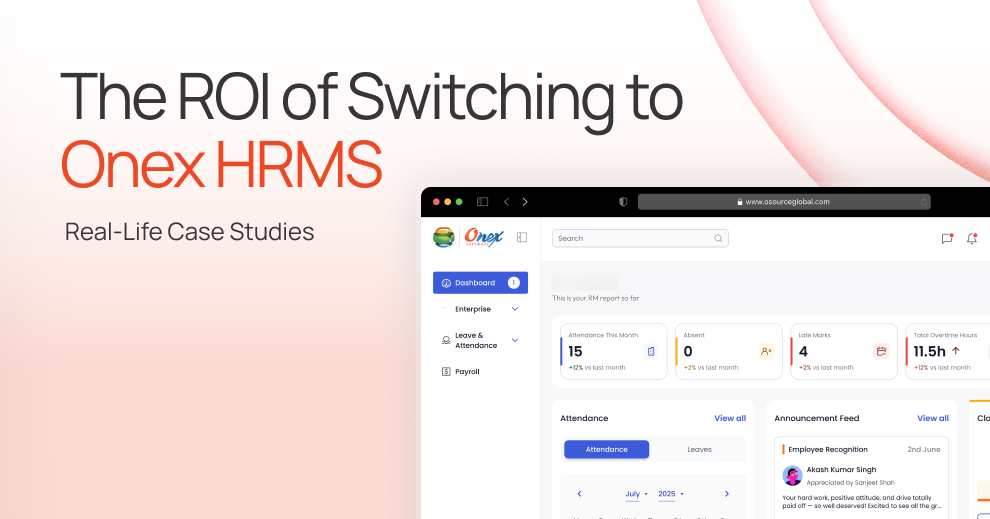
    We are witnessing a shift from manually handling the tasks to automating them. With the continuous advancements in the technology, it has become easy to manage and operate. It has led to an error-free and time-saving solution for businesses, allowing them time to focus on the crucial tasks. Osource Global is a leading technology-driven BPO company and IT solution provider that offers end-to-end software solutions and outsourcing services for enterprises. We at Osource Global deliver a wide range of business process and technology services, such as employee expense, payroll outsourcing, fixed asset capitalisation, vendor payment, staffing, and information security consulting, among other services. We have designed Onex HRMS to help you handle your most cherished assets – human resources. From onboarding, paperwork, payslips, and payroll to managing every other data point, Onex HRMS is all you need to run a successful business free from managing human resource hassles. Onex HRMS becomes much more than merely a technology update. In this blog we will discuss how Onex helps ease the HR operation pain while simultaneously boosting your ROI. What is the real ROI for switching to Onex HRMS? Like most investments, Onex HRMS ROI includes tangible cost savings, faster HRMS integration,...
    October 10, 2025
    6 minutes, 0 seconds Read

    How to Ensure Seamless Integration of HRMS with Your Existing Systems

    With the shift in technology, we are witnessing a major change in the corporate world. The introduction of automation tools has helped us leverage several critical advantages in managing human resources effectively. HRMS has transformed how companies operate by accelerating time-consuming manual processes, reducing errors, and facilitating data accuracy and compliance.  Ensuring seamless HRMS integration enhances productivity across departments, enabling faster hiring, streamlined payroll, and more efficient management of employee records, saving time for you to focus on what actually matters. What is HRMS Integration and why is it important?  HRMS Integration refers to the process of connecting your human resource management system with the existing software tools, such as payroll or ERP platforms, ensuring the data and processes flow seamlessly across operations.  It eliminates manual entries and reduces errors while efficiently increasing productivity. This results in integrating with an HRMS system that is reliable and accurate for the employee payroll system.  How HRMS Create Efficiency in Payroll Management Systems?  An integrated HRMS would handle employee data in real-time, such as attendance and compensation from your payroll management systems. Also, the employee salary calculations, deductions and payments to employee banking institutions will be accurate and automated while being compliant with...
    October 10, 2025
    5 minutes, 4 seconds Read

    The Hidden Dangers of Poor Access Control in the Digital Age

    In today's rapidly evolving digital landscape, the importance of access control has reached new heights. Organizations are increasingly relying on a diverse range of systems, from cloud platforms to on-premise solutions, to store and manage critical business data. As cyber threats become more sophisticated and organizations scale, ensuring proper access control is more crucial than ever. Access control is about managing who can access what within a company’s systems. Without robust access control measures in place, companies expose themselves to a range of security risks, including unauthorized access to sensitive data, loss of operational efficiency, and non-compliance with industry regulations. For modern enterprises, the consequences of poor access control can be devastating. In this blog post, we will understand the hidden dangers of poor access control and how it can affect business operations.  What is Access Control? Access control refers to the processes and policies used to manage who has access to specific resources, applications, or data within an organization. At its core, access control ensures that only authorized users can interact with sensitive data and systems, while unauthorized users are kept out. Key components of access control include: Authentication: Verifying a user's identity through passwords, biometrics, or multi-factor authentication...
    August 29, 2025
    6 minutes, 51 seconds Read

    Why System Access Management is Crucial for Modern Enterprises

    As modern enterprises evolve in an increasingly digital world, the need for robust access management becomes more critical than ever. In the past, controlling access to physical resources and networks was manageable, but with the expansion of digital systems, cloud computing, and remote work, managing system access has grown increasingly complex. Today, system access management is the backbone of organizational security. It guarantees that access to essential systems and confidential information is restricted solely to approved users. But beyond security, system access plays a vital role in improving operational efficiency and maintaining compliance with regulatory requirements. Companies must ensure that only the right people have the right access, at the right time, to avoid costly security breaches or operational disruptions. As businesses scale, the risk of data breaches, system misuse, and compliance failures grows. In this blog post, we will understand why access management is more than just a necessary operational tool and how its strategic component can shape a company’s long-term success. What is System Access Management? System Access management is the process of regulating who can access what resources within an organization. It ensures that only verified individuals are granted the right level of access to networks, data,...
    August 28, 2025
    Banner image with text " Automation Tools Every Fractional Executive Should Know About" alongside a professional sitting in an office setting.
    7 minutes, 35 seconds Read

    Best Automation Tools in 2025 to Boost Efficiency for Fractional Executives

    Table of Contents: Introduction What is a Fractional Executive? Why Fractional Executives Need Automation Tools How Automation Improves Operational Efficiency and Business Growth Challenges of Implementing Automation and How Fractional Executives Can Overcome Them The Role of Osource Conclusion Introduction In today’s fast-paced business world, fractional executives need efficient ways to streamline operations, improve productivity, and drive business growth. Business automation tools and automation software offer solutions to these challenges, allowing fractional executives to focus on strategic leadership rather than day-to-day operations.  In this blog post, we explore the essential automation tools that fractional executives should be familiar with to drive business efficiency and accelerate growth. 1. What is a Fractional Executive?  A fractional executive is a part-time executive who provides high-level strategic guidance to organizations. Fractional executives often take on roles such as Fractional CXOs, CFOs, or CHROs, offering their expertise on a temporary or part-time basis. These leaders help businesses at critical junctures, such as scaling operations, improving efficiency, or navigating complex challenges. 2. Why Fractional Executives Need Automation Tools  Fractional executives face several challenges as they work to implement effective strategies and drive growth. One key challenge is the need to manage multiple business functions with limited...
    August 21, 2025
    Banner image with text "How Fractional CXOs Leverage Business Automation in India" alongside a professional standing with arms crossed in an office setting.
    4 minutes, 30 seconds Read

    How Fractional CXOs Leverage Business Automation In India

    As businesses evolve, the need for automation becomes more pressing. In a competitive environment, companies must optimize their processes, reduce operational costs, and scale efficiently to stay ahead. Business automation allows businesses to automate repetitive tasks, improve efficiency, and reduce human error. For growing companies, this is an essential tool to streamline operations while focusing on strategy. Fractional CXOs are uniquely positioned to lead this transformation, as they combine high-level leadership with cost-effective automation solutions that promote sustainable growth. In this blog post, we’ll explore how Fractional CXOs leverage automation to foster growth, and how Osource supports this transformation with its tailored solutions. What is a Fractional CXO? A Fractional CXO is an experienced executive who works part-time or on a contract basis to provide high-level strategic leadership without the financial burden of a full-time hire. These executives are typically brought in for specific areas such as business strategy, operations, or finance. Fractional CXOs bring expertise in scaling businesses, improving efficiency, and aligning the company’s operations with long-term goals. They step in to guide businesses through periods of growth, transformation, or when there is a leadership gap, and they bring significant value in utilizing automation to streamline business operations. Business...
    August 20, 2025
    Banner image with text “Is a Fractional CXO Right for Your Indian Business?” alongside a smiling professional holding a tablet
    5 minutes, 3 seconds Read

    Is a Fractional CXO Right for Your Indian Business?

    As companies grow, they often encounter obstacles that require experienced leadership and specialized expertise. Whether it's refining the business strategy, improving business efficiency, or scaling operations, strategic leadership is crucial for navigating these challenges. For many companies, especially in the early stages of growth, hiring a full-time C-Suite executive can be cost-prohibitive. In this blog post, we will understand how a Fractional CXO will be the right choice for your business and how a highly experienced executive who brings value without the long-term financial commitment of a full-time hire. What Is a Fractional CXO? A Fractional CXO is an experienced executive who works on a part-time or contractual basis. These C-Suite executives bring specialized expertise in areas like business strategy, financial oversight, operations, or marketing to growing companies. Unlike traditional C-Suite executives, Fractional CXOs are hired for a specific need and work for a fraction of the time, helping companies achieve strategic goals without the financial burden of a full-time role. When Should You Hire a Fractional CXO? Deciding when to hire a Fractional CXO largely depends on your company’s needs and growth stage. Here are some scenarios where a Fractional CXO can be an ideal fit: Leadership Gaps: If...
    August 19, 2025
    8 minutes, 14 seconds Read

    Fractional CXOs vs. Consultants in India: The Difference and When to Hire Which?

    In today’s rapidly evolving business environment, companies are continuously seeking expert leadership to solve complex problems, improve operations, and achieve growth. As businesses look for external expertise, the choice often boils down to two options: hiring a Fractional CXO or a consultant. In this blog post, we will explain what a Fractional CXO and a consultant are, their key differences, and when to hire each for your business. We will also discuss how Osource can support your leadership needs with both Fractional CXO services and consulting solutions. What Is a Fractional CXO? A Fractional CXO is an executive who works part-time or on a contract basis, providing high-level leadership in areas such as finance, operations, marketing, or strategy. These executives are typically experienced professionals who bring their expertise to help businesses solve specific problems, scale operations, or manage periods of growth without the need for a full-time hire. Unlike consultants, Fractional CXOs integrate into the company’s leadership team, aligning with the organization’s overall business strategy. Fractional CXOs are involved in the day-to-day management and decision-making, helping drive sustainable business growth. What Is a Consultant? A consultant, on the other hand, is typically hired for a specific project or to solve...
    August 14, 2025
    7 minutes, 0 seconds Read

    What Is a Fractional CXO and Why More Companies Are Hiring Them?

    In today’s fast-moving business landscape, companies are constantly striving for growth, efficiency, and innovation while managing their costs. To stay competitive and meet these demands, many businesses are turning to Fractional CXOs executives who offer their expertise on a part-time or contract basis. This model is becoming increasingly popular for companies seeking high-level leadership without the financial commitment of full-time C-Suite executives. In this blog post, we’ll understand exactly what a Fractional CXO is, why more companies are opting for this leadership model, and how it can contribute to business strategy, efficiency, and long-term growth. What Is a Fractional CXO? A Fractional CXO is an executive who provides strategic leadership to a company on a part-time, contract, or project basis. These executives can fill C-Suite roles like Chief Financial Officer (CFO), Chief Marketing Officer (CMO), Chief Operating Officer (COO), or even Chief Executive Officer (CEO), offering specialized expertise without the cost of a full-time hire. Unlike traditional C-Suite executives, who work with a company full-time, Fractional CXOs are typically brought in to oversee specific business functions, solve immediate challenges, or guide strategic initiatives. Why Are More Companies Hiring Fractional CXOs? The trend of hiring Fractional CXOs is not just a...
    August 13, 2025
    7 minutes, 21 seconds Read

    How Fractional CFOs Drive Strategic Finance for Indian Startups

    As fast-growing companies navigate the complexities of scaling their operations, having strategic finance in place becomes increasingly important. Often, managing financial growth, ensuring profitability, and maintaining cash flow can overwhelm existing leadership teams. This is where a fractional CFO plays a critical role. This blog post explores how fractional CFOs help fast-growing companies by optimizing financial strategies, enhancing profitability, and ensuring financial scalability.   What is a Fractional CFO? A fractional CFO is a part-time executive who provides strategic financial leadership to companies without the need for a full-time commitment. These professionals specialize in managing key aspects of financial management, financial planning, and cash flow management. Their role is especially valuable for fast-growing companies that need financial expertise but can’t yet justify a full-time hire. Fractional CFOs bring deep expertise in areas like financial forecasting, cost optimization, and business growth strategy. They step in to offer the same level of guidance as a traditional CFO, but on a flexible, contract-based model. This enables companies to access expert-level financial strategy at a fraction of the cost. How Fractional CFOs Drive Strategic Financial Leadership Fractional CFOs are not just about managing numbers; they bring strategic financial leadership to the table. Their role...
    August 12, 2025
    7 minutes, 13 seconds Read

    Ways Fractional CFOs Improve Profitability and Cash Flow

    In today’s fast-paced business environment, profitability and cash flow management are two essential elements that determine a company’s success. Without efficient management of these two factors, businesses can struggle to survive, especially when looking to scale or attract investment. A fractional CFO can provide high-level financial expertise to optimize profitability and cash flow while ensuring that resources are allocated effectively. This blog post explores the role of a fractional CFO in driving business efficiency, increasing profitability, and ensuring sustainable cash flow.   What is a Fractional CFO? A fractional CFO is a financial expert who works on a part-time, contract, or interim basis to provide financial expertise for businesses that need high-level financial oversight but don’t have the resources to hire a full-time CFO. They offer a flexible and cost-effective solution, bringing strategic financial insight into areas such as financial management, cash flow forecasting, and business expansion planning. Fractional CFOs work with companies of all sizes, from small-sized enterprises to mid-sized enterprises, helping them achieve financial stability and implement solid financial strategies that align with long-term goals.   Why Profitability and Cash Flow Are Critical to Business Success Profitability and cash flow are foundational to the financial health of any...
    August 11, 2025
    5 minutes, 53 seconds Read

    Navigating Economic Uncertainty in India with the Expertise of a Fractional CFO

    In today's volatile business environment, economic uncertainty is a constant challenge. Companies across all sectors are grappling with changing market dynamics, fluctuating demand, and unexpected global events that can affect financial stability. Amid this uncertainty, businesses need robust financial leadership to guide them through the turbulence. A fractional CFO provides the strategic financial oversight needed to ensure that a business remains agile and prepared, no matter what economic challenges arise. In this blog, we’ll explore how a fractional CFO can help businesses manage economic uncertainty, drive business growth, and maintain a healthy cash flow. What is a Fractional CFO and How Do They Navigate Economic Uncertainty? A fractional CFO is a part-time financial expert who offers high-level financial leadership without the cost of a full-time, in-house CFO. These professionals bring extensive experience in financial strategy, financial management, and business growth to companies in need of temporary or flexible leadership. By working on a contract basis, a fractional CFO helps businesses develop sound financial plans, mitigate risks, and optimize cash flow especially in uncertain times. In the face of economic uncertainty, a fractional CFO provides strategic financial leadership by: Adapting financial strategy: They review and adjust financial plans to ensure the...
    August 11, 2025
    5 minutes, 48 seconds Read

    The Secret Weapon for Investor-Ready Financial Strategy: A Fractional CFO

    In today’s competitive business environment, securing investment is crucial for growth, scalability, and long-term success. However, attracting investors requires more than just a great product or service. Businesses must present a solid financial strategy that not only demonstrates financial stability but also shows potential for growth and scalability. This is where a fractional CFO can play a key role in ensuring your financial strategy is investor-ready. A fractional CFO offers the financial expertise that businesses need, especially for small-sized enterprises and mid-sized enterprises looking to grow without committing to the cost of a full-time executive. This blog explores how partnering with a fractional CFO can give your business the strategic financial leadership it needs to attract investors and drive growth. What is a Fractional CFO? A fractional CFO is a financial expert who works with businesses on a contract basis or part-time. Unlike a full-time CFO, who is employed permanently, a fractional CFO provides high-level financial guidance and leadership on a flexible, part-time schedule. This model is particularly beneficial for small-sized enterprises and mid-sized enterprises that require expert financial management but may not have the resources to hire a full-time executive. The fractional CFO oversees everything from financial forecasting and...
    August 6, 2025
    5 minutes, 32 seconds Read

    The Role of a Fractional CFO in Digital Transformation

    Digital transformation isn’t limited to IT and operations it directly impacts how financial decisions are made, tracked, and optimized. As organizations focus on efficiency, scalability, and compliance, the finance function becomes a central part of any transformation effort. A Fractional CFO plays a strategic role in helping businesses navigate this shift. With a focus on aligning finance goals with digital capabilities, they guide organizations toward smarter decisions, improved visibility, and sustainable performance. What Does a Fractional CFO Bring to Digital Strategy? A Fractional CFO offers high-level financial leadership on a part-time or project basis, making them ideal for companies that need expert support without hiring a full-time executive. This model supports both cost control and strategic agility, especially useful in digital transformation initiatives where budgeting, technology evaluation, and integration require cross-functional oversight. Fractional CFO services are becoming more relevant as businesses adopt digital tools at every level of operations. These professionals lead initiatives that align financial systems with broader business goals, supporting real-time decision-making, risk assessment, and technology planning. Key Functions Enabled by a Fractional CFO in Digital Transformation A Fractional CFO plays a central role in aligning digital transformation efforts with measurable financial outcomes. Their ability to balance financial...
    August 4, 2025
    4 minutes, 26 seconds Read

    Top 5 Myths About Fractional CFOs—Debunked

    In today’s fast-evolving business environment, companies of all sizes are looking for ways to remain agile, financially stable, and growth-focused. One solution that’s gaining traction is the Fractional CFO. This part-time, high-level financial expert can guide your business through challenges without the expense of a full-time hire. However, several myths still surround fractional CFOs, which can lead to confusion and hesitation. In this blog post, we will debunk the top 5 myths about fractional CFOs and uncover how they can bring substantial value to large and medium-sized businesses alike. 1. Myth: Fractional CFOs Are Only for Large Businesses A common misconception is that fractional CFOs are best suited for large businesses with complex financial needs. While it’s true that many large companies benefit from external expertise, medium-sized businesses are equally well-positioned to leverage the advantages of a fractional CFO. Many growing businesses face similar challenges: navigating financial forecasting, managing cash flow, and optimizing risk management plans. A fractional CFO offers financial expertise to address these challenges effectively, providing businesses with the ability to scale efficiently. They help manage cash flow and streamline financial reporting, which can be vital for medium-sized businesses to ensure long-term profitability. 2. Myth: Fractional CFOs Are...
    August 1, 2025
    7 minutes, 0 seconds Read

    When Should You Hire a Fractional CFO? Key Signs to Watch

    As businesses grow, financial complexity increases. Founders and leadership teams often reach a point where spreadsheets and ad hoc planning are no longer enough. The need for structure, insight, and accountability becomes critical, but not every company is ready to hire a full-time CFO. A Fractional CFO offers a practical solution: access to senior financial leadership on a contact-based schedule, tailored to the company’s size and stage. For startup founders, fast growing companies, and teams managing either small scale operations or preparing for scale, the right timing makes all the difference. In this blog, we will be discussing key focus areas when to hire fractional CFO.  What Does a Fractional CFO Do? A Fractional CFO brings strategic direction to financial planning without the long-term commitment of a full-time executive. They support a range of needs budgeting, reporting, compliance, investor communications, and operational decision-making, on a part-time or project basis. Their role is to strengthen financial clarity and leadership while aligning processes with company goals. For types of businesses that are growing quickly or facing new financial demands, this model ensures continuity and control without the overhead. Key Signs It’s Time to Hire a Fractional CFO Here are clear, observable signs...
    July 30, 2025
    5 minutes, 12 seconds Read

    Fractional CFO vs Full-Time CFO: Which Is Right for Your Company?

    As companies navigate evolving market conditions, the need for strong financial leadership is more important than ever. Choosing between a Fractional CFO and a Full-time CFO depends on your current business requirements, operational structure, and long-term growth plans. Each role brings distinct value, and understanding the difference is key to making a decision that supports your company's financial health, structure, and strategic direction. In this blog, we will be understanding amongst a Fractional CFO and a Full-time CFO, which would be a correct choice  Defining the Roles: Fractional CFO and Full-Time CFO Fractional CFO A Fractional CFO is a contract-based financial leader who works with organizations on a part-time or project-specific basis. This model offers flexibility and is typically engaged when businesses require experienced input in budgeting, forecasting, or fundraising without hiring a permanent executive. Full-Time CFO A Full-time CFO is a permanent executive who becomes an integral part of the leadership team. They oversee all financial operations, help shape long-term strategy, and lead internal finance teams. This role is embedded within the company’s business hierarchy, with ongoing accountability and strategic involvement. Each type plays a distinct role in the overall financial management approach depending on the size, maturity, and...
    July 29, 2025
    5 minutes, 32 seconds Read

    What Is a Fractional CFO and How Can They Transform Your Business?

    In a business environment where agility and precision matter, companies are rethinking how they access senior financial leadership. A Fractional CFO offers organizations a cost effective, flexible way to gain financial expertise without committing to a full-time executive. This model is especially valuable for businesses looking to improve financial compliance, streamline decision-making, and align operations with long-term growth objectives. In this blog post, we will understand in depth about the term Fractional CFO and explore how it can help businesses to grow.  What is a Fractional CFO A Fractional CFO is a seasoned financial executive who works with organizations on a contract-based or part-time schedule. This model gives businesses access to financial expertise without the full-time cost or commitment typically associated with executive hires. These professionals are brought in during periods of change, growth, or financial complexity. Whether it's for fundraising preparation, budgeting oversight, or compliance management, a fractional CFO provides strategic support that fits the company’s needs and pace. Role of a Fractional CFO The role of a Fractional CFO centers around delivering strategic financial leadership in a focused, time-efficient way. Instead of managing daily operations full-time, they contribute through high-impact financial strategies and consultative leadership. They work closely...
    July 24, 2025
    4 minutes, 35 seconds Read

    How Personnel Management Software Streamlines Employee Lifecycle Tracking

    Tracking the employee lifecycle is central to building a consistent and compliant HR operation. As businesses scale, manually managing key employee milestones onboarding, payroll, performance reviews, and offboarding becomes increasingly inefficient. Without a structured system in place, HR teams risk data silos, compliance gaps, and delays in critical processes. Personnel management software addresses these issues by automating and standardizing workflows across the entire lifecycle. It ensures that employee records, tasks, approvals, and compliance-related updates are accessible, auditable, and consistent. In this blog post, we will understand how effectively personnel management software streamlines employee lifecycle tracking  What Is Personnel Management Software? Personnel management software is a digital platform that helps HR teams manage employee information, tasks, and events from the moment someone joins to the point they leave the organization. It goes beyond simple HR recordkeeping to include modules for: Employee onboarding Payroll processing Performance management Compliance management Training and development Exit procedures and offboarding Unlike standalone employee onboarding software, this system is designed to manage the employee lifecycle as a unified flow. It integrates with other tools, ensuring data consistency across HR, finance, and compliance functions. Key Stages of the Employee Lifecycle and How Software Enhances Each Employee Onboarding Personnel...
    July 23, 2025
    4 minutes, 15 seconds Read

    HR Software Adoption in Southeast Asia: Trends and Opportunities for Singapore-Based Teams

    Across borders and workforce expectations change, teams are investing in smarter ways to manage talent, compliance, and operations. Singapore, in particular, is positioned at the center of this transformation. HR software is no longer a back-office convenience. It's a foundational part of business operations, used to streamline employee data, automate routine tasks, and enable strategic decision-making. With rising pressure to improve efficiency, ensure compliance, and deliver better employee experiences, adoption of modern HR systems is accelerating, especially among Singapore-based teams leading regional operations. In this blog, we will understand what are the HR Software Adoption trends and opportunities are in the Singapore region.  Understanding HR Software: Core Functions and Modern Capabilities HR software encompasses a range of digital tools designed to automate and manage key HR functions. At its core, it helps teams stay organized, compliant, and responsive as business needs evolve. Modern HR software typically includes features like: Payroll processing: Managing salary calculations, tax deductions, CPF contributions, reimbursements, and final settlements. Employee Lifecycle Management: Supporting every stage from onboarding to exit, including training, appraisals, promotions, and leave tracking. Recruitment automation: Streamlining candidate sourcing, interview scheduling, and offer management. HR system software: Acting as the centralized platform for employee data,...
    July 18, 2025
    3 minutes, 46 seconds Read

    HRMS 2.0 vs. HRMS 4.0: What’s the Right Fit for Your Enterprise Today?

    Understanding the Evolution of HR Technology Enterprise HR technology has shifted from record-keeping systems to platforms that support strategic workforce planning, compliance, and operational agility. Early human resource management systems were designed to track personnel data. Over time, HR platforms evolved into more integrated tools offering payroll management, attendance, and compliance tracking. The introduction of HRMS 2.0 brought more structured automation, enabling organizations to handle core HR systems such as employee records, leave, and payroll more efficiently. However, changing workforce dynamics, distributed teams, and stricter compliance demands have accelerated the need for intelligent, flexible systems. This shift has laid the groundwork for HRMS 4.0 a generation of systems designed for enterprises looking to scale, digitize processes, and adopt AI-driven insights. What is HRMS 2.0? Core Features and Limitations HRMS 2.0 refers to the second generation of HR platforms that emerged as organizations moved away from manual, paper-based systems. These platforms focused on digital storage, standardized workflows, and basic automation. Typical features included: Centralized employee management system HR payroll software for basic calculations and statutory deductions Attendance and leave tracking Basic HR compliance reports While HRMS 2.0 improved administrative efficiency, it had limitations in areas like user experience, data visibility, and...
    July 15, 2025
    7 minutes, 22 seconds Read

    A CFO’s Guide to Outsourcing AR Management for Scalable Finance Operations

    In today's fast-moving business landscape, CFOs are expected to deliver financial accuracy, support strategic decision-making, and drive operational efficiency, all while managing limited resources. One area under growing scrutiny is accounts receivable (AR) management, which directly influences cash flow, compliance, and overall finance operations. As companies scale, maintaining control over receivables becomes more complex and resource-intensive. This blog explores how outsourcing AR functions can help CFOs streamline processes, improve visibility, and build a more agile, performance-driven finance organization. What Does Effective AR Management Involve? Accounts receivable (AR) management plays a critical role in finance operations. It directly impacts cash flow management, financial accuracy, and the overall health of the balance sheet. When done well, AR management helps ensure predictable income, minimizes bad debt, and maintains strong customer relationships. Effective AR management involves more than just tracking invoices. It includes setting clear payment terms, streamlining payment processing, actively following up on overdue accounts, and maintaining accurate records for financial compliance. For finance planning to be meaningful, organizations need consistent visibility into receivables and reliable data that drives confident financial decisions. CFOs who prioritize operational efficiency in AR create processes that allow for quicker dispute resolution, cleaner reconciliations, and shorter Days Sales...
    July 11, 2025
    13 minutes, 11 seconds Read

    Why HR Management Software Is a Must-Have for Growing Businesses

    As businesses undergo business expansion, managing HR processes manually becomes inefficient and prone to errors. This challenge becomes more prominent as the workforce grows. To overcome these obstacles, businesses are increasingly turning to HR management software to streamline processes, ensure compliance, and maintain business scalability. In this blog, we’ll explore why investing in HR software is crucial for growing businesses. What is HR Management Software? HR management software (HRMS) is a digital solution designed to streamline and optimize various HR functions. From recruitment and onboarding to payroll management and employee performance evaluation, HRMS centralizes HR operations into a single platform. Unlike traditional manual methods, HR management software integrates digital workflows, automating routine tasks and ensuring compliance with regulations. This allows HR professionals to focus on more strategic activities, such as talent development and improving employee experience. Some key benefits include: Automated payroll management Efficient recruitment processes Centralized employee data Compliance management The HR software is scalable, meaning it can evolve with your business, ensuring that as your workforce grows, your HR processes remain effective and efficient. Why Do Growing Businesses Need HR Software? As businesses scale, the complexity of HR management increases significantly. What worked for a small team often...
    July 8, 2025
    4 minutes, 16 seconds Read

    How to Choose the Right Accounts Payable Automation Software for Banking and Insurance

    In industries like banking, financial services, and insurance (BFSI), managing accounts payable can become an overwhelming task. The sheer volume of invoices, the complexities of financial compliance, and the constant pressure to ensure timely payments can stretch your resources thin. Accounts payable automation offers a solution by streamlining the entire process, making it faster, more accurate, and easier to manage. This blog will explore the significance of AP automation for BFSI, covering key features, why it's essential for the sector, and how to evaluate the right tools for your business. We’ll also look at how Osource can assist you in simplifying your accounts payable process. What Is AP Automation? Accounts payable automation is the process of digitizing and automating the entire invoicing and payment procedure, replacing manual invoice capture, data entry, and approval processes. By utilizing software to handle tasks such as invoice capture, financial forecasting, and payment execution, businesses can reduce errors, save time, and improve overall financial management. With AP automation, the process is simplified, allowing for quicker approvals, better visibility into transactions, and more financial security through automated checks. This solution is particularly useful for organizations with high transaction volumes and complex business compliance needs, such as...
    July 8, 2025
    4 minutes, 5 seconds Read

    How to Choose the Best HRM Software for Your Business

    Choosing the right HRM software is one of the most crucial decisions an organization can make. As companies grow, the complexity of managing a workforce increases, and traditional methods no longer suffice. A robust human resource management software can streamline HR workflows, enhance employee satisfaction, and improve overall business performance. But selecting the best HRM software for your business isn’t as simple as picking one that looks good on paper. This blog is designed to help business leaders make informed decisions when selecting HRM software. It covers the essential factors to consider, outlines a structured vendor evaluation strategy, and highlights how Osource’s Onex HRMS can offer a solution tailored to your business’s needs Detailed Considerations of HRM Software Selection Selecting the right HRM software involves more than just evaluating features it’s about understanding how the system will fit into your business strategy planning and workforce management needs. Below are key factors to consider when making your choice: Fundamental HR Capabilities Employee Information Management: A good HRM software should allow businesses to manage and store detailed employee records efficiently. This includes personal information, salaries, benefits, and performance data.  Payroll Management: Payroll is a crucial function that requires accuracy and compliance with...
    July 8, 2025
    5 minutes, 28 seconds Read

    Key Features to Look for in a Modern Personnel Management System for Mid-Sized Enterprises

    For mid-sized enterprises, selecting the right personnel management system is a crucial decision that directly impacts HR operations, employee engagement, and overall business efficiency. An effective personnel management system not only streamlines HR processes but also ensures compliance, enhances performance tracking, and reduces administrative workload. In this blog, we explore the key features to consider when choosing a personnel management system and how an integrated approach can drive long-term success for your business. We’ll also highlight how Osource and its Onex HRMS can help mid-sized companies optimize their HR processes.   What is a Personnel Management System? A personnel management system is a software solution designed to manage various HR functions such as employee data management, payroll, benefits, performance tracking, and compliance. For mid-sized enterprises, this system becomes the backbone of HR operations, centralizing all employee-related processes into one accessible platform. By automating repetitive tasks and integrating data from different HR functions, a personnel management system helps businesses save time, reduce errors, and improve efficiency across the board. It ensures that all employee information, from recruitment to retirement, is stored securely and easily accessible.   Key Features of a Modern Personnel Management System 1. Workflow Automation A modern personnel management...
    July 7, 2025
    8 minutes, 50 seconds Read

    Looking for a Global HRMS? Here’s How to Choose One That Scales with You

    Introduction As businesses expand across regions and time zones, HR operations quickly shift from being simple administrative functions to complex, multi-layered systems. Managing people at scale,  especially in a global setup brings new challenges in payroll, compliance, employee engagement, and performance tracking. Traditional systems, often cobbled together through spreadsheets or legacy tools, simply can’t keep up. What’s needed is a scalable, cloud-based HR management software that grows with your workforce, adapts to local regulations, and provides a single source of truth across the organization. This blog will help you understand what to look for in a global HR management software, the pitfalls to avoid, and how to evaluate solutions that can scale alongside your business goals. What Is HR Management Software (HRMS)? HR management software is a digital solution designed to automate and streamline essential human resource functions. These systems manage everything from employee records and payroll to attendance tracking, onboarding, and performance evaluations—all within a unified platform. At its core, HRMS helps organizations maintain control over people operations while improving efficiency and accuracy. For growing companies, especially those with a distributed workforce, a centralized system reduces manual errors, saves time, and ensures consistency in processes. It’s important to understand...
    July 7, 2025
    5 minutes, 17 seconds Read

    How to Streamline Pre-Payroll Activities Using Automated HRMS Systems

    Pre-payroll is a critical yet often overlooked stage in payroll operations. It involves collecting and validating data such as attendance, leave, reimbursements, and tax declarations before salary processing begins. Any delay or error at this stage can impact payroll accuracy, employee trust, and compliance. For growing businesses, manual handling of pre-payroll tasks reduces business efficiency and increases the risk of non-compliance. Automating these activities through a structured human resource management system helps streamline processes, reduce effort, and improve overall payroll readiness.   What Are Pre-Payroll Activities? Pre-payroll includes all processes that prepare payroll inputs for final processing. This ensures data is accurate, approved, and compliant before salary is disbursed. Core Components: Attendance and Leave Management Tracks employee hours, late arrivals, and approved time-off to determine payable days.  Reimbursement Claims Validates claims like travel or food expenses in accordance with internal policies.  Tax Declarations Records employee investment proofs and calculates monthly deductions under applicable tax laws.  Compliance Inputs Gathers necessary data for Provident Fund, ESI, Professional Tax, and other statutory requirements, ensuring proper alignment with payroll managed services.  These components must be managed efficiently to maintain payroll accuracy and compliance. An automated payroll management system improves visibility and reduces manual reconciliation....
    July 7, 2025
    9 minutes, 7 seconds Read

    How to Simplify Factory Compliance Audits with Integrated Payroll Systems

    Introduction What Is a Factory Compliance Audit? For many factories, a compliance audit is often a time-consuming, manual exercise riddled with fragmented data across payroll, HR, and compliance functions. Paper-based records, siloed systems, and inconsistent processes can lead to missed deadlines, reporting errors, and even penalties. In contrast, an integrated payroll and HR system simplifies audit preparation by centralizing and automating key compliance processes. It empowers manufacturers to: Maintain audit-ready payroll processes Automate digital HR audits Ensure payroll data accuracy for audits Streamline factory audit documentation Enable real-time compliance monitoring This shift from manual processes to integrated solutions is critical for any manufacturing business looking to achieve consistent manufacturing compliance management while improving efficiency and reducing risk. In this blog, we explore how manufacturers can leverage integrated payroll and HR systems to simplify their compliance audits, enhance accuracy, and stay ahead of evolving statutory requirements. Common Challenges in Factory Compliance Audits Conducting a compliance audit in a manufacturing environment is far from straightforward. The nature of factory operations multiple shifts, varying pay structures, seasonal workers, and complex statutory obligations introduces several challenges. Without an integrated approach, these challenges can significantly increase audit risks and resource costs. Manual Processes and Data...
    July 7, 2025
    11 minutes, 14 seconds Read

    What Is HRMS 4.0 and Why It’s the Future of Workforce Management in 2025

    HRMS 4.0 is emerging as the solution to these demands. By combining AI in HRMS, cloud-based HR infrastructure, and advanced workforce management capabilities, this new generation of software is helping businesses align their HR strategies with broader goals for digital HR transformation. This blog will help you understand what HRMS 4.0 is, why it matters for your business, and how it can position your organisation for success. Whether you’re exploring new hr management software options or looking to modernise existing processes, the insights here will guide your decisions and help you choose the right path forward. What Is HRMS 4.0? HRMS 4.0 represents a new era of hr management software one designed to meet the complex needs of modern businesses. It goes far beyond traditional systems that were limited to basic payroll processing and record-keeping. Today’s HR leaders require intelligent platforms that can manage the full spectrum of workforce management, drive better decision-making, and support a seamless employee experience. At its core, HRMS 4.0 leverages technologies such as AI in HRMS, machine learning, and cloud computing to automate routine tasks and deliver actionable insights. The result is a system that not only reduces administrative overhead but also empowers HR teams...
    July 7, 2025
    4 minutes, 45 seconds Read

    Top Features to Look for in a Payroll Processing Software in 2025.

    Payroll processing is a critical aspect of any business, ensuring employees are paid on time and vendors are settled efficiently. However, in today’s evolving business environment, payroll processing has become more than just issuing salaries and handling vendor payments. In 2025, it’s now closely linked with HRMS and financial automation, offering businesses a more streamlined and accurate way to manage their workforce and ensure financial compliance. This blog explores why payroll automation and the right software are essential for businesses aiming for growth, scalability, and enhanced decision-making.   What Advanced Payroll Compliance Offers Adopting payroll processing software with strong compliance and analytics provides businesses with significant benefits. These features not only streamline payroll but also ensure that businesses stay compliant with evolving labor laws and regulations. Here's how advanced payroll compliance can help: Cuts Down Manual Work Automation of routine tasks such as calculating taxes, processing salaries, and generating reports drastically reduces the need for manual intervention. This speeds up payroll processing, reduces errors, and saves valuable time for HR departments, which can then focus on strategic activities instead of repetitive tasks.   . Reduces Compliance Risk Advanced payroll compliance tools ensure that your business remains in line with labor...
    July 4, 2025
    5 minutes, 1 second Read

    How Accounts Receivable Management Services Improve Cash Flow Visibility for B2B Enterprises

    For B2B enterprises, cash flow visibility is one of the most critical aspects of financial management. Effective cash flow monitoring helps businesses ensure they can meet operational expenses, invest in growth, and avoid financial instability. Without clear visibility into cash flow, businesses may face challenges in maintaining liquidity and planning for the future. Accounts receivable management is a central part of cash flow visibility. By effectively managing receivables, businesses can reduce delays in payments, minimize overdue invoices, and gain real-time insights into their financial status. Receivable management services, like those offered by Osource, provide enterprises with the tools they need to streamline this process, enhance accounts transparency, and ensure consistent cash flow.   How Osource’s Approach Ensures Accounts Transparency and Accuracy One of the most significant challenges in accounts receivable is ensuring accounts transparency and maintaining the accuracy of accounts. Many businesses struggle with manual tracking, which can lead to errors, missed payments, and a lack of clarity on the current financial situation. At Osource, we prioritize accuracy of accounts and transparency in all our services. Our approach integrates Onex Recon, an advanced reconciliation tool that automates the reconciliation process and ensures data integrity. By centralizing and automating the management...
    July 4, 2025
    7 minutes, 8 seconds Read

    The Role of AI and Automation in Modern HR Management Software.

    The world of HRMS (Human Resource Management System) has undergone a significant transformation, driven by AI and automation. These technological advancements are reshaping how businesses handle core HR functions such as recruitment processes, payroll management, and employee engagement. With the rise of AI recruitment tools, effective payroll management, and employee management software, businesses can now achieve greater business efficiency and reduced employee turnover. The integration of these modern systems enables HR professionals to focus on strategic tasks, leaving repetitive processes to be handled by advanced technologies. Importance of Automation In today's fast-paced business environment, automation in HRMS plays a crucial role in streamlining processes. By adopting AI-powered HR software, organizations can minimize human error and reduce the time spent on routine HR tasks. The key benefits include: Faster recruitment processes  Accurate payroll processing  Seamless compliance management  Improved employee experience  Increased business efficiency  Reduced payroll audits  Enhanced employee engagement  By automating these tasks, HR departments can concentrate on core activities, such as talent development and employee well-being, which ultimately leads to a more efficient business. What Are the HR Challenges? Organizations across various industries face several HR challenges that hinder their ability to effectively manage their workforce. These challenges range from...
    July 4, 2025
    5 minutes, 37 seconds Read

    Computer Applications in HR: Beyond Payroll – Real Use Cases for Business Leaders

    The role of technology in transforming human resource management (HRM) is undeniable. What once relied heavily on manual processes and paper-based systems is now being replaced by computer applications in HRM that automate and optimize HR functions. The scope of HR technology extends far beyond payroll management today; it influences every aspect of HR, from recruitment to compliance. Osource Global is at the forefront of this transformation, offering solutions that streamline HR operations, improve efficiency, and support business growth. This blog will explore how Osource’s HR tech solutions are reshaping HR, enabling businesses to optimize their HR processes for the digital age.   1. Recruitment and Talent Acquisition: Streamlining Hiring with AI How AI-Powered Tools Are Reshaping the Hiring Process AI-powered recruitment tools have transformed how companies approach hiring. With Osource Global’s AI-driven tools, businesses can automate the entire recruitment process from job posting to candidate selection. This automation significantly speeds up the hiring cycle while improving the accuracy of candidate matching. Real-World Applications and Benefits for Business Leaders By leveraging recruitment automation, Osource helps businesses not only save time but also attract better candidates. AI-driven recruitment reduces human bias, improves hiring accuracy, and accelerates the entire recruitment cycle. This...
    July 3, 2025
    5 minutes, 14 seconds Read

    Transforming HR with Tech: Applications Driving Efficiency in Large Teams

    As businesses scale and teams grow, managing HR processes efficiently becomes a challenge. Traditional HR methods relying heavily on manual tasks can no longer keep up with the demands of large, rapidly expanding teams. Human resource technology has stepped in as a transformative solution to these challenges. By automating HR processes, optimizing workflows, and providing data-driven insights, HR technology solutions are helping large teams thrive and scale effectively. This blog explores how HRMS platforms, automation of HR tools, and performance tracking tools are driving business efficiency in large organizations.   1. Recruitment Automation: Streamlining Talent Acquisition with HR Technology In large teams, recruitment can be a cumbersome and time-consuming process. Managing hundreds or thousands of applicants manually is not only inefficient but also prone to human bias. HRMS platforms with AI-driven recruitment tools help organizations streamline this process. From candidate sourcing to interview scheduling and resume screening, HR technology automates key tasks, allowing HR teams to focus on finding the best talent for the job. Osource Global’s AI-powered recruitment system automates candidate screening by analyzing resumes against job descriptions, significantly speeding up the process. This eliminates manual errors and reduces bias, leading to better candidate matches. With HR automation in...
    July 3, 2025
    4 minutes, 22 seconds Read

    Choosing the Right HR Software in Singapore: Key Considerations for Regional Enterprise

    As regional enterprises expand across Southeast Asia, managing human resources efficiently becomes more complex. From payroll compliance to employee lifecycle management, the right HR software can streamline operations, improve accuracy, and support local regulations like Singapore’s CPF system. This blog outlines the key features and compliance considerations to evaluate when selecting HR software, and explains how Osource’s Onex HRMS is built to meet the needs of growing businesses in Singapore.   Key Capabilities to Look for in HR Software   Employee Lifecycle Management and Organizational Control Effective HR software must support Employee Lifecycle Management from onboarding through exit. This includes confirmations, promotions, leave and attendance, reimbursements, training, appraisals, and offboarding. Seamless handling of this cycle allows HR teams to focus on workforce strategy while the system maintains consistent process control and compliance tracking. How Onex HRMS Addresses End to End Needs Onex HRMS is designed to manage HR operations from a single platform. It supports structured approvals, escalations, and exception handling, all mapped to pre-built workflows. HR teams can configure modules to suit business needs, while employees benefit from intuitive access to leave, payslips, and profile data. Core HR Functions vs. Advanced Workforce Management Enterprises should assess whether the platform...
    July 3, 2025
    10 minutes, 42 seconds Read

    Looking for a Global HRMS? Here’s How to Choose One That Scales with You

    Introduction As businesses expand across regions and time zones, HR operations quickly shift from being simple administrative functions to complex, multi-layered systems. Managing people at scale,  especially in a global setup brings new challenges in payroll, compliance, employee engagement, and performance tracking. Traditional systems, often cobbled together through spreadsheets or legacy tools, simply can’t keep up. What’s needed is a scalable, cloud-based HR management software that grows with your workforce, adapts to local regulations, and provides a single source of truth across the organization. Whether you’re hiring remotely or opening offices in new markets, the right HR management system can streamline operations, reduce compliance risks, and improve employee experiences from onboarding to exit. But choosing that “right” system isn’t always straightforward. This blog will help you understand what to look for in a global HR management software, the pitfalls to avoid, and how to evaluate solutions that can scale alongside your business goals. What Is HR Management Software (HRMS)? HR management software is a digital solution designed to automate and streamline essential human resource functions. These systems manage everything from employee records and payroll to attendance tracking, onboarding, and performance evaluations—all within a unified platform. At its core, HRMS helps...
    July 2, 2025
    5 minutes, 43 seconds Read

    Accounting Outsourcing in India: Benefits, Cost-Saving Insights & Global Adoption Trends

    What is Accounting Outsourcing? Accounting outsourcing refers to the process of delegating finance and accounting functions to a third-party service provider. This includes transactional activities like Accounts Payable & Receivable, General Ledger Accounting, Fixed Asset Management, payroll, and financial reporting. By transferring these functions to an external specialist, businesses can focus internal resources on strategic priorities while ensuring operational accuracy, compliance, and efficiency. India has become a global center for accounting outsourcing due to its talent availability, cost advantages, and strong process maturity. Organizations ranging from startups to large enterprises use outsourcing to streamline finance operations, manage complexity, and support growth across markets.   Top Benefits of Accounting Outsourcing in India Access to Skilled Finance Professionals India offers a deep talent pool of chartered accountants, CPAs, and finance specialists. Providers build teams equipped to manage complex finance tasks with global frameworks in mind, supporting high standards of data quality and accuracy. Cost Effective Outsourcing Labor costs in India are significantly lower compared to Western markets. Outsourcing eliminates the need for infrastructure, HR, and software investments, making it a cost effective outsourcing strategy for businesses looking to optimize spend without compromising capability. Automation and Operational Efficiency Leading Indian firms embed automation...
    July 1, 2025
    5 minutes, 9 seconds Read

    The Role of HRMS in Streamlining Onboarding: Tools, Templates & Timelines

    What Is a Human Resource Management System (HRMS)? A Human Resource Management System (HRMS) is a digital platform that helps companies manage various HR functions through automation and data-driven processes. Core modules typically include employee record management, payroll, leave tracking, compliance support, recruitment workflows, and onboarding tools. For mid-sized and growing enterprises, an HRMS replaces fragmented manual processes with a unified system that enhances task accuracy, improves workplace efficiency, and enables better decision-making. Why Onboarding Needs Streamlining in Mid-to-Large Enterprises Hiring is only the beginning. Onboarding plays a key role in setting expectations, accelerating productivity, and reducing early attrition. Yet many organizations face delays and inconsistencies due to disconnected tools, manual data entry, and unclear task ownership. Common Onboarding Challenges Missing or incomplete employee documentation Redundant manual data collection Lack of visibility into onboarding status Delayed provisioning of tools, assets, or system access Gaps in legal compliance tracking and recordkeeping These issues impact company efficiency, create a poor first impression for new hires, and increase the risk of errors in payroll and benefits enrollment. How an HRMS Streamlines Onboarding Centralized Employee Data Collection HRMS platforms simplify the intake process by collecting all necessary employee information, ID proofs, tax declarations, bank...
    July 1, 2025
    7 minutes, 36 seconds Read

    What is HR Outsourcing and its Benefits

    What is HR Outsourcing? HR outsourcing involves assigning specific human resource functions to an external service provider for execution and management.The goal is to reduce operational load, improve accuracy, and stay compliant with labor regulations. For many companies, HR functions such as payroll, compliance, or performance management can become time-consuming. HR outsourcing offers a structured way to manage these tasks through third-party expertise. Key HR functions often outsourced include: Payroll processing and statutory compliance Employee onboarding and offboarding Leave and attendance management Benefits administration Performance evaluation cycles By using HR outsourcing, businesses reduce internal burden, gain access to up-to-date tools, and shift focus back to strategic activities.The model also supports companies looking to integrate human resources and technology. Many providers use platforms that bring automation, dashboards, and centralized records.Today, HR outsourcing has grown into a practical solution for companies aiming to operate lean, compliant, and digitally enabled. Why Do Companies Outsource HR? Managing HR in-house can quickly become complex especially as teams grow and regulations shift. For many businesses, outsourcing HR is a way to streamline operations without compromising compliance or employee satisfaction. Here are the core reasons companies choose to outsource HR: Reduce Administrative Burden: HR tasks like payroll,...
    June 5, 2025
    2 minutes, 35 seconds Read

    AI-Powered HRMS: How Osource’s New Onex HRMS is Transforming Enterprise Workforce Management

    Why are Enterprises investing in AI backed HR Solutions  With over 70% of scaling enterprises are adopting AI backed HR solutions, it's clear that automation is a competitive necessity. Companies across sectors are embracing HR technology to boost efficiency, lower costs, and enhance employee experiences. A recent survey revealed that over 60% of enterprises reduced operational costs by 10% or more after implementing digital HR platforms. From real-time analytics to remote work support, the benefits of digital HR are driving enterprise adoption worldwide. Meet the Upgraded Onex HRMS by Osource Global Osource Global, a leader in HR technology and business process outsourcing, has unveiled a powerful upgrade to its flagship product—Onex HRMS. The new version is built to meet the complex needs of large organizations through: AI-powered automation Modernized UI/UX Cloud-based scalability Customizable HR workflows Whether you’re managing payroll, performance, or remote employees, Onex HRMS simplifies operations and improves accuracy across your entire human resource management system. Key Features to look for in an AI First HRMS  To help enterprises streamline HR operations, important key features to look for include:  includes: Employee Lifecycle Management: Manage every stage — from onboarding to exit—with centralized data and seamless workflows. Workforce Management Automation:...
    May 7, 2025
    3 minutes, 20 seconds Read

    5 Critical General Ledger Accounting Mistakes You are Making in 2025

    Your company's general ledger accounting isn't just a record of transactions, it's the financial pulse of your business. Every financial decision, from routine operations to strategic investments, depends on the accuracy and reliability of your general ledger accounting. Unfortunately, common accounting errors can quickly derail your financial stability, leading to financial compliance issues, incorrect reporting, and poor business decisions. In 2025, technology has advanced significantly, yet many companies continue to struggle with outdated practices and overlooked details. Understanding and addressing these errors is essential not only for immediate financial clarity but for the long-term health and growth of your company. Here are five common errors you're likely making, along with actionable fixes: 1. Inaccurate Data Entry Mistake: Entering transactions incorrectly is one of the simplest yet most devastating accounting errors in financial management. Impact: Misleading financial insights affecting critical decisions Difficulty tracking essential performance metrics, affecting strategic plans Increased risk of regulatory penalties due to inaccurate reporting Action: Implement double-entry general ledger accounting immediately to cross-verify entries Adopt AI-driven general ledger accounting software to automate and detect human accounting errors Increase ledger reconciliation frequency to weekly rather than monthly to promptly identify and rectify discrepancies Ask yourself: Are your current...
    May 6, 2025
    6 minutes, 5 seconds Read

    Key Features to Look for in General Ledger Management Software

    What is General Ledger Management Software? Managing finances can be a challenge for any business, especially when it comes to dealing with that fiscal data to be accurate, timely, and biddable. This is where General Ledger Management Software comes by, offering businesses a streamlined result to handle their account needs effectively.This software is an important tool that helps businesses maintain an accurate, up- to- date record of all their fiscal deals. It functions as the centre for managing account records, icing that every fiscal sale is logged, distributed, and fluently accessible. At its core, this helps you track all aspects of your business’s financial assets and liabilities to revenue and expenses. The software automatically organizes these transactions into a general ledger, providing a clear picture of your company’s financial health. Key Features to Look for in General Ledger Management Software When evaluating General Ledger Management Software, it's essential to understand the key features that will directly impact your financial operations. The right software can make a significant difference in streamlining processes, improving on providing error free data, and providing deeper insights into your financial data. Here are the top features to consider Automation and Efficiency: One of the primary advantages...
    May 6, 2025
    4 minutes, 25 seconds Read

    How Payroll Automation Improves Accuracy and Reduces HR Workload

    Managing payroll manually is a complex and time-consuming process that is prone to errors. HR teams are responsible for processing large amounts of data, calculating taxes, making deductions, and ensuring compliance with regulations. As companies grow, these payroll tasks only become more complicated. Payroll automation offers an effective solution by streamlining the entire process, reducing the burden on HR teams, and ensuring accuracy in payroll management. By automating payroll, companies can significantly reduce manual effort, eliminate human errors, and ensure timely, consistent payments for employees. Benefits of Payroll Automation Payroll software brings numerous advantages to businesses, improving efficiency and ensuring accurate payroll processing. Enhanced Accuracy in Payroll Processing Payroll automation eliminates manual calculations and data entry. Reduces the risk of errors like incorrect tax calculations or missed overtime. Ensures accurate and compliant payroll processing every time. Reduced Risk of Human Error Manual payroll processing is highly prone to errors. Automation ensures every paycheck is calculated correctly and on time. Reduces the risk of discrepancies, employee complaints, and legal issues. Timely and Consistent Payments Automating payroll processing ensures timely processing without delays. Employees receive their salaries on time, boosting trust and morale. Improved Compliance with Tax Regulations HR software keeps up...
    April 29, 2025
    3 minutes, 38 seconds Read

    7 Signs Your AP Process Is Due For An Upgrade

    As your business grows, things get more complex. More vendors to manage. More invoices to approve. More pressure on your team to keep up.If your ap process still involves manual steps, paper invoices, or long email chains for approvals, it’s probably slowing everything down. Late payments. Frustrated suppliers. Burned-out staff. These issues don’t just affect finance they ripple across the whole business.The good news? You don’t have to keep running AP the hard way. Here are seven signs your current ap process needs a serious upgrade and what you can do to change that. 1. Your Team Looks Exhausted Long hours just to stay on top of basic tasks Manual data entry takes over the day Mistakes increase, and morale drops What to do: Automate invoice capture and approvals Connect directly to your ERP Eliminate paper and reduce repetitive work AP automation reduces the manual load 2. You’re Still Tracking Paper Invoices Invoices go missing between departments Approvals take too long More time is spent searching than actually processing What to do: Switch to digital invoice routing Set up workflows that auto-send to the right approvers Keep everything in one place no more chasing documents Fixing this improves your ap...
    April 29, 2025
    5 minutes, 12 seconds Read

    The Ultimate Guide to Optimize General Ledger Management

    Efficient general ledger (GL) management is essential for accurate financial reporting and streamlined business operations. Whether you're a small business or part of a larger enterprise, optimizing your general ledger process ensures that your accounting data is reliable, timely, and compliant. This guide will walk you through the best practices, common challenges, and technological tools to help you optimize general ledger management for your business. Introduction to General Ledger Management Understanding the basics of general ledger management is the first step toward optimizing your financial processes. What is General Ledger Management? General ledger management involves recording, organizing, and maintaining all financial transactions within an organization. It links various financial processes together, providing a clear picture of the company’s financial health. The GL serves as the backbone of your accounting system. Importance of General Ledger in Financial Accounting Consolidates data from various sub-ledgers (accounts payable, accounts receivable, etc.). Generates crucial financial reports like balance sheets, income statements, and cash flow statements. Ensures compliance with accounting standards. Supports audits and assists in decision-making. Key Components of a General Ledger Chart of Accounts: Lists all accounts used in your general ledger. Journal Entries: Record all financial transactions in the appropriate accounts. Trial Balance:...
    March 29, 2025
    Payroll Management
    5 minutes, 36 seconds Read

    Payroll Management: Should You Handle It In-House or Outsource?

    Table of Contents: In-House Payroll Outsourced Payroll Conclusion Are you a business owner, an HR professional, or someone who frequently manages company finances? If so, you may have wondered whether outsourcing payroll is a better option than handling it in-house. Many businesses face this decision, weighing the advantages and disadvantages of each approach. The reality is that both in-house payroll and outsourced payroll services come with their own set of pros and cons. The best choice for your company will depend on your specific needs and operational preferences. Below, we outline the key benefits and drawbacks of each option based on expert insights. In-House Payroll Managing payroll internally requires a significant level of diligence and responsibility from your team. Many businesses rely on dedicated bookkeepers, accountants, or HR personnel to handle payroll operations. While this approach provides direct control, it also comes with challenges. Consider these advantages and potential downsides. Pros 1. Greater Control Over Payroll Operations Some companies prefer the ability to oversee payroll processes directly. By keeping payroll management in-house, businesses maintain full control over the workflow, allowing for better customization and immediate adjustments when necessary. Moreover, some business owners hesitate to share sensitive information—such as employee salaries,...
    March 12, 2025
    4 minutes, 22 seconds Read

    Why Businesses are moving towards Outsourcing HR Operations

    Managing HR functions effectively is a crucial yet challenging task for businesses of all sizes. As organizations grow, HR processes become more complex, requiring significant resources and expertise. To alleviate these challenges, many enterprises are turning to outsourcing HR services, a solution that can streamline operations, improve compliance, and ultimately boost business efficiency. By choosing outsourced HR services, businesses gain access to expert HR management, payroll processing, and compliance management systems. This allows them to reduce manual errors, increase efficiency, and focus on driving growth. What is HR Outsourcing? HR Outsourcing refers to the practice of hiring external providers, known as human resources outsourcing companies, to manage specific HR functions such as payroll processing, talent management, and compliance management. This strategic decision helps businesses improve operational efficiency and reduce the administrative burden associated with HR tasks. When considering outsourced HR services, businesses should look for signs that their current HR processes are inefficient, such as: Excessive time spent on HR administration and manual tasks A lack of employee self-service portals or mobile access Difficulty in staying compliant with evolving regulations Adopting outsourced HR services allows businesses to focus on their core activities while ensuring that their HR needs are effectively...
    February 5, 2025
    4 minutes, 57 seconds Read

    Payroll outsourcing costs: What to expect & how to maximize ROI

    Table of Contents: Introduction Understanding payroll outsourcing costs How payroll outsourcing saves money Maximizing ROI with payroll outsourcing Real-Life Example: How outsourcing transformed a retail business Why payroll outsourcing is a smart investment Why choose Osource for payroll outsourcing Final Thoughts: Making payroll work for you   Introduction: For many businesses, payroll is one of the most time-consuming and error-prone tasks. It’s not just about paying employees, it’s about staying compliant, managing deductions, and ensuring accuracy every time. Outsourcing payroll has emerged as a smart solution, but many decision-makers still hesitate, wondering about the costs and whether it’s worth the investment. This blog will break down what you can expect in terms of payroll outsourcing costs and how to ensure you get the best return on investment (ROI). Whether you’re a small business or a large corporation, this guide is designed to help you make informed decisions.   Understanding payroll outsourcing costs  The costs of payroll outsourcing can vary widely depending on factors like company size, the complexity of payroll requirements, and the services you need. Here’s a breakdown of common pricing models used by payroll outsourcing companies: 1. Per Employee Per Month (PEPM) This is one of the most...
    January 26, 2025
    5 minutes, 10 seconds Read

    How payroll outsourcing reduces compliance risks for businesses

    Table of Contents: Introduction Why Compliance is a critical business challenge How Payroll outsourcing minimizes compliance risks Why more businesses are turning to payroll outsourcing services in India Why partnering with Osource is a smart move Let’s take the stress out of compliance Introduction Running a business comes with its fair share of challenges, and staying compliant with changing regulations is one of the trickiest. There are always new tax laws to follow, employee benefits to calculate, and deadlines to meet. Missing something along the way could lead to serious consequences like fines, legal action, or even a loss of trust with your employees. This is why many businesses are turning to payroll outsourcing companies for help. They bring expertise and assurance, helping you focus on your business while they handle the complexities of compliance. Let’s dive into how payroll outsourcing services in India can take the stress out of staying compliant.   Why Compliance is a critical business challenge  Ensuring compliance isn’t just about ticking off tasks, it’s about protecting your business and supporting your employees. From tax laws to labor regulations, there’s a lot to stay on top of, and it changes constantly. In India, laws like the...
    January 14, 2025
    5 minutes, 22 seconds Read

    Common Myths about Payroll Outsourcing – Debunked!

    Table of Contents: Introduction Myth 1: Outsourcing payroll is too expensive Myth 2: I’ll lose control over payroll operations Myth 3: It’s only for big companies Myth 4: Payroll outsourcing is just data entry Myth 5: My data won’t be safe Myth 6: Transitioning to payroll outsourcing is a hassle Myth 7: It’s one-size-fits-all solution Myth 8: Employees will feel disconnected Myth 9: Outsourcing means no accountability Why Osource   Introduction Managing payroll isn’t just another task on a business checklist  - it’s a responsibility that directly impacts your employees’ trust and morale. Yet, for many businesses, it often feels like a never-ending cycle of calculations, compliance headaches, and increasing deadlines. If this sounds familiar, you’re not alone. Payroll outsourcing companies have emerged as a source of genuine relief, promising to reduce these burdens. But doubts often cloud the conversation, shaped by misunderstandings and fears. Let’s break these myths together, address the real pain points, and see how payroll outsourcing can genuinely transform the way you manage payroll.   Myth 1: Outsourcing payroll is too expensive When cash flow is tight, every rupee matters. The thought of spending on external payroll services might seem counterproductive, especially when you’re already juggling...
    December 24, 2024
    5 minutes, 47 seconds Read

    5 key signs it’s time to outsource your payroll operations

    Table of Contents: Introduction Your business is growing faster than your payroll systems Compliance is becoming a nightmare Payroll Errors are costing you more than you realize Your team is overburdened with payroll tasks You need a competitive edge in attracting & retaining talent Focus on Growth, Let Osource Handle the Payroll Conclusion    Introduction In any growing business, one of the most critical, yet often overlooked, aspects is payroll management. As companies expand and evolve, the intricacies of managing payroll grow exponentially. From staying compliant with tax regulations to ensuring timely and accurate payment to employees, handling payroll in-house becomes an increasingly complex task. For many businesses, payroll outsourcing companies emerge as a viable solution - saving time, reducing risk, and ensuring smooth operations. But how do you know when it’s truly the right time to make the switch? Here are five key signs that indicate it might be time to explore payroll outsourcing services in India, and why Osource is the ideal partner to streamline your payroll operations.   1. Your business is growing faster than your payroll systems  Rapid business growth often brings with it an influx of new employees, each with their own payroll needs, benefits,...
    December 12, 2024
    6 minutes, 40 seconds Read

    The Ultimate Guide to Choosing the Best Document Management Software for Your Business

    Table of Contents: Introduction Why Document management system matters  Identify your business needs  Look for core features that enhance efficiency Consider Data Security & Compliance Standards  Scalability for Business Growth  Cloud based vs On Premises Solutions  Evaluate User Experience & Interface Design  Automation capabilities for efficiency  Cost Consideration & ROI  Check for Vendor Support & Training Options  Assessing Integration & Customization options   Conclusion    Introduction Choosing the right document management software (DMS) is essential for today’s businesses looking to streamline operations, reduce clutter, and enhance data security. From managing contracts and invoices to archiving emails and client files, an effective DMS not only organizes your documents but also gives you greater control over data access and compliance. The right solution saves time, minimizes manual errors, and ultimately supports seamless collaboration across teams. But with so many top document management tools available, how do you find the best  document management software for your business needs? Here’s a detailed guide to making an informed choice. Why Document management system matters  For many businesses, document management often becomes a bottleneck that hampers efficiency. Traditional paper-based filing or outdated manual systems can lead to lost documents, increased storage costs, and security risks. A DMS...
    November 7, 2024
    5 minutes, 7 seconds Read

    How to Choose the Best Expense Management Systems for Your Business

    Table of Contents: Introduction Understand your business needs Prioritize Automation Features Ensure Real-Time expense tracking Look for Customizable Reporting and Analytics Assess the Integration Capabilities Ensure Strong Data Security Measures Check for Scalability and Flexibility Evaluate Vendor Support and Training Top Benefits of Implementing an Expense management system Long-Term Impact of Expense management systems Choosing the Right Solution with Osource’s Onex SMS   Introduction Choosing the right expense management system can redefine financial operations for your business. It's about finding a solution that aligns with your needs, from real-time spend visibility to automated reconciliation. With the rise of cloud based expense management systems and automated expense management, today's solutions offer an all-in-one tool to manage expenses, automate approvals, and ensure compliance. But with many options on the market, how can businesses make an informed choice? 1. Understand your business needs  Different businesses have unique requirements based on factors like industry, team size, and growth stage. Start by evaluating your current pain points. Do you need a solution that focuses on travel expenses? Or perhaps one that provides robust vendor management and procurement-to-payment (P2P) tracking? Example: A small startup may prioritize ease of use and scalability, while a larger corporation might...
    November 2, 2024
    Spend management software
    7 minutes, 8 seconds Read

    Spend Management Software: Why you Can’t Afford to Skip it

    What is Spend Management Software? When your organization handles millions in annual expenses across multiple departments, tracking every rupee becomes both essential and increasingly difficult. That’s where spend management software comes in, not as just another finance tool, but as a strategic asset that empowers finance leaders with visibility, control, and agility over how money moves within the business. These software  helps enterprises monitor, control, and optimize every stage of organizational spending with modern platforms like Onex Spend one can bring together workflow intelligence, policy enforcement, and real-time analytics to ensure that spend decisions are not just tracked, but strategically aligned with broader business goals. Unlike legacy financial systems or disconnected spreadsheets,this software isn't about replacing finance teams, it's about enabling them to make smarter, faster decisions backed by data, not guesswork. What work does Spend Management Software Do? Finance leaders are moving away from manual spend management not because it’s broken but because it’s inherently limited. The enterprises which aim to grow tend to opt for software that makes the workflow effective and efficient. Manual systems often delay visibility, meaning overspending or policy breaches are often discovered after the fact, when course correction is too late or too costly....
    October 24, 2024
    Expense management system
    5 minutes, 20 seconds Read

    Everything to look for while outsourcing Spend Management System

    What is an Expense Management System? An expense management system is a comprehensive software solution designed to automate, streamline, and control the entire lifecycle of business expenses. From procurement to payment, these systems provide a centralized platform that offers real-time tracking and visibility into spending activities.  By replacing outdated manual systems and spreadsheets, an effective spend management system enables businesses to maintain transparency and control in finance, ensuring every expense is accounted for with precision and efficiency. Why Expense Management Is Critical for Business Success Effective expense management plays a vital role in ensuring a company’s financial health and long-term viability. It is no longer a mere back-office function but a strategic business process that influences key performance outcomes. As businesses grow, fiscal complications multiply, making it challenging to maintain control over spending without the right tools, in this particularly large enterprises face unique challenges due to their scale, complexity, and nonsupervisory surroundings. Effective expenditure operation becomes a foundation for maintaining functional control and fiscal discipline.  Some of the ways in which expense management system be critical for large enterprises: Control Over Financial Outflows: As businesses expand, expenses multiply across departments, vendors, and projects. Without a robust system, it’s easy...
    October 21, 2024
    7 minutes, 12 seconds Read

    Why Spend Management Software is Essential for SMBs

      Table of Contents: Introduction Key features of Spend management software How Spend management software enhances compliance & risk management How Spend Management Software Solves Key SMB Challenges Why SMBs Need Business Spend Management Software for Growth The Hidden Costs of Inefficient Spend management Where enterprise spend management software is heading for SMBs Why Osource is Ideal Spend management partner for SMBs Introduction Managing business expenses is no easy task, especially for SMBs where every dollar matters. A spend management system acts as the backbone for businesses looking to streamline how they control, track, and optimize spending. By providing clear oversight, it tackles critical issues like delayed payments, fragmented supplier data, and untracked costs. The stakes are high - 82% of small businesses fail due to poor cash flow management. For SMBs, efficient spend management isn’t just a convenience - it’s essential for survival. Gone are the days of manually processing invoices or tracking expenses in spreadsheets. Today, SMBs are moving to automated spend management software, leveraging real-time tracking, automated approvals, and data-driven insights to turn inefficient processes into streamlined, cost-saving solutions - keeping them competitive in an ever-evolving market.   Key features of Spend management software   Real-time spend...
    October 17, 2024
    7 minutes, 22 seconds Read

    How to streamline HR Processes with an integrated HR Management System

    Introduction A growing business depends on its people. But as teams expand, managing human resources becomes exponentially complex. Manual payroll errors, compliance risks, fragmented employee data, and outdated performance reviews quietly drain time and resources.  An effective HR management system transforms how HR teams operate not just by automating routine tasks, but also by enabling smarter, data-driven workforce decisions.  This article explores the hidden costs of inefficient HR processes, how integrated HRMS platforms improve the employee experience, and how Onex HRMS helps growing businesses manage their workforce with confidence and clarity.   The Hidden Costs of Inefficient HR Management Systems Managing HR with manual processes and disconnected systems comes with hidden costs that compound over time. These inefficiencies quietly erode productivity, increase risk, and limit a company’s ability to scale. Here are three critical areas where outdated HR workflows create operational drag: The high cost of manual workflows: Processing payroll, managing leave, and tracking attendance through spreadsheets or siloed systems is slow, error-prone, and resource-intensive. When HR teams spend hours reconciling data and correcting mistakes, strategic work — like talent development or culture initiatives — falls to the bottom of the priority list. Over time, these inefficiencies impact employee trust...
    October 14, 2024
    6 minutes, 29 seconds Read

    Top 10 Benefits of Workforce Management Software for Growing Businesses

    Table of Contents: Introduction What is a workforce management software? Importance of workforce management software  How Workforce Management Software Boosts Business Growth: 10 Key Benefits Conclusion   Introduction:  Managing a growing workforce is no easy task, and as businesses scale, the challenges of managing employees, optimizing schedules, ensuring compliance, and maintaining operational efficiency only increase. This is where workforce management software steps in, providing a comprehensive solution to streamline operations, reduce costs, and improve employee satisfaction. In this blog, we will explore the top 10 benefits of workforce management software and why it is becoming indispensable for businesses on a growth trajectory.    What is a workforce management software? Workforce management software is a tool designed to simplify and automate the day-to-day processes involved in managing a business's workforce. Think of it as a digital hub that handles everything from employee scheduling and time tracking to payroll processing and compliance monitoring, all in one place. Instead of HR teams juggling spreadsheets or manually updating attendance logs, this software streamlines the process, ensuring accuracy and efficiency. What makes it particularly powerful is its ability to provide real-time insights, helping businesses make data-driven decisions, optimize labor costs, and enhance employee engagement. As...
    October 7, 2024
    19 minutes, 46 seconds Read

    The Role of Reconciliation Tools in Reducing Financial Risk

    Table of Contents: Introduction What are Reconciliation Tools? How Reconciliation Tools Reduce Financial Risk The Role of Automation in Financial Reconciliation Financial Compliance Tools in Reconciliation Software How to Implement Reconciliation Tools for Optimal Risk Management Fraud Prevention in Financial Reconciliation Ensuring Compliance in Financial Reporting Future Trends in Reconciliation Software Conclusion   Introduction Managing financial risk is a critical priority for organizations, particularly when handling large volumes of transactions across multiple channels. Reconciliation tools are central to mitigating financial risks by automating the process of comparing internal financial records with external statements, such as bank data, to ensure every discrepancy is identified and resolved in real time. For finance directors and IT managers, ensuring accuracy in financial reconciliation is key to preventing discrepancies, detecting fraud early, and maintaining compliance with regulatory standards. The use of automated reconciliation tools not only streamlines these processes but also eliminates the manual effort and errors traditionally associated with financial data management. This blog will explore the essential role of reconciliation tools in reducing financial risk, particularly through financial reconciliation automation, fraud prevention, and ensuring compliance in financial reporting. Understanding how these tools integrate into your financial workflows can significantly improve accuracy, transparency, and...
    September 26, 2024
    14 minutes, 45 seconds Read

    How to Choose the Right Reconciliation Software for Your Business

    Table of Contents: Introduction What is Reconciliation Software? Key Reconciliation Software Features Cloud-Based Reconciliation Financial Compliance Tools in Reconciliation Software How to Choose the Right Reconciliation Software for Your Business Case Studies and Real-Life Examples Conclusion   Introduction The increasing complexity of financial operations has driven the need for robust reconciliation software. Designed to automate the process of matching internal financial records with external data, reconciliation software reduces manual effort and errors, improving overall financial accuracy. For finance directors and IT managers, selecting the right software is critical—not just for current needs but also for future growth and scalability. This post explores key features, advantages, and compliance considerations to guide you in choosing the best reconciliation solution for your business. To keep up with the demand for speed and accuracy, businesses need to leverage advanced reconciliation software that automates transaction matching, streamlines workflows, and integrates seamlessly with existing ERP and accounting systems. With the right tool, your finance team can reduce reconciliation time, increase operational efficiency, and improve compliance, all while scaling to meet future business growth. In this guide, we’ll break down the essential features of reconciliation software, explore the advantages of cloud-based solutions, and outline key compliance tools...
    September 26, 2024
    B2B Payments and Transaction Reconciliation
    13 minutes, 35 seconds Read

    How to Simplify B2B Payments and Transaction Reconciliation

    Introduction Importance of Bank Reconciliation Software What is Bank Reconciliation Software?  The Challenges of B2B Payments and Transaction Reconciliation Benefits of Bank Reconciliation Software How to Implement Bank Reconciliation Software Future Trends in Bank Reconciliation Software Conclusion Introduction Managing B2B payments and transaction reconciliation has become increasingly complex in today’s financial environment. With global B2B transactions expected to reach $25 trillion by 2025, businesses are handling more payments than ever before. However, the traditional manual reconciliation processes are proving inadequate in managing this surge. According to a recent survey, 42% of finance professionals cited manual reconciliation as a major pain point, contributing to errors, inefficiencies, and delayed financial reporting​. (iBanFirst) This is where bank reconciliation software becomes indispensable. Designed to automate and streamline the reconciliation process, this software reduces errors, enhances accuracy, and accelerates financial operations. In this blog, we will explore the critical role of bank reconciliation software in simplifying B2B payments, addressing the challenges of accounts payable reconciliation, and managing the complexities of cross-border payments. Importance of Bank Reconciliation Software As the global economy becomes more interconnected, the volume of B2B transactions has not only increased but also diversified in complexity. Cross-border transactions alone are expected to account...
    August 29, 2024
    Cash Flow Management
    14 minutes, 39 seconds Read

    Improving Cash Flow Management with Bank Reconciliation Software

    Table of Contents: Introduction Importance of Business Process Management What is Business Process Management? Key Components of BPM The Benefits of Business Process Management 5 Ways Business Process Management Saves Time & Money How to Implement Business Process Management  Best Practices Common Challenges and Solutions Case Studies and Examples Future Trends in Business Process Management Expert Opinions Conclusion Introduction Cash flow management is the backbone of any successful business, ensuring that companies have the necessary liquidity to meet their obligations, invest in growth, and respond to unforeseen challenges. As financial operations become increasingly complex, driven by higher transaction volumes and global trade, maintaining an accurate and real-time view of cash flow has never been more critical. Bank reconciliation software plays a pivotal role in this process by automating reconciliation tasks, providing real-time insights, and reducing the potential for errors that could disrupt financial stability. Importance of Bank Reconciliation Software With the increasing volume and complexity of financial transactions, businesses face growing challenges in maintaining accurate cash flow. Errors in reconciliation can lead to significant cash flow issues, such as overdrafts, missed payments, and inaccurate financial reporting. Bank reconciliation software addresses these challenges by automating the reconciliation process, ensuring that all...
    August 22, 2024
    7 minutes, 46 seconds Read

    Business Process Management Challenges and How to Overcome Them

    What is Business Process Management and Why It Matters A business can only move as fast as its processes allow. Whether it’s onboarding a new employee, responding to a customer query, or closing a financial quarter, the underlying workflows define how quickly and accurately these tasks get done. That’s where Business Process Management steps in.  At its foundation, BPM offers a structured, methodical way to understand how work gets done, map out processes, implement them efficiently, track their performance, and make continuous improvements. BPM is about building a foundation for operational clarity, agility, and efficiency. It gives businesses the structure to handle complexity without becoming chaotic. In this blog we are going to understand what  makes BPM truly valuable is its adaptability. It doesn’t matter if you're running a manufacturing plant or a financial advisory firm—the methodology scales. When implemented correctly, BPM helps organizations reduce friction, lower costs, ensure compliance, and consistently deliver better outcomes. The Urgency of Business Process Management Speed is no longer a luxury. Customers want instant support. Markets shift overnight. Regulations evolve faster than ever. In this environment, static or inefficient processes become liabilities. That’s why Business Process Management has moved from a nice-to-have to a...
    August 16, 2024
    Business Process Management
    21 minutes, 37 seconds Read

    5 Ways Business Process Management Saves Organizations Time & Money

    Table of Contents: Introduction Importance of Business Process Management What is Business Process Management? Key Components of BPM The Benefits of Business Process Management 5 Ways Business Process Management Saves Time & Money How to Implement Business Process Management  Best Practices Common Challenges and Solutions Case Studies and Examples Future Trends in Business Process Management Expert Opinions Conclusion Introduction Business Process Management (BPM) is no longer a luxury but a necessity for organizations striving to optimize their operations in today's highly competitive market. As businesses grow and evolve, the complexity of their internal processes increases, making it crucial to implement systems that streamline operations and minimize inefficiencies. BPM offers a systematic approach to improving these processes, leading to significant time and cost savings. With the advent of advanced technologies such as automation and artificial intelligence, BPM has evolved from a mere process management tool to a comprehensive solution that integrates seamlessly with various aspects of business operations. This evolution has made BPM indispensable for organizations that aim to enhance productivity, reduce operational costs, and ensure compliance with industry regulations. Importance of Business Process Management: Business Process Management is essential for aligning business processes with organizational goals. It serves as the...
    August 8, 2024
    5 minutes, 3 seconds Read

    HR Outsourcing: Pros, Cons, and Selecting the Right Partner

    Managing HR functions can be a complex and time-consuming task for businesses, especially for small and medium-sized companies with limited resources. As organizations grow, the demand for efficient HR management increases, often stretching internal teams thin. This is where HR outsourcing comes into play. This blog explores the growing trend of HR outsourcing, highlighting its benefits, potential drawbacks, and how businesses can leverage outsourced HR services to streamline operations and enhance efficiency What is HR Outsourcing? HR Outsourcing (HRO) is the practice of delegating human resources functions to an external provider, often to streamline operations, improve efficiency, and reduce costs. By outsourcing functions such as payroll processing, compliance management, and recruitment, businesses can focus more on their core activities without the burden of complex HR tasks. This allows small and medium-sized companies to access specialized expertise and advanced HR tools without the overhead of a dedicated in-house HR team. Key Features of HR Outsourcing Outsourcing HR functions offers several benefits. Here are the key features that make HR outsourcing an attractive option for businesses looking to optimize operations: Payroll Processing: Outsourcing payroll processing functions ensures timely and accurate payroll management, helping businesses avoid penalties and reduce administrative workload.  Compliance Management:...
    July 8, 2024
    Outsourcing Payroll
    4 minutes, 26 seconds Read

    Outsourcing Payroll: A Strategic Move for Time, Money, and Employee Happiness With Osource Global

    Table of Contents Time-Saving: The Productivity Benefits of Outsourcing Payroll Hidden Cost: The Financial Advantages of Outsourcing Payroll Boost Employee Morale and Retention Key Steps for Implementing Payroll Outsourcing Your Perfect Partner for Streamlined Payroll and Peace of Mind Payroll outsourcing is when a company decides to hire an external service to handle its payroll responsibilities. It provides a great option for businesses that don't want to deal with the complexities of managing payroll internally. Just picture yourself as a business. Why would you choose to handle payroll (paying employees, managing taxes, etc.) on your own when it's difficult and requires a significant amount of time and effort? Do you think it would be more beneficial to hire another company to handle it for you? Doing it this way might be easier and save you a lot of time. Benefits of Outsourcing Payroll It's clear that outsourcing payroll offers more than just administrative relief. This strategic shift can fundamentally transform how your business operates, from enhancing productivity to optimizing financial management. Time-Saving: The Productivity Benefits of Outsourcing Payroll Outsourcing payroll can significantly reduce the time spent on complex tasks inherent to payroll management. In-house payroll processing requires meticulous attention to...
    May 24, 2024
    Strategic Savings
    8 minutes, 21 seconds Read

    Spend Management for Profitability: How Onex SMS Drives Real Business Gains

    Introduction Profit margins shrink fast when spending goes unchecked. Every transaction, contract, and purchase request affects your bottom line. Yet many businesses still manage spending with fragmented tools and outdated processes.That’s where spend management for profitability becomes non-negotiable. Why Is Spend Management Critical to Profit Margins? Every dollar saved in operations is a dollar added to profit. But without visibility and control, spending spreads in ways that hurt your margins. In such cases a strong spend management can help by  catching  duplicate payments, inflated invoices, and non-compliant purchases before they drain resources.  The Shift from Manual Tracking to Intelligent Spend Systems  Manual tracking creates blind spots.Spreadsheets, emails, and isolated tools slow everything down approvals, reconciliations, audits. Mistakes multiply. Compliance suffers, but modern spend systems flip that by automating;the avoidance of repetitive tasks purchase requests, invoice matching, and approvals flow without delays or manual input. Budget tracking becomes an easier task for finance teams and department heads. This isn’t just a tech upgrade. It’s a strategic upgrade by using spend management for profitability and putting control, speed, and insight at the center of spending. The Real Cost of Poor Spend Visibility When spending happens outside of a controlled system, it chips...
    May 24, 2024
    Paperless Prosperity
    4 minutes, 58 seconds Read

    Paperless Prosperity: How Onex Business Process Management Transforms Operational Efficiency

    Table of Contents What is Onex Flow? How Onex Flow Transforms Business Efficiency Simplifying Information Retrieval and Access Enhanced Collaboration and Communication Increased Productivity and Time-Saving Reduced Costs and Environmental Impact Compliance with Industry Regulations and Standards Implementing Onex Flow in Your Business Traditional paper-based document management systems present significant challenges for modern businesses. These systems are often inefficient, costly, and environmentally unsustainable. With the growing demand for efficient and secure document management solutions, Onex Document Management emerges as a transformative tool. This system empowers businesses to streamline workflows, elevate productivity, and gain a competitive edge through efficient document organization, automation, and accessibility. What is Onex Flow? Onex Flow is a dynamic digital solution designed to replace outdated paper-based systems. It serves as a centralized platform for capturing, storing, managing, and tracking documents in a digital format. Onex stands out for its powerful features, including secure storage, user-based access controls, version control, and robust search functionalities. These features not only simplify document management but also enhance security and compliance with industry standards. When compared with traditional systems, Onex offers a more organized, accessible, and efficient approach to document management, making it a superior choice for businesses aiming to optimize their...
    May 24, 2024
    Account Payable
    3 minutes, 54 seconds Read

    In House vs. Outsource Accounts Payable

    Request for Quote Table of Contents What Is Accounts Payable? Challenges of In-House Accounts Payable Accounts Payable Outsourcing Makes It Easy – End-to-End Invoice Processing The Topmost Advantages That Osource Will Surely Provide Are Contact Osource What Is Accounts Payable? In today’s rapidly growing world, "accounts payable" is a term you hear often when managing the finances of any business. Accounts Payable is a term used to represent the department of a company that takes care of the money owed by the company to suppliers or its vendors. Challenges of In-House Accounts Payable In today’s scenario, the in-house accounts payable domain has begun to carry out more tasks, such as reviewing, checking, and approving invoices or claims for all kinds of payments. It has become a difficult task for small companies or new start-ups, wherein invoices come in huge numbers each day. So, monitoring that activity turned out to be challenging for the in-house accounts payable department. The in-house accounts payable department deals with a wide variety of issues on a regular basis. The AP department's responsibility is to make payments on time to its vendors. But somehow, they face issues processing a single invoice, and it takes many steps....
    July 21, 2022
    Save Tax
    5 minutes, 55 seconds Read

    Some Tips to Save Income Tax on Salary

    Table of Contents Understanding Income Tax Deductions for Salaried Employees House Rent Allowance (HRA) Leave Travel Allowance (LTA) Medical Expenses Education Loan Deductions Count on Us to Handle Your Queries While You Focus On Growing Your Business!! Understanding Income Tax Deductions for Salaried Employees Tax planning is an essential part of financial management for salaried employees, and understanding income tax deductions can make a significant difference in saving income tax on salary. By taking advantage of available tax-saving options, salaried individuals can reduce their tax liabilities while enhancing their financial well-being.  From various allowances to specific deductions under different sections, there are multiple ways to minimize taxable income and save more of your hard-earned money.  In this article, we'll explore key income tax deductions that salaried employees can leverage, providing you with a roadmap with some tips to Save Income Tax on Salary . House Rent Allowance (HRA) House Rent Allowance (HRA) is one of the most useful tax-saving tools for salaried employees living in rented accommodations. It helps offset the cost of rent and can be fully or partially exempt from tax depending on your salary, the rent paid, and the city you reside in. To claim HRA: You...
    July 8, 2022
    Tips for Managing Your Payroll
    9 minutes, 48 seconds Read

    How to Manage Payroll Efficiently Without an Accounting Expert

    Introduction Payroll management can be one of the most challenging tasks for any business, big or small. It’s more than just paying employees on time, it’s about ensuring compliance, minimizing errors, and maintaining employee satisfaction. A small mistake in payroll can lead to dissatisfaction, legal trouble, and even financial loss. With the increasing complexity of payroll laws and regulations, many companies struggle to keep up with the constant demands of managing payroll. But there’s good news. The rise of payroll services and advanced technology has made it easier than ever for businesses to streamline their payroll processes, reduce errors, and save valuable time.  In this blog, we’ll explore actionable tips and strategies to improve your payroll system, from aligning pay schedules to automating tasks and even outsourcing payroll management. Let’s dive into how you can make your payroll system more efficient, accurate, and cost-effective. Align Your Pay Schedules One of the first steps in streamlining your payroll services is aligning your pay schedules. Having a consistent and clearly defined pay schedule is crucial for ensuring timely and accurate payroll processing. Whether you pay employees weekly, bi-weekly, or monthly, a predetermined pay schedule minimizes confusion and helps avoid costly mistakes. A...
    January 31, 2022
    6 minutes, 50 seconds Read

    How Finance and Accounting Outsourcing (FAO) Services Help Businesses Cut Costs and Improve Productivity

    As businesses scale, finance can quietly become a drag, slowing decisions, stretching teams, and draining resources. What began as a manageable in-house setup often turns into a maze of manual work, compliance pressure, and delayed insights. Finance and Accounting Outsourcing (FAO) flips that script. With the right partner, you don’t just save costs—you unlock speed, accuracy, and strategic clarity. It’s not about doing the same things cheaper; it’s about doing them better, faster, and with a clear line of sight to growth. Partnering with experts in finance and accounting outsourcing services ensures that your business gains the efficiency it needs to scale. Breaking Down the Real Challenges of Internal  Accounting  Many businesses initially manage finance and accounting in-house for reasons like confidentiality, control, or cost-saving. But as the organization grows, so do the limitations of this model, often in ways that are invisible until they start impacting performance. 1. Hidden Operational Costs While an internal team might seem cost-effective at first glance, the true expense extends far beyond salaries. Businesses must invest in continuous training, financial software licenses, IT infrastructure, and dedicated HR time to manage and retain accounting staff. These ongoing costs can quietly drain resources, especially for small...
    January 15, 2022

    Unit No. 4, 5th Floor, B Wing, Phoenix House, High Street Phoenix, 462 S.B. Marg, Lower Parel (w) Mumbai - 400 013. India.

      How can we help?

      Finance And Accounting Services

      Human Resource Services

      B2B SaaS Solution

      Customize Solutions

      Your Details

      Name*

      Email*

      Phone number*

      Organization*

      Location*

      Select Enquiry Type*

      How can we help?*

      What is 9 x 1 ?

      By clicking submit you agree with the Privacy policy of Osource