Table of Contents :
- The Hidden Reason Most Enterprise Automation Initiatives Fail Before They Begin
- What Is Custom Ecosystem Architecture in Enterprise Automation?
- What Is API Integration and Why Does Every Custom Ecosystem Depend on It?
- How Does System Integration Eliminate Operational Silos in Large Enterprises?
- How Does Cloud Integration Make Enterprise Ecosystems Scalable and Future-Ready?
- How Does Onex Enable Enterprises to Build Custom Ecosystems Without Development Friction?
- What Does Enterprise Automation Look Like When the Ecosystem Is Right?
- Your Custom Ecosystem Readiness Checklist: Are You Ready to Automate at Scale?
- Build Once. Integrate Everything. Automate at Scale.
Introduction
Most enterprise automation projects do not fail because of bad technology. They fail because they are built on disconnected, fragmented systems. If your finance, HR, and procurement tools are not speaking the same language, no automation layer in the world can fix the chaos underneath.
This is where custom ecosystem architecture powered by API integration becomes the most critical decision an enterprise can make. Osource Global has built its entire enterprise automation practice on this principle: you cannot automate what is not connected.
The Hidden Reason Most Enterprise Automation Initiatives Fail Before They Begin
Enterprise leaders invest significantly in automation every year. Yet, a considerable proportion of digital transformation initiatives stall or fail to deliver measurable ROI within the first two years. The reason is rarely the automation tool itself, it is almost always the infrastructure underneath it.
When enterprise systems ERP, HRMS, procurement, finance sit in isolated silos, automation simply moves the problem faster. You end up with faster errors, faster duplication, and faster inefficiency. The fix is not more software. It is a smarter architecture.
Why Siloed Systems Undermine Automation
- Data lives in multiple places with no single source of truth
- Manual handoffs between departments create costly delays and errors
- Reporting becomes inaccurate because systems do not synchronise in real time
- IT teams spend more time firefighting integrations than enabling business growth
Before any enterprise can automate effectively, it must first architect a connected ecosystem. That means every tool, every dataset, and every workflow must be integrated into a unified environment and that begins with API integration.
What Is Custom Ecosystem Architecture in Enterprise Automation?
Custom ecosystem architecture is the process of designing and deploying a digital environment built specifically around how your business operates not how a generic software vendor assumes it does. Unlike off-the-shelf solutions that force businesses to adapt their processes to fit the software, a custom ecosystem does the opposite.
It wraps intelligently around your existing operations, connects your existing tools, and creates one unified, automated environment where data, decisions, and workflows move without friction. In the context of enterprise automation, this means:
- Mapping your unique business processes and identifying all integration points
- Connecting existing and new systems via APIs and integration layers
- Enabling real-time data flow across finance, HR, procurement, and operations
- Deploying automation logic on top of a connected, reliable foundation
This is precisely what Osource’s Onex platform enables without requiring enterprises to rebuild from scratch or maintain large in-house development teams.
What Is API Integration and Why Does Every Custom Ecosystem Depend on It?
API integration the process of connecting separate software applications via Application Programming Interfaces is the technical backbone of any custom ecosystem. Think of APIs as the common language that allows your CRM, ERP, HRMS, and finance tools to communicate with each other in real time.
Without API integration, each system operates in isolation, requiring manual data exports, spreadsheet reconciliations, and time-consuming cross-departmental co-ordination. With it:
- Data flows automatically between systems the moment a transaction occurs
- Finance teams receive real-time updates without manual intervention
- HR platforms sync employee data across payroll, compliance, and lifecycle tools
- Procurement systems trigger vendor payments automatically upon approval
Real-World Scenario: Finance Reconciliation
Consider a mid-to-large enterprise processing hundreds of vendor invoices daily. Without API integration, the finance team manually exports data from the procurement system, imports it into the reconciliation tool, cross-checks it against bank statements, and flags discrepancies a process that can take days and introduces significant human error.
With API integration connecting the procurement platform, ERP, and reconciliation engine, the entire cycle is automated. Invoices are matched, discrepancies flagged in real time, and the finance team moves from data entry to exception management. Onex Recon by Osource automates exactly this handling more than nine types of complex financial reconciliations with 100% data integrity.
How Does System Integration Eliminate Operational Silos in Large Enterprises?
API integration connects individual tools. System integration takes this a step further, it creates a unified operational environment where every system across the enterprise functions as part of one cohesive whole. For enterprise decision-makers, the distinction matters: API integration is the mechanism; system integration is the outcome.
- Finance and procurement systems share a common data layer, eliminating reconciliation gaps
- HR and payroll platforms synchronise automatically, reducing compliance risk
- Operations and vendor management tools communicate in real time, accelerating the procure-to-pay cycle
Real-World Scenario: Procure-to-Pay Integration
A large retail enterprise operating across multiple geographies struggles with procurement delays. Purchase orders raised in one system require manual approval in another, and vendor payments sit in a third tool entirely. The result is a fragmented procure-to-pay cycle that takes weeks.
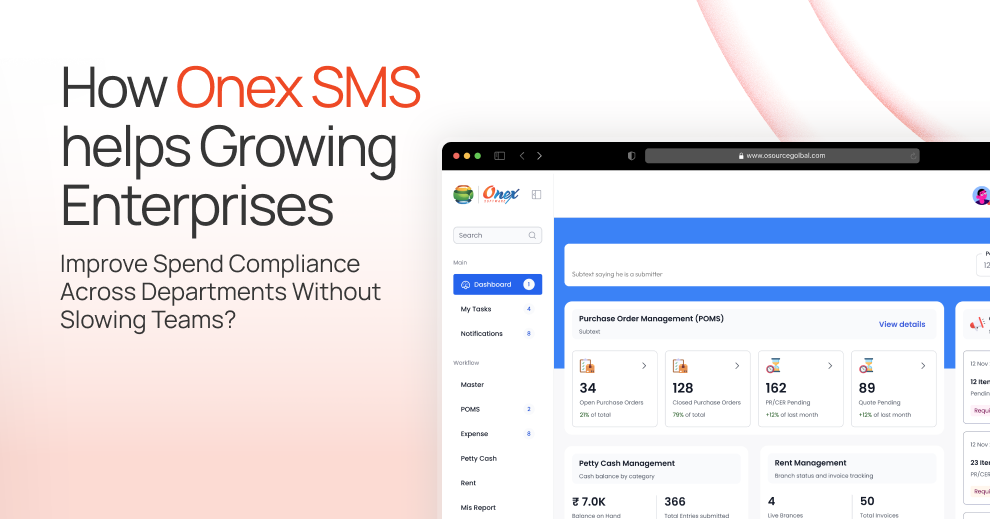
With system integration connecting procurement, approval workflows, and vendor payment tools via Onex SMS, the entire cycle runs autonomously from item search to invoice matching to payment authorisation with no manual handoffs and complete audit visibility.
How Does Cloud Integration Make Enterprise Ecosystems Scalable and Future-Ready?
Even the most well-architected ecosystem becomes a liability if it cannot scale. This is where cloud integration becomes a critical layer of any enterprise integration strategy. Cloud integration connects on-premise systems, cloud-based applications, and hybrid environments into one seamless, accessible digital infrastructure.
For enterprises operating across multiple geographies, cloud integration is not optional. It is foundational. It enables:
- Centralised data access across distributed teams and global locations
- Elastic scalability as transaction volumes and business units grow
- Faster deployment of new tools and automation logic without infrastructure constraints
- Consistent compliance and security standards across all regions and jurisdictions
For enterprises expanding into new markets or managing complex multi-entity operations, a cloud-integrated ecosystem is what makes automation sustainable at scale and what turns today’s integration investment into tomorrow’s competitive advantage.
How Does Onex Enable Enterprises to Build Custom Ecosystems Without Development Friction?
Traditional enterprise software development is slow, expensive, and rigid. Building custom integrations typically requires months of development, significant IT resources, and ongoing maintenance overhead. Osource Global designed the Onex ecosystem to eliminate this friction entirely.
Onex allows enterprises to build and deploy business-critical applications tailored to their exact operational requirements without the delays and resource demands of traditional development. The Onex platform achieves this through three core capabilities:
Intelligent Finance Orchestration – Automates end-to-end financial operations including reconciliation, asset lifecycle management, and vendor spend governance. Onex Recon alone handles more than nine types of complex reconciliations, processing hundreds of millions of transactions annually with 100% data integrity.
Human Capital Dynamics – Connects HR, payroll, compliance, and employee lifecycle management into one integrated environment, eliminating manual co-ordination and reducing compliance risk across all geographies.
Unified Process Digitisation – Transforms manual, paper-based business processes into fully digital, automated workflows enabling organisations to operate at 100% paperless efficiency across 860+ business units worldwide.
What Does Enterprise Automation Look Like When the Ecosystem Is Right?
When integration is done correctly, automation is no longer a project. It becomes a permanent operating advantage. Osource’s enterprise clients demonstrate this across three measurable dimensions:
- Scalable: 400M+ annual automations processed across the Onex ecosystem
- Efficient: 1.8M+ AI agent executions driving intelligent, real-time decision-making
- Reliable: 1,500+ agentic deployments across enterprise operations globally
These numbers are not generated by a single automation tool. They are the result of enterprises that first built the right connected ecosystem and then let automation do what it does best. When finance, HR, procurement, and operations are all integrated on a single integration platform, every new automation initiative compounds in value, creating an enterprise that does not just run faster it gets smarter over time.
Your Custom Ecosystem Readiness Checklist: Are You Ready to Automate at Scale?
Before embarking on enterprise automation, assess your organisation against these critical readiness criteria:
Are your core systems (ERP, HRMS, procurement, finance) connected via APIs or a common data layer?
- Do your teams have a single source of truth for financial and operational data?
- Can your current infrastructure scale without manual IT intervention?
- Are your workflows documented and mapped clearly across departments?
- Is your cloud integration strategy aligned with your geographic and compliance requirements?
- Have you identified the highest-value automation opportunities within your current ecosystem?
- If you answered ‘no’ to more than two of these questions, your enterprise is not yet ready to automate at scale. What you need first is the right integration foundation — and a platform built to deliver it without friction.
Conclusion
AI and automation are not just about speeding up tasks, they are about building smarter, connected business workflows. With the right API integration, data integration, and system integration, enterprises can design and automate workflows that are fully customized to their operations.
When your systems are truly connected, every workflow becomes more efficient, scalable, and aligned with real-time business needs turning automation into a long-term strategic advantage.
Ready to streamline and scale your business workflows? Get in touch with Osource Global today.
FAQs
1. What is API integration in enterprise automation?
API integration is the process of connecting separate enterprise software systems such as ERP, HRMS, and finance tools
via Application Programming Interfaces (APIs), enabling real-time data exchange and automated workflows across the organisation without manual intervention.
2. Why is system integration important before implementing automation?
Automation built on disconnected systems simply accelerates existing inefficiencies. System integration creates a unified operational environment where data flows seamlessly across departments making automation accurate, reliable, and truly scalable.
3. What is the difference between API integration and enterprise integration?
API integration is the technical mechanism it connects individual applications. Enterprise integration is the broader strategic outcome it unifies all systems, data, and workflows across the enterprise into one cohesive, automated ecosystem.
4. How does Osource’s Onex platform support enterprise integration?
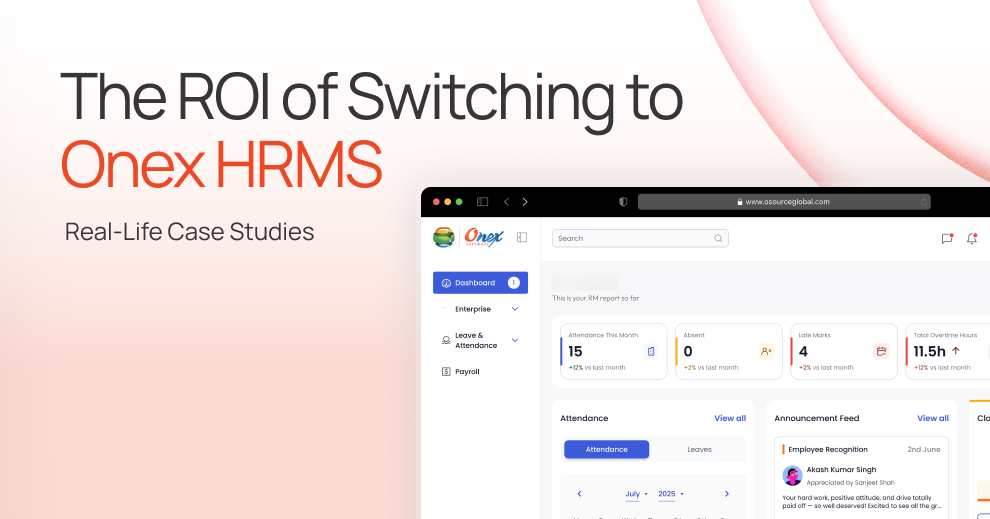
Onex provides a suite of connected products including Onex Recon, Onex SMS, and Onex HRMS that integrate finance, procurement, and HR operations on a single platform. This enables enterprises to architect custom ecosystems and automate business-critical processes without traditional development complexity.